

Copyright © National Academy of Sciences. All rights reserved.
Solar and Space Physics: A Science for a Technological Society
75
4
Recommendations
In previous chapters the survey committee describes challenges and opportunities for the field of
solar and space physics and outlines goals for the upcoming decade and beyond. This chapter presents
recommendations for accomplishing these goals, addressing both research and applications. Summarized
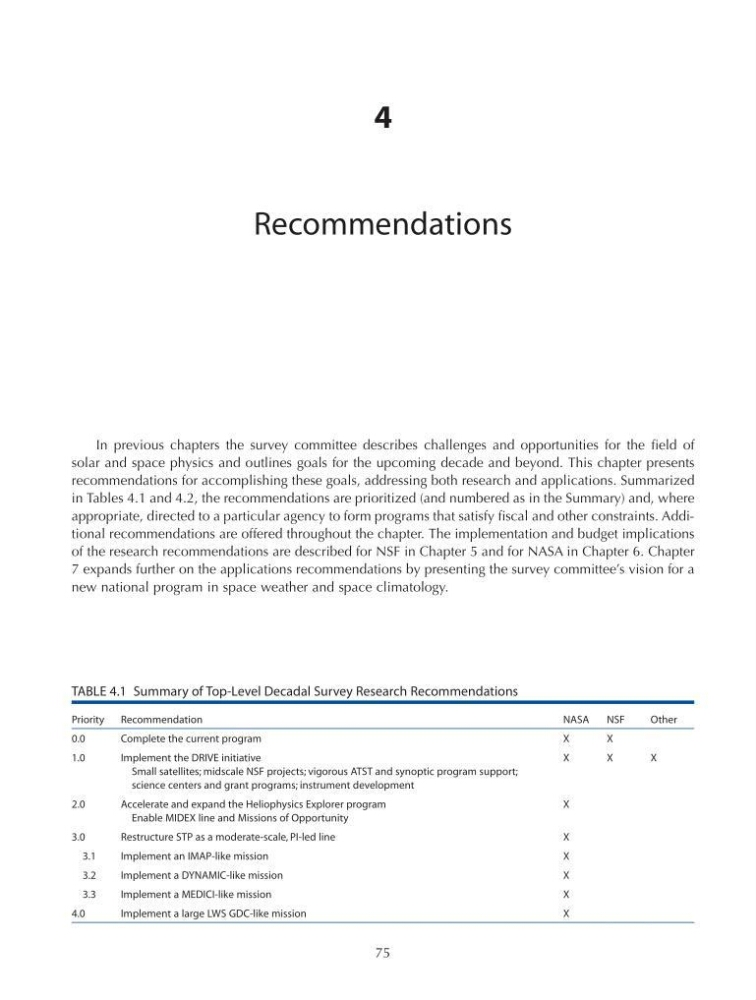
in Tables 4.1 and 4.2, the recommendations are prioritized (and numbered as in the Summary) and, where
appropriate, directed to a particular agency to form programs that satisfy fiscal and other constraints. Additional recommendations are offered throughout the chapter. The implementation and budget implications
of the research recommendations are described for NSF in Chapter 5 and for NASA in Chapter 6. Chapter
7 expands further on the applications recommendations by presenting the survey committee’s vision for a
new national program in space weather and space climatology.
TABLE 4.1 Summary of Top-Level Decadal Survey Research Recommendations
Priority
Recommendation
NASA
NSF
Other
0.0
Complete the current program
X
X
1.0
Implement the DRIVE initiative
Small satellites; midscale NSF projects; vigorous ATST and synoptic program support;
science centers and grant programs; instrument development
X
X
X
2.0
Accelerate and expand the Heliophysics Explorer program
Enable MIDEX line and Missions of Opportunity
X
3.0
Restructure STP as a moderate-scale, PI-led line
X
3.1
Implement an IMAP-like mission
X
3.2
Implement a DYNAMIC-like mission
X
3.3
Implement a MEDICI-like mission
X
4.0
Implement a large LWS GDC-like mission
X
Solar and Space Physics: A Science for a Technological Society
75
4
Recommendations
In previous chapters the survey committee describes challenges and opportunities for the field of
solar and space physics and outlines goals for the upcoming decade and beyond. This chapter presents
recommendations for accomplishing these goals, addressing both research and applications. Summarized
in Tables 4.1 and 4.2, the recommendations are prioritized (and numbered as in the Summary) and, where
appropriate, directed to a particular agency to form programs that satisfy fiscal and other constraints. Additional recommendations are offered throughout the chapter. The implementation and budget implications
of the research recommendations are described for NSF in Chapter 5 and for NASA in Chapter 6. Chapter
7 expands further on the applications recommendations by presenting the survey committee’s vision for a
new national program in space weather and space climatology.
TABLE 4.1 Summary of Top-Level Decadal Survey Research Recommendations
Priority
Recommendation
NASA
NSF
Other
0.0
Complete the current program
X
X
1.0
Implement the DRIVE initiative
Small satellites; midscale NSF projects; vigorous ATST and synoptic program support;
science centers and grant programs; instrument development
X
X
X
2.0
Accelerate and expand the Heliophysics Explorer program
Enable MIDEX line and Missions of Opportunity
X
3.0
Restructure STP as a moderate-scale, PI-led line
X
3.1
Implement an IMAP-like mission
X
3.2
Implement a DYNAMIC-like mission
X
3.3
Implement a MEDICI-like mission
X
4.0
Implement a large LWS GDC-like mission
X