

246
CHAPITRE 7. MODELE D'ISING
m ==mi+ m 2 = e- 2 /Jqf sinh2,BB '.:e e- 2 /J(qf-Bl.
2
On remarquera que ce resultat est aussi celui du calcul exact de l'Ex. 7.10.
- Si B > Jq, on tire
m = 1- 2e- 2 f3(B-q]),
mais
mstag = 0.
Des equations du champ moyen on tire :
b = !!_ = m1 tanh- 1 m1 -m2 tanh- 1 m2
qJ
tanh- 1 m 1 -tanh- 1 m 2
T
m1-m2
t - - - - - - - - - - -
- qJ - tanh- 1 m 1 -tanh- 1 m 2
A la limite ou mstag tend vers 0, on trouve
b = ~ + ttanh- 1 ~ -
(7.21)
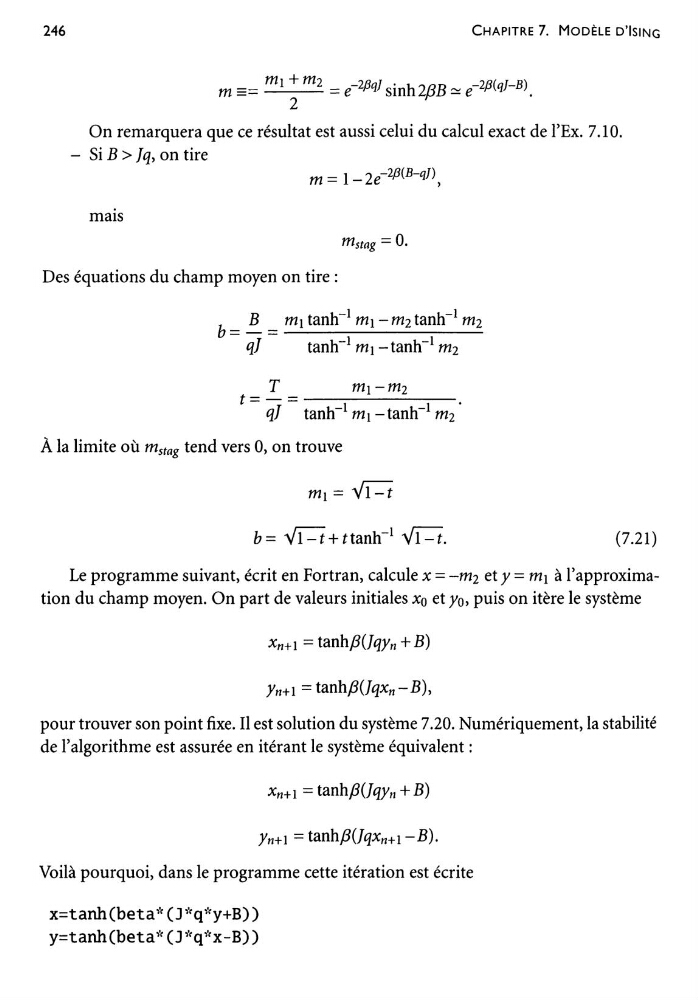
Le programme suivant, ecrit en Fortran, calcule x = -m2 et y = m1 a !'approximation du champ moyen. On part de valeurs initiales xo et Yo, puis on itere le systeme
Xn+l = tanh,B(Jqyn + B)
Yn+I = tanh,B(Jqxn-B),
pour trouver son point fixe. II est solution du systeme 7.20. Numeriquement, la stabilite
de l'algorithme est assuree en iterant le systeme equivalent:
Xn+I = tanh,B(Jqyn + B)
Yn+I = tanh,B(Jqxn+I -B).
Voila pourquoi, clans le programme cette iteration est ecrite
x=tanh(beta''' (J'''qt'y+B))
y=tanh(beta''' (J '''q'''x-B))
CHAPITRE 7. MODELE D'ISING
m ==mi+ m 2 = e- 2 /Jqf sinh2,BB '.:e e- 2 /J(qf-Bl.
2
On remarquera que ce resultat est aussi celui du calcul exact de l'Ex. 7.10.
- Si B > Jq, on tire
m = 1- 2e- 2 f3(B-q]),
mais
mstag = 0.
Des equations du champ moyen on tire :
b = !!_ = m1 tanh- 1 m1 -m2 tanh- 1 m2
qJ
tanh- 1 m 1 -tanh- 1 m 2
T
m1-m2
t - - - - - - - - - - -
- qJ - tanh- 1 m 1 -tanh- 1 m 2
A la limite ou mstag tend vers 0, on trouve
b = ~ + ttanh- 1 ~ -
(7.21)
Le programme suivant, ecrit en Fortran, calcule x = -m2 et y = m1 a !'approximation du champ moyen. On part de valeurs initiales xo et Yo, puis on itere le systeme
Xn+l = tanh,B(Jqyn + B)
Yn+I = tanh,B(Jqxn-B),
pour trouver son point fixe. II est solution du systeme 7.20. Numeriquement, la stabilite
de l'algorithme est assuree en iterant le systeme equivalent:
Xn+I = tanh,B(Jqyn + B)
Yn+I = tanh,B(Jqxn+I -B).
Voila pourquoi, clans le programme cette iteration est ecrite
x=tanh(beta''' (J'''qt'y+B))
y=tanh(beta''' (J '''q'''x-B))