

Respiratory Activity Classification
87
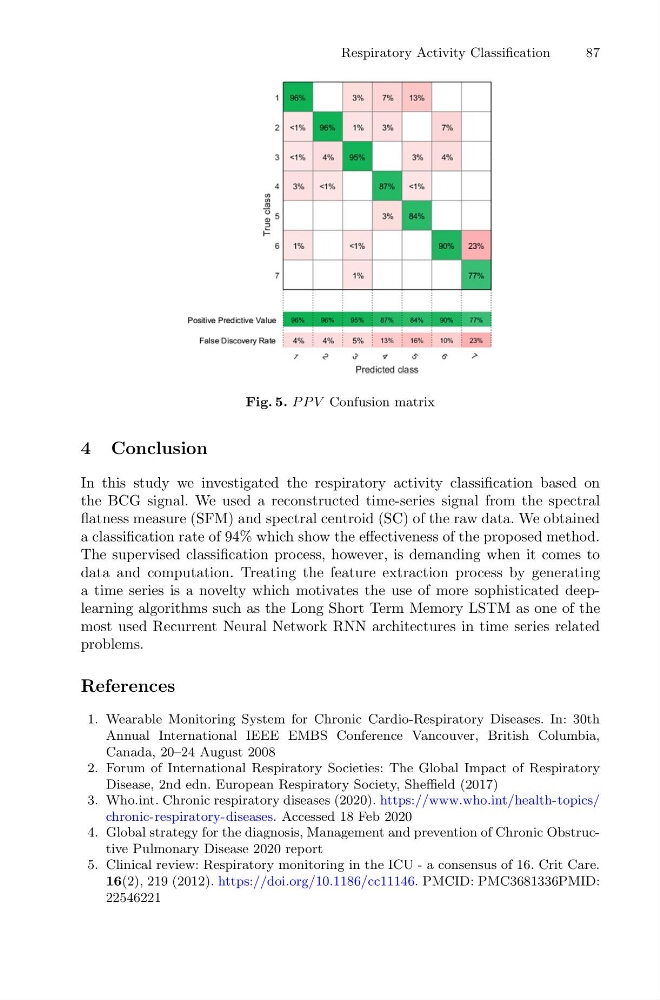
Fig. 5. P P V Confusion matrix
4 Conclusion
In this study we investigated the respiratory activity classification based on
the BCG signal. We used a reconstructed time-series signal from the spectral
flatness measure (SFM) and spectral centroid (SC) of the raw data. We obtained
a classification rate of 94% which show the effectiveness of the proposed method.
The supervised classification process, however, is demanding when it comes to
data and computation. Treating the feature extraction process by generating
a time series is a novelty which motivates the use of more sophisticated deeplearning algorithms such as the Long Short Term Memory LSTM as one of the
most used Recurrent Neural Network RNN architectures in time series related
problems.
References
1. Wearable Monitoring System for Chronic Cardio-Respiratory Diseases. In: 30th
Annual International IEEE EMBS Conference Vancouver, British Columbia,
Canada, 20–24 August 2008
2. Forum of International Respiratory Societies: The Global Impact of Respiratory
Disease, 2nd edn. European Respiratory Society, Sheffield (2017)
3. Who.int. Chronic respiratory diseases (2020). https://www.who.int/health-topics/
chronic-respiratory-diseases. Accessed 18 Feb 2020
4. Global strategy for the diagnosis, Management and prevention of Chronic Obstructive Pulmonary Disease 2020 report
5. Clinical review: Respiratory monitoring in the ICU - a consensus of 16. Crit Care.
16(2), 219 (2012). https://doi.org/10.1186/cc11146. PMCID: PMC3681336PMID:
22546221
87
Fig. 5. P P V Confusion matrix
4 Conclusion
In this study we investigated the respiratory activity classification based on
the BCG signal. We used a reconstructed time-series signal from the spectral
flatness measure (SFM) and spectral centroid (SC) of the raw data. We obtained
a classification rate of 94% which show the effectiveness of the proposed method.
The supervised classification process, however, is demanding when it comes to
data and computation. Treating the feature extraction process by generating
a time series is a novelty which motivates the use of more sophisticated deeplearning algorithms such as the Long Short Term Memory LSTM as one of the
most used Recurrent Neural Network RNN architectures in time series related
problems.
References
1. Wearable Monitoring System for Chronic Cardio-Respiratory Diseases. In: 30th
Annual International IEEE EMBS Conference Vancouver, British Columbia,
Canada, 20–24 August 2008
2. Forum of International Respiratory Societies: The Global Impact of Respiratory
Disease, 2nd edn. European Respiratory Society, Sheffield (2017)
3. Who.int. Chronic respiratory diseases (2020). https://www.who.int/health-topics/
chronic-respiratory-diseases. Accessed 18 Feb 2020
4. Global strategy for the diagnosis, Management and prevention of Chronic Obstructive Pulmonary Disease 2020 report
5. Clinical review: Respiratory monitoring in the ICU - a consensus of 16. Crit Care.
16(2), 219 (2012). https://doi.org/10.1186/cc11146. PMCID: PMC3681336PMID:
22546221