

Modeling of Bootstrapping and Registration IoT Design Patterns
59
There are two possible general models depending on the location of the
device. If the device is placed locally, we use the “Medium Based Bootstrap
Pattern” as a solution to configure the new device. If it is placed at a distance,
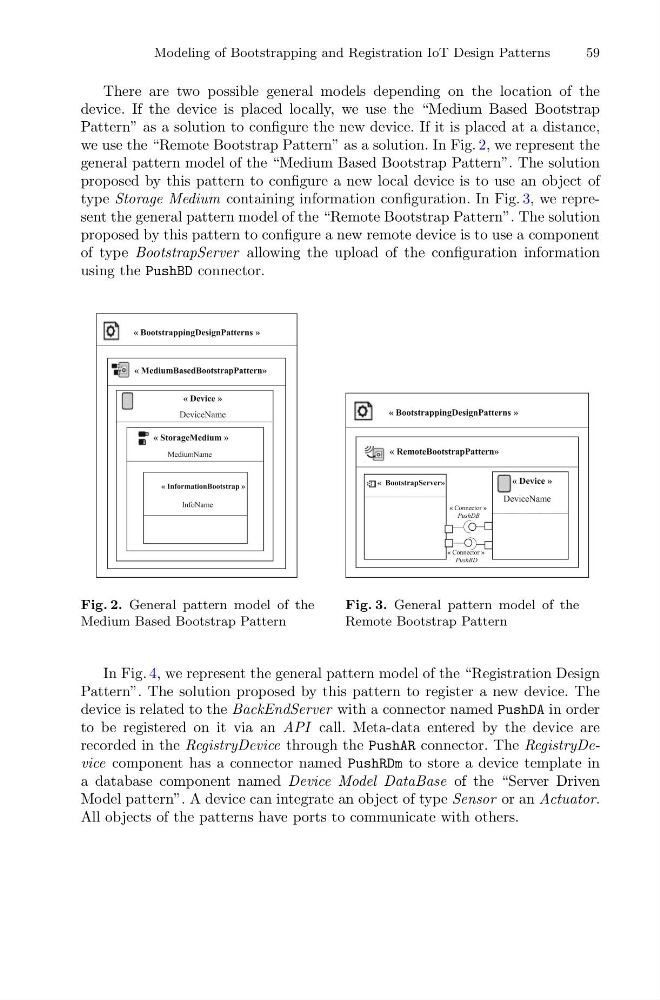
we use the “Remote Bootstrap Pattern” as a solution. In Fig. 2, we represent the
general pattern model of the “Medium Based Bootstrap Pattern”. The solution
proposed by this pattern to configure a new local device is to use an object of
type Storage Medium containing information configuration. In Fig. 3, we represent the general pattern model of the “Remote Bootstrap Pattern”. The solution
proposed by this pattern to configure a new remote device is to use a component
of type BootstrapServer allowing the upload of the configuration information
using the PushBD connector.
Fig. 2. General pattern model of the
Medium Based Bootstrap Pattern
Fig. 3. General pattern model of the
Remote Bootstrap Pattern
In Fig. 4, we represent the general pattern model of the “Registration Design
Pattern”. The solution proposed by this pattern to register a new device. The
device is related to the BackEndServer with a connector named PushDA in order
to be registered on it via an API call. Meta-data entered by the device are
recorded in the RegistryDevice through the PushAR connector. The RegistryDevice component has a connector named PushRDm to store a device template in
a database component named Device Model DataBase of the “Server Driven
Model pattern”. A device can integrate an object of type Sensor or an Actuator.
All objects of the patterns have ports to communicate with others.
59
There are two possible general models depending on the location of the
device. If the device is placed locally, we use the “Medium Based Bootstrap
Pattern” as a solution to configure the new device. If it is placed at a distance,
we use the “Remote Bootstrap Pattern” as a solution. In Fig. 2, we represent the
general pattern model of the “Medium Based Bootstrap Pattern”. The solution
proposed by this pattern to configure a new local device is to use an object of
type Storage Medium containing information configuration. In Fig. 3, we represent the general pattern model of the “Remote Bootstrap Pattern”. The solution
proposed by this pattern to configure a new remote device is to use a component
of type BootstrapServer allowing the upload of the configuration information
using the PushBD connector.
Fig. 2. General pattern model of the
Medium Based Bootstrap Pattern
Fig. 3. General pattern model of the
Remote Bootstrap Pattern
In Fig. 4, we represent the general pattern model of the “Registration Design
Pattern”. The solution proposed by this pattern to register a new device. The
device is related to the BackEndServer with a connector named PushDA in order
to be registered on it via an API call. Meta-data entered by the device are
recorded in the RegistryDevice through the PushAR connector. The RegistryDevice component has a connector named PushRDm to store a device template in
a database component named Device Model DataBase of the “Server Driven
Model pattern”. A device can integrate an object of type Sensor or an Actuator.
All objects of the patterns have ports to communicate with others.