

Remote Health Monitoring Systems Based on Bluetooth Low Energy (BLE)
43
2 BLE Based RHMS
This section illustrates and explains the general architecture of the RHMS. Then,
it studies and analyzes related works focusing on RHMS that integrate BLE
communication interfaces between the physiological sensors and the PDA.
2.1 RHMS Basic Architecture
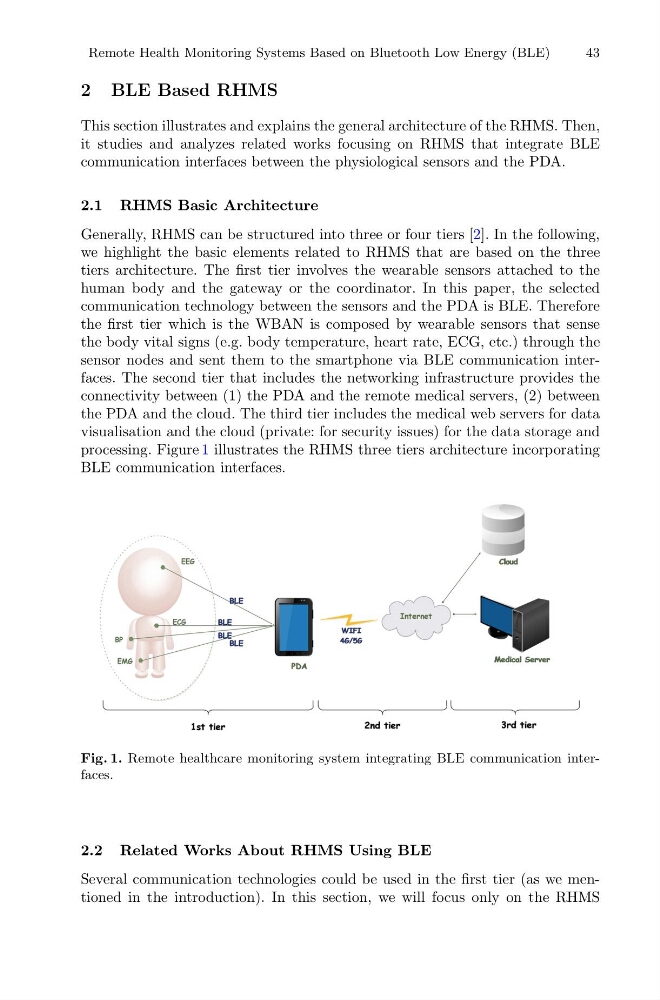
Generally, RHMS can be structured into three or four tiers [2]. In the following,
we highlight the basic elements related to RHMS that are based on the three
tiers architecture. The first tier involves the wearable sensors attached to the
human body and the gateway or the coordinator. In this paper, the selected
communication technology between the sensors and the PDA is BLE. Therefore
the first tier which is the WBAN is composed by wearable sensors that sense
the body vital signs (e.g. body temperature, heart rate, ECG, etc.) through the
sensor nodes and sent them to the smartphone via BLE communication interfaces. The second tier that includes the networking infrastructure provides the
connectivity between (1) the PDA and the remote medical servers, (2) between
the PDA and the cloud. The third tier includes the medical web servers for data
visualisation and the cloud (private: for security issues) for the data storage and
processing. Figure 1 illustrates the RHMS three tiers architecture incorporating
BLE communication interfaces.
Fig. 1. Remote healthcare monitoring system integrating BLE communication interfaces.
2.2 Related Works About RHMS Using BLE
Several communication technologies could be used in the first tier (as we mentioned in the introduction). In this section, we will focus only on the RHMS
43
2 BLE Based RHMS
This section illustrates and explains the general architecture of the RHMS. Then,
it studies and analyzes related works focusing on RHMS that integrate BLE
communication interfaces between the physiological sensors and the PDA.
2.1 RHMS Basic Architecture
Generally, RHMS can be structured into three or four tiers [2]. In the following,
we highlight the basic elements related to RHMS that are based on the three
tiers architecture. The first tier involves the wearable sensors attached to the
human body and the gateway or the coordinator. In this paper, the selected
communication technology between the sensors and the PDA is BLE. Therefore
the first tier which is the WBAN is composed by wearable sensors that sense
the body vital signs (e.g. body temperature, heart rate, ECG, etc.) through the
sensor nodes and sent them to the smartphone via BLE communication interfaces. The second tier that includes the networking infrastructure provides the
connectivity between (1) the PDA and the remote medical servers, (2) between
the PDA and the cloud. The third tier includes the medical web servers for data
visualisation and the cloud (private: for security issues) for the data storage and
processing. Figure 1 illustrates the RHMS three tiers architecture incorporating
BLE communication interfaces.
Fig. 1. Remote healthcare monitoring system integrating BLE communication interfaces.
2.2 Related Works About RHMS Using BLE
Several communication technologies could be used in the first tier (as we mentioned in the introduction). In this section, we will focus only on the RHMS