

An Embedded ANN Raspberry PI
381
requires 20 iterations to achieve an accuracy above 82%, whereas, this model
needs only 7 iterations to achieve this value of accuracy with the minimum of
loss rate (10%) which indicate the necessity of the gyroscope for inertial sensor
based HAR system.
4.3 LSTM-RNN Evaluation
The LSTM-RNN model is built using the Keras library and Tensorflow as its backend. The model first has two hidden LSTM layers with (N inputs+1 ) units each,
which are used to extract features from the sequence of input data with the “ReLU”
activation function for each neuron. The output layer was configured to utilize a
‘Softmax activation and the ‘Adam’ optimizer was used to boost accuracy. The
model was compiled to run 50 epochs with a batch size of 1024 using ‘Mean Squared
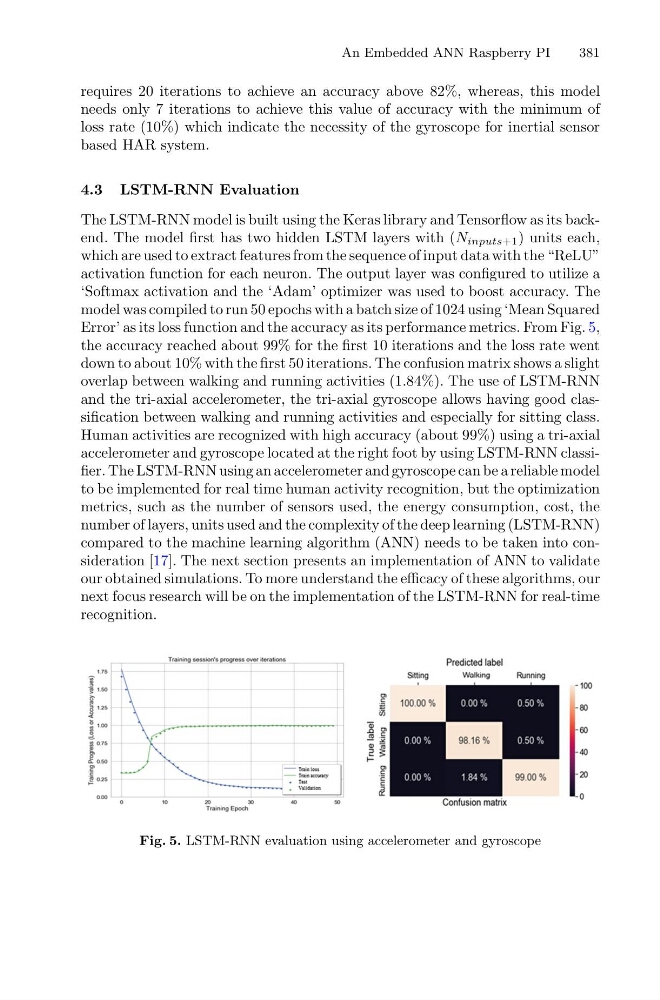
Error’ as its loss function and the accuracy as its performance metrics. From Fig. 5,
the accuracy reached about 99% for the first 10 iterations and the loss rate went
down to about 10% with the first 50 iterations. The confusion matrix shows a slight
overlap between walking and running activities (1.84%). The use of LSTM-RNN
and the tri-axial accelerometer, the tri-axial gyroscope allows having good classification between walking and running activities and especially for sitting class.
Human activities are recognized with high accuracy (about 99%) using a tri-axial
accelerometer and gyroscope located at the right foot by using LSTM-RNN classifier. The LSTM-RNN using an accelerometer and gyroscope can be a reliable model
to be implemented for real time human activity recognition, but the optimization
metrics, such as the number of sensors used, the energy consumption, cost, the
number of layers, units used and the complexity of the deep learning (LSTM-RNN)
compared to the machine learning algorithm (ANN) needs to be taken into consideration [17]. The next section presents an implementation of ANN to validate
our obtained simulations. To more understand the efficacy of these algorithms, our
next focus research will be on the implementation of the LSTM-RNN for real-time
recognition.
Fig. 5. LSTM-RNN evaluation using accelerometer and gyroscope
381
requires 20 iterations to achieve an accuracy above 82%, whereas, this model
needs only 7 iterations to achieve this value of accuracy with the minimum of
loss rate (10%) which indicate the necessity of the gyroscope for inertial sensor
based HAR system.
4.3 LSTM-RNN Evaluation
The LSTM-RNN model is built using the Keras library and Tensorflow as its backend. The model first has two hidden LSTM layers with (N inputs+1 ) units each,
which are used to extract features from the sequence of input data with the “ReLU”
activation function for each neuron. The output layer was configured to utilize a
‘Softmax activation and the ‘Adam’ optimizer was used to boost accuracy. The
model was compiled to run 50 epochs with a batch size of 1024 using ‘Mean Squared
Error’ as its loss function and the accuracy as its performance metrics. From Fig. 5,
the accuracy reached about 99% for the first 10 iterations and the loss rate went
down to about 10% with the first 50 iterations. The confusion matrix shows a slight
overlap between walking and running activities (1.84%). The use of LSTM-RNN
and the tri-axial accelerometer, the tri-axial gyroscope allows having good classification between walking and running activities and especially for sitting class.
Human activities are recognized with high accuracy (about 99%) using a tri-axial
accelerometer and gyroscope located at the right foot by using LSTM-RNN classifier. The LSTM-RNN using an accelerometer and gyroscope can be a reliable model
to be implemented for real time human activity recognition, but the optimization
metrics, such as the number of sensors used, the energy consumption, cost, the
number of layers, units used and the complexity of the deep learning (LSTM-RNN)
compared to the machine learning algorithm (ANN) needs to be taken into consideration [17]. The next section presents an implementation of ANN to validate
our obtained simulations. To more understand the efficacy of these algorithms, our
next focus research will be on the implementation of the LSTM-RNN for real-time
recognition.
Fig. 5. LSTM-RNN evaluation using accelerometer and gyroscope