

In next step, four statistical features are extracted from each subband. In this way
each intended instance is presented by 16 parameters. The compression gain of the
designed framework over the conventional equal is computed by using R COMP ¼ N r
P . It
results in 22.5-fold real-time compression gain of the proposed solution over the
conventional equal.
Above results show that the devised solution outperforms the conventional equals
in terms of processing efficiency and compression gain. However, due to the multirate
processing feature it may lose its performance in terms of the precision. Therefore, the
overall performance of the system is measured in terms of the accuracy of the classification process. The KNN classifier is employed with k = 5 configuration. Training
and testing sets are made of 3 distinct classes. Total 450 instances are used. The 10-fold
cross validation technique is used for all experiments. Classifier’s performance is
quantified in terms of the accuracy and the specificity by using Eq. (6) and Eq. (7). The
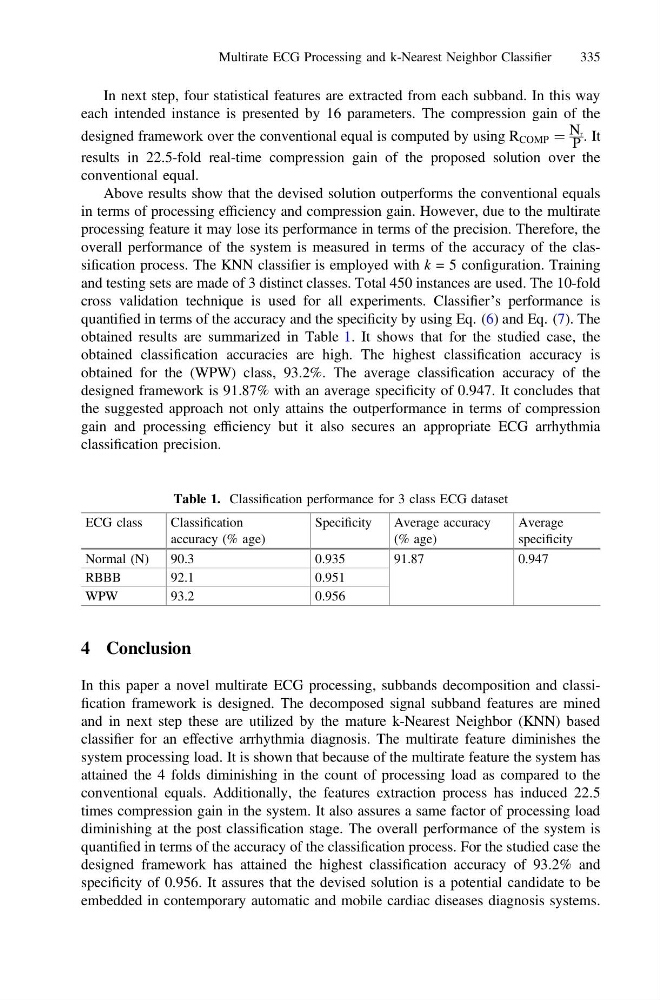
obtained results are summarized in Table 1. It shows that for the studied case, the
obtained classification accuracies are high. The highest classification accuracy is
obtained for the (WPW) class, 93.2%. The average classification accuracy of the
designed framework is 91.87% with an average specificity of 0.947. It concludes that
the suggested approach not only attains the outperformance in terms of compression
gain and processing efficiency but it also secures an appropriate ECG arrhythmia
classification precision.
4 Conclusion
In this paper a novel multirate ECG processing, subbands decomposition and classification framework is designed. The decomposed signal subband features are mined
and in next step these are utilized by the mature k-Nearest Neighbor (KNN) based
classifier for an effective arrhythmia diagnosis. The multirate feature diminishes the
system processing load. It is shown that because of the multirate feature the system has
attained the 4 folds diminishing in the count of processing load as compared to the
conventional equals. Additionally, the features extraction process has induced 22.5
times compression gain in the system. It also assures a same factor of processing load
diminishing at the post classification stage. The overall performance of the system is
quantified in terms of the accuracy of the classification process. For the studied case the
designed framework has attained the highest classification accuracy of 93.2% and
specificity of 0.956. It assures that the devised solution is a potential candidate to be
embedded in contemporary automatic and mobile cardiac diseases diagnosis systems.
Table 1. Classification performance for 3 class ECG dataset
ECG class
Classification
accuracy (% age)
Specificity
Average accuracy
(% age)
Average
specificity
Normal (N)
90.3
0.935
91.87
0.947
RBBB
92.1
0.951
WPW
93.2
0.956
Multirate ECG Processing and k-Nearest Neighbor Classifier
335
each intended instance is presented by 16 parameters. The compression gain of the
designed framework over the conventional equal is computed by using R COMP ¼ N r
P . It
results in 22.5-fold real-time compression gain of the proposed solution over the
conventional equal.
Above results show that the devised solution outperforms the conventional equals
in terms of processing efficiency and compression gain. However, due to the multirate
processing feature it may lose its performance in terms of the precision. Therefore, the
overall performance of the system is measured in terms of the accuracy of the classification process. The KNN classifier is employed with k = 5 configuration. Training
and testing sets are made of 3 distinct classes. Total 450 instances are used. The 10-fold
cross validation technique is used for all experiments. Classifier’s performance is
quantified in terms of the accuracy and the specificity by using Eq. (6) and Eq. (7). The
obtained results are summarized in Table 1. It shows that for the studied case, the
obtained classification accuracies are high. The highest classification accuracy is
obtained for the (WPW) class, 93.2%. The average classification accuracy of the
designed framework is 91.87% with an average specificity of 0.947. It concludes that
the suggested approach not only attains the outperformance in terms of compression
gain and processing efficiency but it also secures an appropriate ECG arrhythmia
classification precision.
4 Conclusion
In this paper a novel multirate ECG processing, subbands decomposition and classification framework is designed. The decomposed signal subband features are mined
and in next step these are utilized by the mature k-Nearest Neighbor (KNN) based
classifier for an effective arrhythmia diagnosis. The multirate feature diminishes the
system processing load. It is shown that because of the multirate feature the system has
attained the 4 folds diminishing in the count of processing load as compared to the
conventional equals. Additionally, the features extraction process has induced 22.5
times compression gain in the system. It also assures a same factor of processing load
diminishing at the post classification stage. The overall performance of the system is
quantified in terms of the accuracy of the classification process. For the studied case the
designed framework has attained the highest classification accuracy of 93.2% and
specificity of 0.956. It assures that the devised solution is a potential candidate to be
embedded in contemporary automatic and mobile cardiac diseases diagnosis systems.
Table 1. Classification performance for 3 class ECG dataset
ECG class
Classification
accuracy (% age)
Specificity
Average accuracy
(% age)
Average
specificity
Normal (N)
90.3
0.935
91.87
0.947
RBBB
92.1
0.951
WPW
93.2
0.956
Multirate ECG Processing and k-Nearest Neighbor Classifier
335