

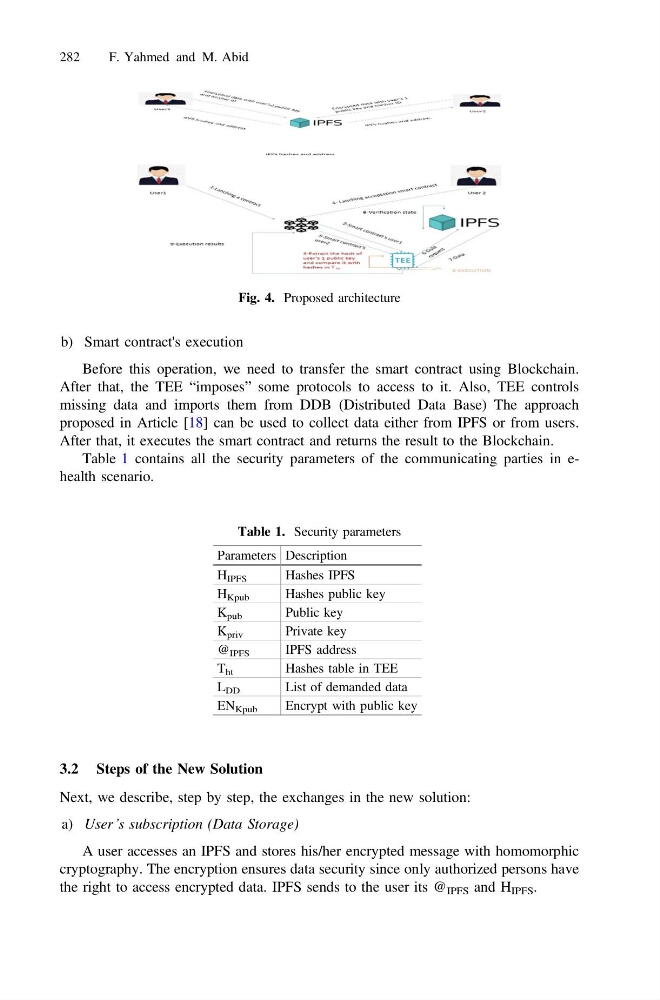
b) Smart contract's execution
Before this operation, we need to transfer the smart contract using Blockchain.
After that, the TEE “imposes” some protocols to access to it. Also, TEE controls
missing data and imports them from DDB (Distributed Data Base) The approach
proposed in Article [18] can be used to collect data either from IPFS or from users.
After that, it executes the smart contract and returns the result to the Blockchain.
Table 1 contains all the security parameters of the communicating parties in ehealth scenario.
3.2 Steps of the New Solution
Next, we describe, step by step, the exchanges in the new solution:
a) User’s subscription (Data Storage)
A user accesses an IPFS and stores his/her encrypted message with homomorphic
cryptography. The encryption ensures data security since only authorized persons have
the right to access encrypted data. IPFS sends to the user its @ IPFS and H IPFS .
Fig. 4. Proposed architecture
Table 1. Security parameters
Parameters Description
H IPFS
Hashes IPFS
H Kpub
Hashes public key
K pub
Public key
K priv
Private key
@ IPFS
IPFS address
T ht
Hashes table in TEE
L DD
List of demanded data
EN Kpub
Encrypt with public key
282
F. Yahmed and M. Abid
Before this operation, we need to transfer the smart contract using Blockchain.
After that, the TEE “imposes” some protocols to access to it. Also, TEE controls
missing data and imports them from DDB (Distributed Data Base) The approach
proposed in Article [18] can be used to collect data either from IPFS or from users.
After that, it executes the smart contract and returns the result to the Blockchain.
Table 1 contains all the security parameters of the communicating parties in ehealth scenario.
3.2 Steps of the New Solution
Next, we describe, step by step, the exchanges in the new solution:
a) User’s subscription (Data Storage)
A user accesses an IPFS and stores his/her encrypted message with homomorphic
cryptography. The encryption ensures data security since only authorized persons have
the right to access encrypted data. IPFS sends to the user its @ IPFS and H IPFS .
Fig. 4. Proposed architecture
Table 1. Security parameters
Parameters Description
H IPFS
Hashes IPFS
H Kpub
Hashes public key
K pub
Public key
K priv
Private key
@ IPFS
IPFS address
T ht
Hashes table in TEE
L DD
List of demanded data
EN Kpub
Encrypt with public key
282
F. Yahmed and M. Abid