

Blockchain and IPFS [14] are based on similar concepts of decentralized networks.
However, each one of them has its own characteristics. IPFS is a file-sharing system
that chops its files. The search for files within IPFS is based on these hashes. Blockchain and IPFS perform very different tasks for their users. It is possible to store files in
IPFS while the hashes are stored in Blockchain.
As discussed before, the TTE has many advantages but it is not based on multiparty computation. Therefore, to eliminate the centralization of data, we try to link
between IPFS, TEE and the Blockchain to have efficient results that respect the security
rules.
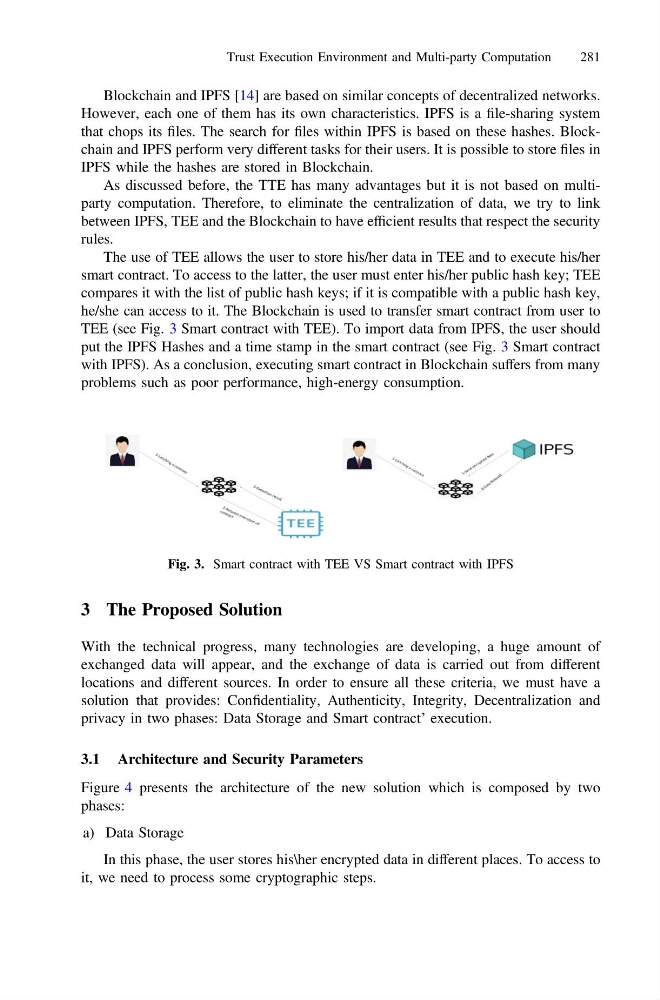
The use of TEE allows the user to store his/her data in TEE and to execute his/her
smart contract. To access to the latter, the user must enter his/her public hash key; TEE
compares it with the list of public hash keys; if it is compatible with a public hash key,
he/she can access to it. The Blockchain is used to transfer smart contract from user to
TEE (see Fig. 3 Smart contract with TEE). To import data from IPFS, the user should
put the IPFS Hashes and a time stamp in the smart contract (see Fig. 3 Smart contract
with IPFS). As a conclusion, executing smart contract in Blockchain suffers from many
problems such as poor performance, high-energy consumption.
3 The Proposed Solution
With the technical progress, many technologies are developing, a huge amount of
exchanged data will appear, and the exchange of data is carried out from different
locations and different sources. In order to ensure all these criteria, we must have a
solution that provides: Confidentiality, Authenticity, Integrity, Decentralization and
privacy in two phases: Data Storage and Smart contract’ execution.
3.1 Architecture and Security Parameters
Figure 4 presents the architecture of the new solution which is composed by two
phases:
a) Data Storage
In this phase, the user stores his\her encrypted data in different places. To access to
it, we need to process some cryptographic steps.
Fig. 3. Smart contract with TEE VS Smart contract with IPFS
Trust Execution Environment and Multi-party Computation
281
However, each one of them has its own characteristics. IPFS is a file-sharing system
that chops its files. The search for files within IPFS is based on these hashes. Blockchain and IPFS perform very different tasks for their users. It is possible to store files in
IPFS while the hashes are stored in Blockchain.
As discussed before, the TTE has many advantages but it is not based on multiparty computation. Therefore, to eliminate the centralization of data, we try to link
between IPFS, TEE and the Blockchain to have efficient results that respect the security
rules.
The use of TEE allows the user to store his/her data in TEE and to execute his/her
smart contract. To access to the latter, the user must enter his/her public hash key; TEE
compares it with the list of public hash keys; if it is compatible with a public hash key,
he/she can access to it. The Blockchain is used to transfer smart contract from user to
TEE (see Fig. 3 Smart contract with TEE). To import data from IPFS, the user should
put the IPFS Hashes and a time stamp in the smart contract (see Fig. 3 Smart contract
with IPFS). As a conclusion, executing smart contract in Blockchain suffers from many
problems such as poor performance, high-energy consumption.
3 The Proposed Solution
With the technical progress, many technologies are developing, a huge amount of
exchanged data will appear, and the exchange of data is carried out from different
locations and different sources. In order to ensure all these criteria, we must have a
solution that provides: Confidentiality, Authenticity, Integrity, Decentralization and
privacy in two phases: Data Storage and Smart contract’ execution.
3.1 Architecture and Security Parameters
Figure 4 presents the architecture of the new solution which is composed by two
phases:
a) Data Storage
In this phase, the user stores his\her encrypted data in different places. To access to
it, we need to process some cryptographic steps.
Fig. 3. Smart contract with TEE VS Smart contract with IPFS
Trust Execution Environment and Multi-party Computation
281