

3 Results
Data Analysis
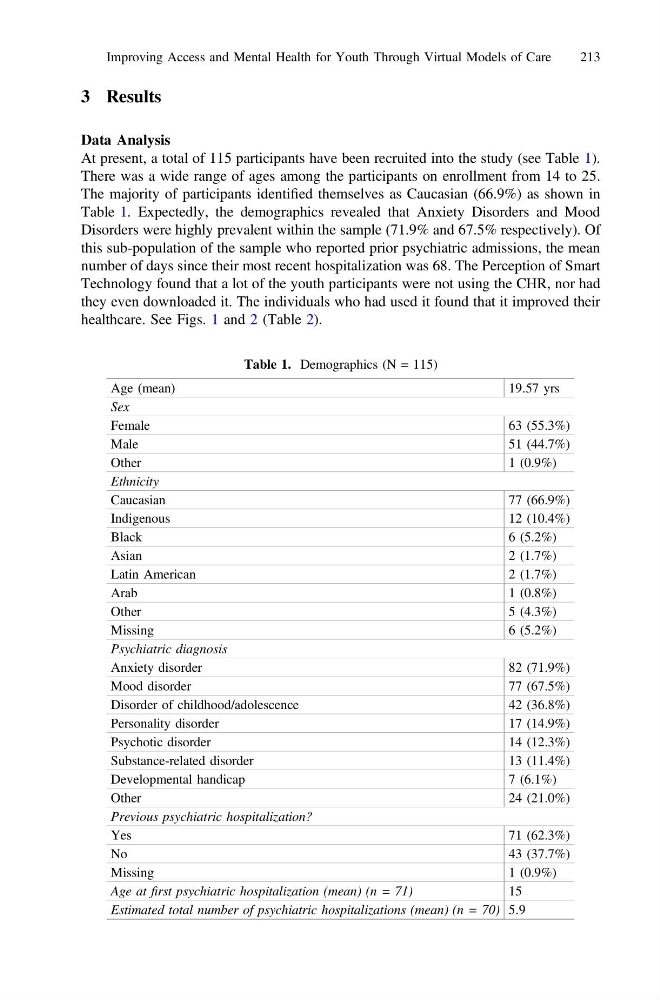
At present, a total of 115 participants have been recruited into the study (see Table 1).
There was a wide range of ages among the participants on enrollment from 14 to 25.
The majority of participants identified themselves as Caucasian (66.9%) as shown in
Table 1. Expectedly, the demographics revealed that Anxiety Disorders and Mood
Disorders were highly prevalent within the sample (71.9% and 67.5% respectively). Of
this sub-population of the sample who reported prior psychiatric admissions, the mean
number of days since their most recent hospitalization was 68. The Perception of Smart
Technology found that a lot of the youth participants were not using the CHR, nor had
they even downloaded it. The individuals who had used it found that it improved their
healthcare. See Figs. 1 and 2 (Table 2).
Table 1. Demographics (N = 115)
Age (mean)
19.57 yrs
Sex
Female
63 (55.3%)
Male
51 (44.7%)
Other
1 (0.9%)
Ethnicity
Caucasian
77 (66.9%)
Indigenous
12 (10.4%)
Black
6 (5.2%)
Asian
2 (1.7%)
Latin American
2 (1.7%)
Arab
1 (0.8%)
Other
5 (4.3%)
Missing
6 (5.2%)
Psychiatric diagnosis
Anxiety disorder
82 (71.9%)
Mood disorder
77 (67.5%)
Disorder of childhood/adolescence
42 (36.8%)
Personality disorder
17 (14.9%)
Psychotic disorder
14 (12.3%)
Substance-related disorder
13 (11.4%)
Developmental handicap
7 (6.1%)
Other
24 (21.0%)
Previous psychiatric hospitalization?
Yes
71 (62.3%)
No
43 (37.7%)
Missing
1 (0.9%)
Age at first psychiatric hospitalization (mean) (n = 71)
15
Estimated total number of psychiatric hospitalizations (mean) (n = 70) 5.9
Improving Access and Mental Health for Youth Through Virtual Models of Care
213
Data Analysis
At present, a total of 115 participants have been recruited into the study (see Table 1).
There was a wide range of ages among the participants on enrollment from 14 to 25.
The majority of participants identified themselves as Caucasian (66.9%) as shown in
Table 1. Expectedly, the demographics revealed that Anxiety Disorders and Mood
Disorders were highly prevalent within the sample (71.9% and 67.5% respectively). Of
this sub-population of the sample who reported prior psychiatric admissions, the mean
number of days since their most recent hospitalization was 68. The Perception of Smart
Technology found that a lot of the youth participants were not using the CHR, nor had
they even downloaded it. The individuals who had used it found that it improved their
healthcare. See Figs. 1 and 2 (Table 2).
Table 1. Demographics (N = 115)
Age (mean)
19.57 yrs
Sex
Female
63 (55.3%)
Male
51 (44.7%)
Other
1 (0.9%)
Ethnicity
Caucasian
77 (66.9%)
Indigenous
12 (10.4%)
Black
6 (5.2%)
Asian
2 (1.7%)
Latin American
2 (1.7%)
Arab
1 (0.8%)
Other
5 (4.3%)
Missing
6 (5.2%)
Psychiatric diagnosis
Anxiety disorder
82 (71.9%)
Mood disorder
77 (67.5%)
Disorder of childhood/adolescence
42 (36.8%)
Personality disorder
17 (14.9%)
Psychotic disorder
14 (12.3%)
Substance-related disorder
13 (11.4%)
Developmental handicap
7 (6.1%)
Other
24 (21.0%)
Previous psychiatric hospitalization?
Yes
71 (62.3%)
No
43 (37.7%)
Missing
1 (0.9%)
Age at first psychiatric hospitalization (mean) (n = 71)
15
Estimated total number of psychiatric hospitalizations (mean) (n = 70) 5.9
Improving Access and Mental Health for Youth Through Virtual Models of Care
213