

206
A. Henaien et al.
7 Performance Evaluation and Results
In order to prove the feasibility of the proposed approach and to evaluate its performance, we have tested the general process previously proposed in Algorithm 1
to an electronic health recorded data set from [22,30]. This data is considered
as preliminary data set. The different proposed steps have been realised with
WEKA [13]. An example of new rule is the detection of a low level of SpO2Oxygen Saturation- that is used to continuously monitor the oxygenation status
of critically ill patients. Actually the SpO2 measurement provides: Pleth waveform (visual indication of patient’s pulse), Oxygen saturation of arterial blood
(SpO2) in percent, Pulse rate (derived from Pleth wave), Perfusion indicator
(Perf)- numerical value for the pulsatile portion of the measured signal caused by
arterial pulsation. Only a medical staff is able to read and to interpret such result,
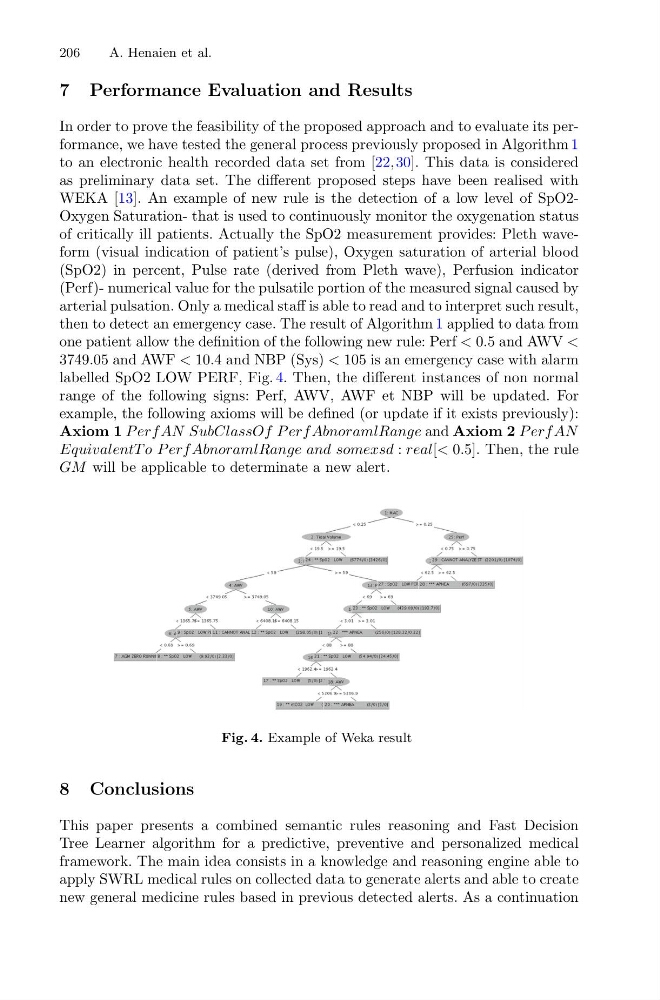
then to detect an emergency case. The result of Algorithm 1 applied to data from
one patient allow the definition of the following new rule: Perf < 0.5 and AWV <
3749.05 and AWF < 10.4 and NBP (Sys) < 105 is an emergency case with alarm
labelled SpO2 LOW PERF, Fig. 4. Then, the different instances of non normal
range of the following signs: Perf, AWV, AWF et NBP will be updated. For
example, the following axioms will be defined (or update if it exists previously):
Axiom 1 P erf AN SubClassOf P erf AbnoramlRange and Axiom 2 P erfAN
EquivalentT o P erf AbnoramlRange and somexsd : real[< 0.5]. Then, the rule
GM will be applicable to determinate a new alert.
Fig. 4. Example of Weka result
8 Conclusions
This paper presents a combined semantic rules reasoning and Fast Decision
Tree Learner algorithm for a predictive, preventive and personalized medical
framework. The main idea consists in a knowledge and reasoning engine able to
apply SWRL medical rules on collected data to generate alerts and able to create
new general medicine rules based in previous detected alerts. As a continuation
A. Henaien et al.
7 Performance Evaluation and Results
In order to prove the feasibility of the proposed approach and to evaluate its performance, we have tested the general process previously proposed in Algorithm 1
to an electronic health recorded data set from [22,30]. This data is considered
as preliminary data set. The different proposed steps have been realised with
WEKA [13]. An example of new rule is the detection of a low level of SpO2Oxygen Saturation- that is used to continuously monitor the oxygenation status
of critically ill patients. Actually the SpO2 measurement provides: Pleth waveform (visual indication of patient’s pulse), Oxygen saturation of arterial blood
(SpO2) in percent, Pulse rate (derived from Pleth wave), Perfusion indicator
(Perf)- numerical value for the pulsatile portion of the measured signal caused by
arterial pulsation. Only a medical staff is able to read and to interpret such result,
then to detect an emergency case. The result of Algorithm 1 applied to data from
one patient allow the definition of the following new rule: Perf < 0.5 and AWV <
3749.05 and AWF < 10.4 and NBP (Sys) < 105 is an emergency case with alarm
labelled SpO2 LOW PERF, Fig. 4. Then, the different instances of non normal
range of the following signs: Perf, AWV, AWF et NBP will be updated. For
example, the following axioms will be defined (or update if it exists previously):
Axiom 1 P erf AN SubClassOf P erf AbnoramlRange and Axiom 2 P erfAN
EquivalentT o P erf AbnoramlRange and somexsd : real[< 0.5]. Then, the rule
GM will be applicable to determinate a new alert.
Fig. 4. Example of Weka result
8 Conclusions
This paper presents a combined semantic rules reasoning and Fast Decision
Tree Learner algorithm for a predictive, preventive and personalized medical
framework. The main idea consists in a knowledge and reasoning engine able to
apply SWRL medical rules on collected data to generate alerts and able to create
new general medicine rules based in previous detected alerts. As a continuation