

ML and Ontology Based Situation Awareness System
205
6.1 Semantic Rules Knowledge
Reasoner Engine (RE) applies the knowledge into the collected data in the order
to determinate new facts about the current patient’s situation in real-time way.
RE will be in continuous search of causes which are any changes in the medical
situation (signs and symptoms of each patient). Our preliminary set of SWRL
is only containing a basic set of medical rules allowing to detect few emergency
cases as: less blood pressure, height temperature, etc. To resume any abnormal value for a vital sign, we define the following SWRL
2 rule (GM ): icnp :
V italSign(?v) ∧ sosa : Observation(?o) ∧ V italSignhasObservation(?v, ?o)
∧ icnp : Result(?r) ∧ sosa : hasResult(?o, ?r) ∧ AbnormalRange(?r) →
AbnormalV italSign(?v). The rule is defining abnormal vital signs as the following: for a vital sign ?v and its observation ?o, if the result ?r of the observation ?o is a value in an abnormal range, then ?v is an abnormal vital sign.
V italSignhasObservation(?v, ?o) and sosa : hasResult(?o, ?r) are expressing
the relation between a vital sign and its observation and between an observation
and its result. The class AbnormalRange(?r) is representing abnormal ranges.
6.2 Learning and Prediction Reasoning
ML Engine (MLE) learns from previous patient’s detected alarms to produce
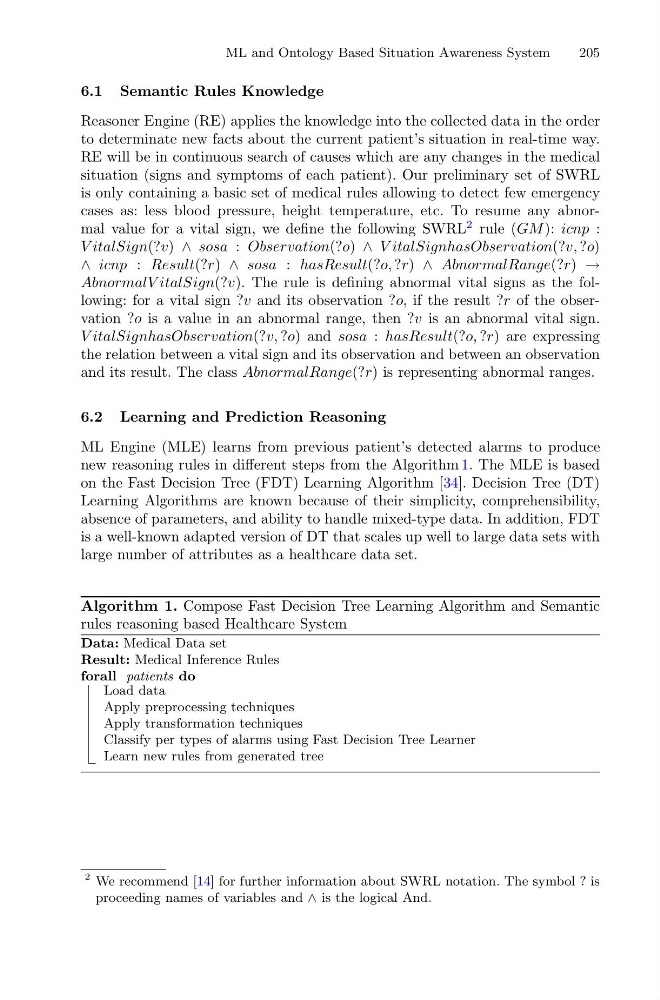
new reasoning rules in different steps from the Algorithm 1. The MLE is based
on the Fast Decision Tree (FDT) Learning Algorithm [34]. Decision Tree (DT)
Learning Algorithms are known because of their simplicity, comprehensibility,
absence of parameters, and ability to handle mixed-type data. In addition, FDT
is a well-known adapted version of DT that scales up well to large data sets with
large number of attributes as a healthcare data set.
Algorithm 1. Compose Fast Decision Tree Learning Algorithm and Semantic
rules reasoning based Healthcare System
Data: Medical Data set
Result: Medical Inference Rules
forall patients do
Load data
Apply preprocessing techniques
Apply transformation techniques
Classify per types of alarms using Fast Decision Tree Learner
Learn new rules from generated tree
2 We recommend [14] for further information about SWRL notation. The symbol ? is
proceeding names of variables and ∧ is the logical And.
205
6.1 Semantic Rules Knowledge
Reasoner Engine (RE) applies the knowledge into the collected data in the order
to determinate new facts about the current patient’s situation in real-time way.
RE will be in continuous search of causes which are any changes in the medical
situation (signs and symptoms of each patient). Our preliminary set of SWRL
is only containing a basic set of medical rules allowing to detect few emergency
cases as: less blood pressure, height temperature, etc. To resume any abnormal value for a vital sign, we define the following SWRL
2 rule (GM ): icnp :
V italSign(?v) ∧ sosa : Observation(?o) ∧ V italSignhasObservation(?v, ?o)
∧ icnp : Result(?r) ∧ sosa : hasResult(?o, ?r) ∧ AbnormalRange(?r) →
AbnormalV italSign(?v). The rule is defining abnormal vital signs as the following: for a vital sign ?v and its observation ?o, if the result ?r of the observation ?o is a value in an abnormal range, then ?v is an abnormal vital sign.
V italSignhasObservation(?v, ?o) and sosa : hasResult(?o, ?r) are expressing
the relation between a vital sign and its observation and between an observation
and its result. The class AbnormalRange(?r) is representing abnormal ranges.
6.2 Learning and Prediction Reasoning
ML Engine (MLE) learns from previous patient’s detected alarms to produce
new reasoning rules in different steps from the Algorithm 1. The MLE is based
on the Fast Decision Tree (FDT) Learning Algorithm [34]. Decision Tree (DT)
Learning Algorithms are known because of their simplicity, comprehensibility,
absence of parameters, and ability to handle mixed-type data. In addition, FDT
is a well-known adapted version of DT that scales up well to large data sets with
large number of attributes as a healthcare data set.
Algorithm 1. Compose Fast Decision Tree Learning Algorithm and Semantic
rules reasoning based Healthcare System
Data: Medical Data set
Result: Medical Inference Rules
forall patients do
Load data
Apply preprocessing techniques
Apply transformation techniques
Classify per types of alarms using Fast Decision Tree Learner
Learn new rules from generated tree
2 We recommend [14] for further information about SWRL notation. The symbol ? is
proceeding names of variables and ∧ is the logical And.