

and places is shown in Table 1, e.g., if the kitchen stove, refrigerator, and cupboard are
not in the house, AS 3 will omit the procedure take food => cook => take tableware,
which implies the resident eats food prepared by someone out of the house in this case.
If all activities of an AS can not be performed because of the layout, its MV i will always
be 0.
Resident’s Personal Profile. To keep generated schedules diverse and reasonable,
parameters corresponding to the evolution of MVs should depend on the resident’s
profile. The profile represents a resident’s tendencies to satisfy different motivations,
which is determined by sampling D, T, and f of an AS performed over reasonable
intervals. Di means the duration of the resident performing the ith AS in a period (T i ),
e.g., D 8 means how long the resident performed the activity “watch TV” per day on
average if T 8 = 1 day. T i and f i mean the period and frequency of performing the ith
AS, respectively, e.g., T 12 means how many days between two instances of the resident’s wandering and f 6 means how many times the resident performed the activity “go
to toilet (short duration)” per day on average, where T i  f i = 1.
Mechanism of MVs Evolution. MVs quantify the motivations to perform activities,
MV i usually decreases when the ith AS is performed, increases when other ASs are
performed, and remains unchanged in special cases. The values of D, T, and f determine the speed of the increase and decrease of MVs. The rules below show the
evolution of MVs, where Rules 1.1) and 1.2) indicate the situations when MV i remains
unchanged, 2.1) to 2.4) show the mechanism of MVs increasing, and 3.1) to 3.4) show
the mechanism of them decreasing.
Rule 1.1) MV i is always 0 if ith AS can not be performed.
Rule 1.2) MV 13 = 1.02Norm_MV in any case, where Norm_MV is a constant.
Note: MV 13 corresponds to relax. This rule means the resident is performing the
activity “relax” when all other MVs are low. Setting MV 13 as a constant keeps MVs
stable in the long term.
Rule 2.1) Ways of MVs increasing include linear and step functional increasing.
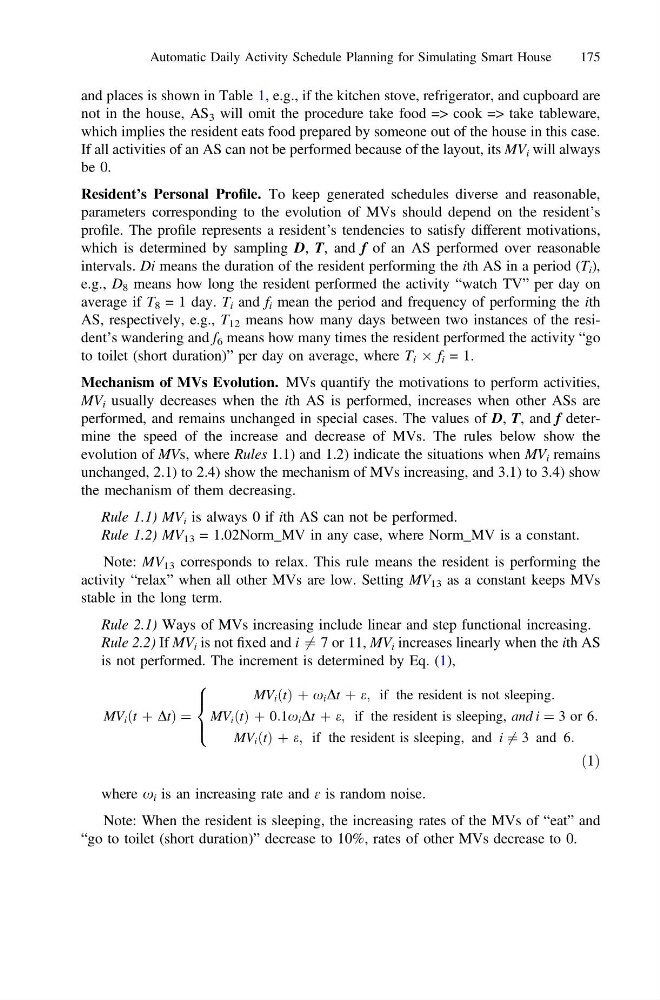
Rule 2.2) If MV i is not fixed and i 6 ¼ 7 or 11, MV i increases linearly when the ith AS
is not performed. The increment is determined by Eq. (1),
MV i t þ Dt
ð
Þ¼
MV i t
ð Þ þ x i Dt þ e; if the resident is not sleeping.
MV i t
ð Þ þ 0:1x i Dt þ e; if the resident is sleeping, and i ¼ 3 or 6:
MV i t
ð Þ þ e; if the resident is sleeping, and i 6 ¼ 3 and 6:
8
> <
> :
ð1Þ
where x i is an increasing rate and ɛ is random noise.
Note: When the resident is sleeping, the increasing rates of the MVs of “eat” and
“go to toilet (short duration)” decrease to 10%, rates of other MVs decrease to 0.
Automatic Daily Activity Schedule Planning for Simulating Smart House
175
not in the house, AS 3 will omit the procedure take food => cook => take tableware,
which implies the resident eats food prepared by someone out of the house in this case.
If all activities of an AS can not be performed because of the layout, its MV i will always
be 0.
Resident’s Personal Profile. To keep generated schedules diverse and reasonable,
parameters corresponding to the evolution of MVs should depend on the resident’s
profile. The profile represents a resident’s tendencies to satisfy different motivations,
which is determined by sampling D, T, and f of an AS performed over reasonable
intervals. Di means the duration of the resident performing the ith AS in a period (T i ),
e.g., D 8 means how long the resident performed the activity “watch TV” per day on
average if T 8 = 1 day. T i and f i mean the period and frequency of performing the ith
AS, respectively, e.g., T 12 means how many days between two instances of the resident’s wandering and f 6 means how many times the resident performed the activity “go
to toilet (short duration)” per day on average, where T i  f i = 1.
Mechanism of MVs Evolution. MVs quantify the motivations to perform activities,
MV i usually decreases when the ith AS is performed, increases when other ASs are
performed, and remains unchanged in special cases. The values of D, T, and f determine the speed of the increase and decrease of MVs. The rules below show the
evolution of MVs, where Rules 1.1) and 1.2) indicate the situations when MV i remains
unchanged, 2.1) to 2.4) show the mechanism of MVs increasing, and 3.1) to 3.4) show
the mechanism of them decreasing.
Rule 1.1) MV i is always 0 if ith AS can not be performed.
Rule 1.2) MV 13 = 1.02Norm_MV in any case, where Norm_MV is a constant.
Note: MV 13 corresponds to relax. This rule means the resident is performing the
activity “relax” when all other MVs are low. Setting MV 13 as a constant keeps MVs
stable in the long term.
Rule 2.1) Ways of MVs increasing include linear and step functional increasing.
Rule 2.2) If MV i is not fixed and i 6 ¼ 7 or 11, MV i increases linearly when the ith AS
is not performed. The increment is determined by Eq. (1),
MV i t þ Dt
ð
Þ¼
MV i t
ð Þ þ x i Dt þ e; if the resident is not sleeping.
MV i t
ð Þ þ 0:1x i Dt þ e; if the resident is sleeping, and i ¼ 3 or 6:
MV i t
ð Þ þ e; if the resident is sleeping, and i 6 ¼ 3 and 6:
8
> <
> :
ð1Þ
where x i is an increasing rate and ɛ is random noise.
Note: When the resident is sleeping, the increasing rates of the MVs of “eat” and
“go to toilet (short duration)” decrease to 10%, rates of other MVs decrease to 0.
Automatic Daily Activity Schedule Planning for Simulating Smart House
175