

• quantification of longer-term and/or periodic activity level behaviours directly from
categorized daily or incidental activity level values as measured and acquired from
the wearable tracker devices through relevant APIs (light/soft, moderate, and
vigorous/intense activity).
4.2 Specific Walking Activity
Similarly, the authors in [14] and [15] demonstrate the following referent threshold
ranges of the number of daily walked steps to be used for classification of walking
activity in healthy adults, and the corresponding scoring function linearly assigning the
following 1–5 integer scores to the classification categories: highly active (12,500 or
more steps/day) – 5, active (10,000–12,499 steps/day) – 4, somewhat active (7,500–
9,999 steps/day) – 3, lowly active (5,000–7,499 steps/day) – 2, and sedentary (under
5,000 steps/day) - 1.
4.3 Cardiovascular Fitness - VO 2 max
VO 2 max is the metric denoting the maximum amount of oxygen that an individual can
use during intense exercise. It is widely and commonly used as an indicator of cardiorespiratory fitness.
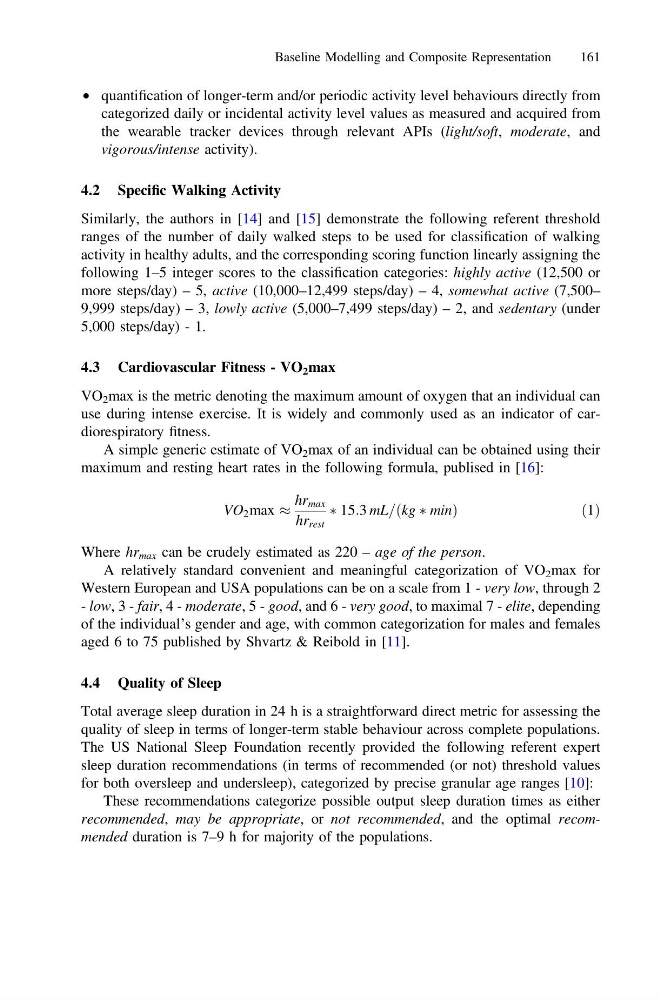
A simple generic estimate of VO 2 max of an individual can be obtained using their
maximum and resting heart rates in the following formula, publised in [16]:
VO 2 max %
hr max
hr rest
à 15:3 mL=ðkg à minÞ
ð 1Þ
Where hr max can be crudely estimated as 220 – age of the person.
A relatively standard convenient and meaningful categorization of VO 2 max for
Western European and USA populations can be on a scale from 1 - very low, through 2
- low, 3 - fair, 4 - moderate, 5 - good, and 6 - very good, to maximal 7 - elite, depending
of the individual’s gender and age, with common categorization for males and females
aged 6 to 75 published by Shvartz & Reibold in [11].
4.4 Quality of Sleep
Total average sleep duration in 24 h is a straightforward direct metric for assessing the
quality of sleep in terms of longer-term stable behaviour across complete populations.
The US National Sleep Foundation recently provided the following referent expert
sleep duration recommendations (in terms of recommended (or not) threshold values
for both oversleep and undersleep), categorized by precise granular age ranges [10]:
These recommendations categorize possible output sleep duration times as either
recommended, may be appropriate, or not recommended, and the optimal recommended duration is 7–9 h for majority of the populations.
Baseline Modelling and Composite Representation
161
categorized daily or incidental activity level values as measured and acquired from
the wearable tracker devices through relevant APIs (light/soft, moderate, and
vigorous/intense activity).
4.2 Specific Walking Activity
Similarly, the authors in [14] and [15] demonstrate the following referent threshold
ranges of the number of daily walked steps to be used for classification of walking
activity in healthy adults, and the corresponding scoring function linearly assigning the
following 1–5 integer scores to the classification categories: highly active (12,500 or
more steps/day) – 5, active (10,000–12,499 steps/day) – 4, somewhat active (7,500–
9,999 steps/day) – 3, lowly active (5,000–7,499 steps/day) – 2, and sedentary (under
5,000 steps/day) - 1.
4.3 Cardiovascular Fitness - VO 2 max
VO 2 max is the metric denoting the maximum amount of oxygen that an individual can
use during intense exercise. It is widely and commonly used as an indicator of cardiorespiratory fitness.
A simple generic estimate of VO 2 max of an individual can be obtained using their
maximum and resting heart rates in the following formula, publised in [16]:
VO 2 max %
hr max
hr rest
à 15:3 mL=ðkg à minÞ
ð 1Þ
Where hr max can be crudely estimated as 220 – age of the person.
A relatively standard convenient and meaningful categorization of VO 2 max for
Western European and USA populations can be on a scale from 1 - very low, through 2
- low, 3 - fair, 4 - moderate, 5 - good, and 6 - very good, to maximal 7 - elite, depending
of the individual’s gender and age, with common categorization for males and females
aged 6 to 75 published by Shvartz & Reibold in [11].
4.4 Quality of Sleep
Total average sleep duration in 24 h is a straightforward direct metric for assessing the
quality of sleep in terms of longer-term stable behaviour across complete populations.
The US National Sleep Foundation recently provided the following referent expert
sleep duration recommendations (in terms of recommended (or not) threshold values
for both oversleep and undersleep), categorized by precise granular age ranges [10]:
These recommendations categorize possible output sleep duration times as either
recommended, may be appropriate, or not recommended, and the optimal recommended duration is 7–9 h for majority of the populations.
Baseline Modelling and Composite Representation
161