

136
D. Zekri et al.
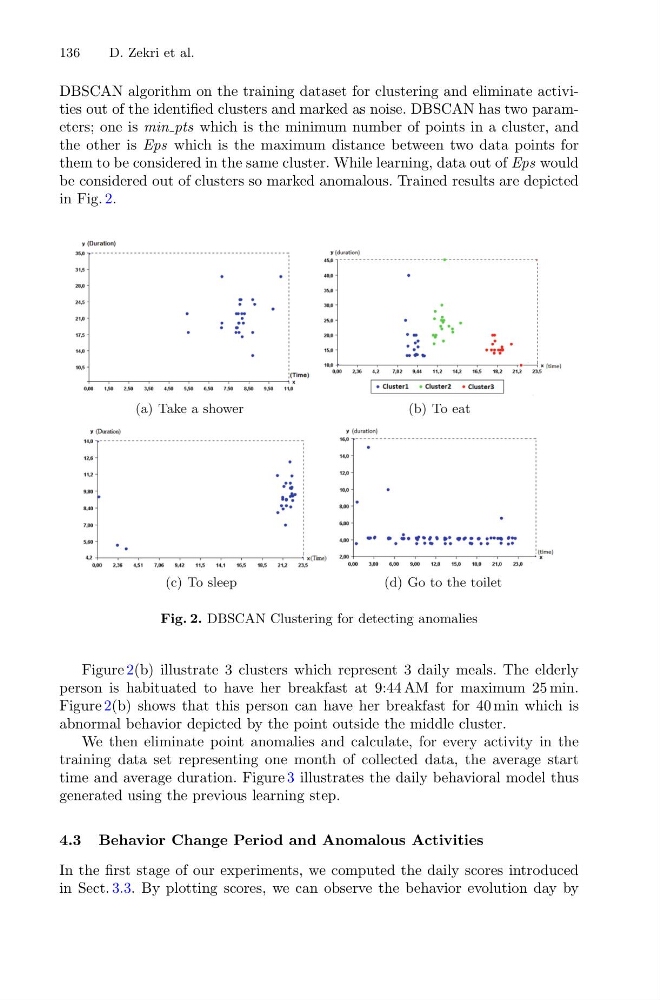
DBSCAN algorithm on the training dataset for clustering and eliminate activities out of the identified clusters and marked as noise. DBSCAN has two parameters; one is min pts which is the minimum number of points in a cluster, and
the other is Eps which is the maximum distance between two data points for
them to be considered in the same cluster. While learning, data out of Eps would
be considered out of clusters so marked anomalous. Trained results are depicted
in Fig. 2.
Fig. 2. DBSCAN Clustering for detecting anomalies
Figure 2(b) illustrate 3 clusters which represent 3 daily meals. The elderly
person is habituated to have her breakfast at 9:44 AM for maximum 25 min.
Figure 2(b) shows that this person can have her breakfast for 40 min which is
abnormal behavior depicted by the point outside the middle cluster.
We then eliminate point anomalies and calculate, for every activity in the
training data set representing one month of collected data, the average start
time and average duration. Figure 3 illustrates the daily behavioral model thus
generated using the previous learning step.
4.3 Behavior Change Period and Anomalous Activities
In the first stage of our experiments, we computed the daily scores introduced
in Sect. 3.3. By plotting scores, we can observe the behavior evolution day by
D. Zekri et al.
DBSCAN algorithm on the training dataset for clustering and eliminate activities out of the identified clusters and marked as noise. DBSCAN has two parameters; one is min pts which is the minimum number of points in a cluster, and
the other is Eps which is the maximum distance between two data points for
them to be considered in the same cluster. While learning, data out of Eps would
be considered out of clusters so marked anomalous. Trained results are depicted
in Fig. 2.
Fig. 2. DBSCAN Clustering for detecting anomalies
Figure 2(b) illustrate 3 clusters which represent 3 daily meals. The elderly
person is habituated to have her breakfast at 9:44 AM for maximum 25 min.
Figure 2(b) shows that this person can have her breakfast for 40 min which is
abnormal behavior depicted by the point outside the middle cluster.
We then eliminate point anomalies and calculate, for every activity in the
training data set representing one month of collected data, the average start
time and average duration. Figure 3 illustrates the daily behavioral model thus
generated using the previous learning step.
4.3 Behavior Change Period and Anomalous Activities
In the first stage of our experiments, we computed the daily scores introduced
in Sect. 3.3. By plotting scores, we can observe the behavior evolution day by