

118
A. Jlassi et al.
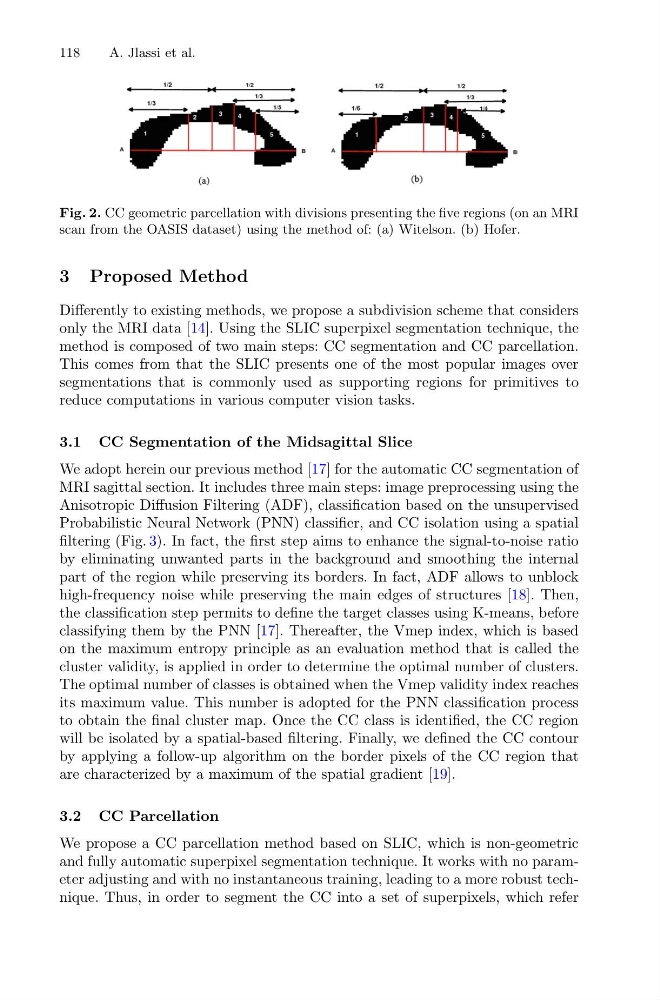
Fig. 2. CC geometric parcellation with divisions presenting the five regions (on an MRI
scan from the OASIS dataset) using the method of: (a) Witelson. (b) Hofer.
3 Proposed Method
Differently to existing methods, we propose a subdivision scheme that considers
only the MRI data [14]. Using the SLIC superpixel segmentation technique, the
method is composed of two main steps: CC segmentation and CC parcellation.
This comes from that the SLIC presents one of the most popular images over
segmentations that is commonly used as supporting regions for primitives to
reduce computations in various computer vision tasks.
3.1 CC Segmentation of the Midsagittal Slice
We adopt herein our previous method [17] for the automatic CC segmentation of
MRI sagittal section. It includes three main steps: image preprocessing using the
Anisotropic Diffusion Filtering (ADF), classification based on the unsupervised
Probabilistic Neural Network (PNN) classifier, and CC isolation using a spatial
filtering (Fig. 3). In fact, the first step aims to enhance the signal-to-noise ratio
by eliminating unwanted parts in the background and smoothing the internal
part of the region while preserving its borders. In fact, ADF allows to unblock
high-frequency noise while preserving the main edges of structures [18]. Then,
the classification step permits to define the target classes using K-means, before
classifying them by the PNN [17]. Thereafter, the Vmep index, which is based
on the maximum entropy principle as an evaluation method that is called the
cluster validity, is applied in order to determine the optimal number of clusters.
The optimal number of classes is obtained when the Vmep validity index reaches
its maximum value. This number is adopted for the PNN classification process
to obtain the final cluster map. Once the CC class is identified, the CC region
will be isolated by a spatial-based filtering. Finally, we defined the CC contour
by applying a follow-up algorithm on the border pixels of the CC region that
are characterized by a maximum of the spatial gradient [19].
3.2 CC Parcellation
We propose a CC parcellation method based on SLIC, which is non-geometric
and fully automatic superpixel segmentation technique. It works with no parameter adjusting and with no instantaneous training, leading to a more robust technique. Thus, in order to segment the CC into a set of superpixels, which refer
A. Jlassi et al.
Fig. 2. CC geometric parcellation with divisions presenting the five regions (on an MRI
scan from the OASIS dataset) using the method of: (a) Witelson. (b) Hofer.
3 Proposed Method
Differently to existing methods, we propose a subdivision scheme that considers
only the MRI data [14]. Using the SLIC superpixel segmentation technique, the
method is composed of two main steps: CC segmentation and CC parcellation.
This comes from that the SLIC presents one of the most popular images over
segmentations that is commonly used as supporting regions for primitives to
reduce computations in various computer vision tasks.
3.1 CC Segmentation of the Midsagittal Slice
We adopt herein our previous method [17] for the automatic CC segmentation of
MRI sagittal section. It includes three main steps: image preprocessing using the
Anisotropic Diffusion Filtering (ADF), classification based on the unsupervised
Probabilistic Neural Network (PNN) classifier, and CC isolation using a spatial
filtering (Fig. 3). In fact, the first step aims to enhance the signal-to-noise ratio
by eliminating unwanted parts in the background and smoothing the internal
part of the region while preserving its borders. In fact, ADF allows to unblock
high-frequency noise while preserving the main edges of structures [18]. Then,
the classification step permits to define the target classes using K-means, before
classifying them by the PNN [17]. Thereafter, the Vmep index, which is based
on the maximum entropy principle as an evaluation method that is called the
cluster validity, is applied in order to determine the optimal number of clusters.
The optimal number of classes is obtained when the Vmep validity index reaches
its maximum value. This number is adopted for the PNN classification process
to obtain the final cluster map. Once the CC class is identified, the CC region
will be isolated by a spatial-based filtering. Finally, we defined the CC contour
by applying a follow-up algorithm on the border pixels of the CC region that
are characterized by a maximum of the spatial gradient [19].
3.2 CC Parcellation
We propose a CC parcellation method based on SLIC, which is non-geometric
and fully automatic superpixel segmentation technique. It works with no parameter adjusting and with no instantaneous training, leading to a more robust technique. Thus, in order to segment the CC into a set of superpixels, which refer