

3.2.5 Processing Time
Experimental results obtained from using the MIT-BIH Arrhythmia Database showed
that the processing time efficiency of our system can be highly increased by implementing the algorithm on GPU instead of the actual CPU. By using CPU, our algorithm
took 2.052 s to make the real time classification of an ECG signal. Nevertheless,
further improvement can be done on this method to achieve higher accuracy with less
processing time.
4 Discussions
The ANN application for ECG signals classification demonstrates greater accuracy
compared to the state of the art, which proves that the ANN system is able to get more
and more advanced results. Indeed, the state to have 100% of accuracy and 0% of error
is hard to achieve. Despite this problem, ANN achieves high accuracy in comparison
with related works. In [2], authors achieved 86% of accuracy. Accordingly, our ANN
method overcomes results depicted in [2] with 7% of accuracy for ECG signals classifications. Indeed more, we are going deeper through layers, more accuracy results are
better. We have achieved the top accuracy for MIT-BIH-ECG signal classification
using the artificial neural network model by a value of 93.1% of accuracy where CNN
comes with the third top accuracy with 92.7%. In Fact, we overcome [9], where authors
proposed an Echo state neural network, with 92.7% of accuracy. Moreover, we surpass
the state of the art in [11] with more than 3% of accuracy, and we have an error close to
zero in histogram error detection with a low value of cross entropy, which proves the
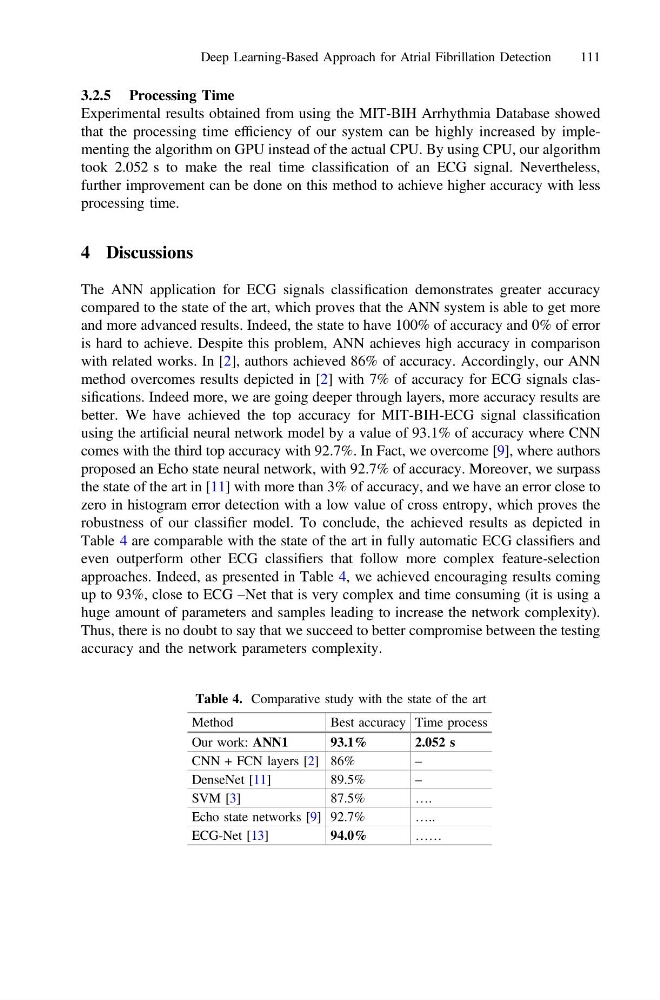
robustness of our classifier model. To conclude, the achieved results as depicted in
Table 4 are comparable with the state of the art in fully automatic ECG classifiers and
even outperform other ECG classifiers that follow more complex feature-selection
approaches. Indeed, as presented in Table 4, we achieved encouraging results coming
up to 93%, close to ECG –Net that is very complex and time consuming (it is using a
huge amount of parameters and samples leading to increase the network complexity).
Thus, there is no doubt to say that we succeed to better compromise between the testing
accuracy and the network parameters complexity.
Table 4. Comparative study with the state of the art
Method
Best accuracy Time process
Our work: ANN1
93.1%
2.052 s
CNN + FCN layers [2] 86%
–
DenseNet [11]
89.5%
–
SVM [3]
87.5%
….
Echo state networks [9] 92.7%
…..
ECG-Net [13]
94.0%
……
Deep Learning-Based Approach for Atrial Fibrillation Detection
111
Experimental results obtained from using the MIT-BIH Arrhythmia Database showed
that the processing time efficiency of our system can be highly increased by implementing the algorithm on GPU instead of the actual CPU. By using CPU, our algorithm
took 2.052 s to make the real time classification of an ECG signal. Nevertheless,
further improvement can be done on this method to achieve higher accuracy with less
processing time.
4 Discussions
The ANN application for ECG signals classification demonstrates greater accuracy
compared to the state of the art, which proves that the ANN system is able to get more
and more advanced results. Indeed, the state to have 100% of accuracy and 0% of error
is hard to achieve. Despite this problem, ANN achieves high accuracy in comparison
with related works. In [2], authors achieved 86% of accuracy. Accordingly, our ANN
method overcomes results depicted in [2] with 7% of accuracy for ECG signals classifications. Indeed more, we are going deeper through layers, more accuracy results are
better. We have achieved the top accuracy for MIT-BIH-ECG signal classification
using the artificial neural network model by a value of 93.1% of accuracy where CNN
comes with the third top accuracy with 92.7%. In Fact, we overcome [9], where authors
proposed an Echo state neural network, with 92.7% of accuracy. Moreover, we surpass
the state of the art in [11] with more than 3% of accuracy, and we have an error close to
zero in histogram error detection with a low value of cross entropy, which proves the
robustness of our classifier model. To conclude, the achieved results as depicted in
Table 4 are comparable with the state of the art in fully automatic ECG classifiers and
even outperform other ECG classifiers that follow more complex feature-selection
approaches. Indeed, as presented in Table 4, we achieved encouraging results coming
up to 93%, close to ECG –Net that is very complex and time consuming (it is using a
huge amount of parameters and samples leading to increase the network complexity).
Thus, there is no doubt to say that we succeed to better compromise between the testing
accuracy and the network parameters complexity.
Table 4. Comparative study with the state of the art
Method
Best accuracy Time process
Our work: ANN1
93.1%
2.052 s
CNN + FCN layers [2] 86%
–
DenseNet [11]
89.5%
–
SVM [3]
87.5%
….
Echo state networks [9] 92.7%
…..
ECG-Net [13]
94.0%
……
Deep Learning-Based Approach for Atrial Fibrillation Detection
111