

96
S. Zorgui et al.
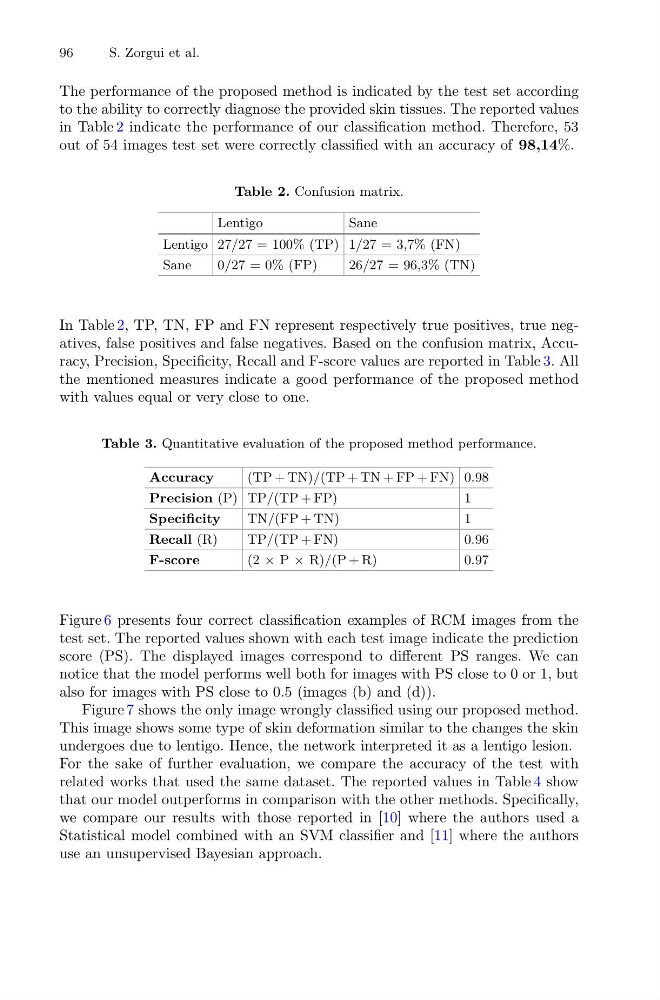
The performance of the proposed method is indicated by the test set according
to the ability to correctly diagnose the provided skin tissues. The reported values
in Table 2 indicate the performance of our classification method. Therefore, 53
out of 54 images test set were correctly classified with an accuracy of 98,14%.
Table 2. Confusion matrix.
Lentigo
Sane
Lentigo 27/27 = 100% (TP) 1/27 = 3,7% (FN)
Sane
0/27 = 0% (FP)
26/27 = 96,3% (TN)
In Table 2, TP, TN, FP and FN represent respectively true positives, true negatives, false positives and false negatives. Based on the confusion matrix, Accuracy, Precision, Specificity, Recall and F-score values are reported in Table 3. All
the mentioned measures indicate a good performance of the proposed method
with values equal or very close to one.
Table 3. Quantitative evaluation of the proposed method performance.
Accuracy
(TP + TN)/(TP + TN + FP + FN) 0.98
Precision (P) TP/(TP + FP)
1
Specificity
TN/(FP + TN)
1
Recall (R)
TP/(TP + FN)
0.96
F-score
(2 × P × R)/(P + R)
0.97
Figure 6 presents four correct classification examples of RCM images from the
test set. The reported values shown with each test image indicate the prediction
score (PS). The displayed images correspond to different PS ranges. We can
notice that the model performs well both for images with PS close to 0 or 1, but
also for images with PS close to 0.5 (images (b) and (d)).
Figure 7 shows the only image wrongly classified using our proposed method.
This image shows some type of skin deformation similar to the changes the skin
undergoes due to lentigo. Hence, the network interpreted it as a lentigo lesion.
For the sake of further evaluation, we compare the accuracy of the test with
related works that used the same dataset. The reported values in Table 4 show
that our model outperforms in comparison with the other methods. Specifically,
we compare our results with those reported in [10] where the authors used a
Statistical model combined with an SVM classifier and [11] where the authors
use an unsupervised Bayesian approach.
S. Zorgui et al.
The performance of the proposed method is indicated by the test set according
to the ability to correctly diagnose the provided skin tissues. The reported values
in Table 2 indicate the performance of our classification method. Therefore, 53
out of 54 images test set were correctly classified with an accuracy of 98,14%.
Table 2. Confusion matrix.
Lentigo
Sane
Lentigo 27/27 = 100% (TP) 1/27 = 3,7% (FN)
Sane
0/27 = 0% (FP)
26/27 = 96,3% (TN)
In Table 2, TP, TN, FP and FN represent respectively true positives, true negatives, false positives and false negatives. Based on the confusion matrix, Accuracy, Precision, Specificity, Recall and F-score values are reported in Table 3. All
the mentioned measures indicate a good performance of the proposed method
with values equal or very close to one.
Table 3. Quantitative evaluation of the proposed method performance.
Accuracy
(TP + TN)/(TP + TN + FP + FN) 0.98
Precision (P) TP/(TP + FP)
1
Specificity
TN/(FP + TN)
1
Recall (R)
TP/(TP + FN)
0.96
F-score
(2 × P × R)/(P + R)
0.97
Figure 6 presents four correct classification examples of RCM images from the
test set. The reported values shown with each test image indicate the prediction
score (PS). The displayed images correspond to different PS ranges. We can
notice that the model performs well both for images with PS close to 0 or 1, but
also for images with PS close to 0.5 (images (b) and (d)).
Figure 7 shows the only image wrongly classified using our proposed method.
This image shows some type of skin deformation similar to the changes the skin
undergoes due to lentigo. Hence, the network interpreted it as a lentigo lesion.
For the sake of further evaluation, we compare the accuracy of the test with
related works that used the same dataset. The reported values in Table 4 show
that our model outperforms in comparison with the other methods. Specifically,
we compare our results with those reported in [10] where the authors used a
Statistical model combined with an SVM classifier and [11] where the authors
use an unsupervised Bayesian approach.