

A Convolutional Neural Network for Lentigo Diagnosis
91
data acquisition and to facilitate the full observation of the biological structures
in deformation over time. Due to all of these reasons, our approach is based on
images acquired thanks to this modality. In [10,11], the authors propose two
RCM lentigo detection methods based on the statistical and Bayesian models
[17] respectively. The methods have proved complicated and hard to implement.
They require manual procedures like feature selection and data preparation. To
this regard, we propose here a method for RCM image classification using a
CNN architecture. Indeed, CNNs have proven their capacity to efficiently solve
several complex problems in medical imaging.
2.2 Convolutional Neural Networks
The CNN [8] is a deep learning architecture that is primarily used for image
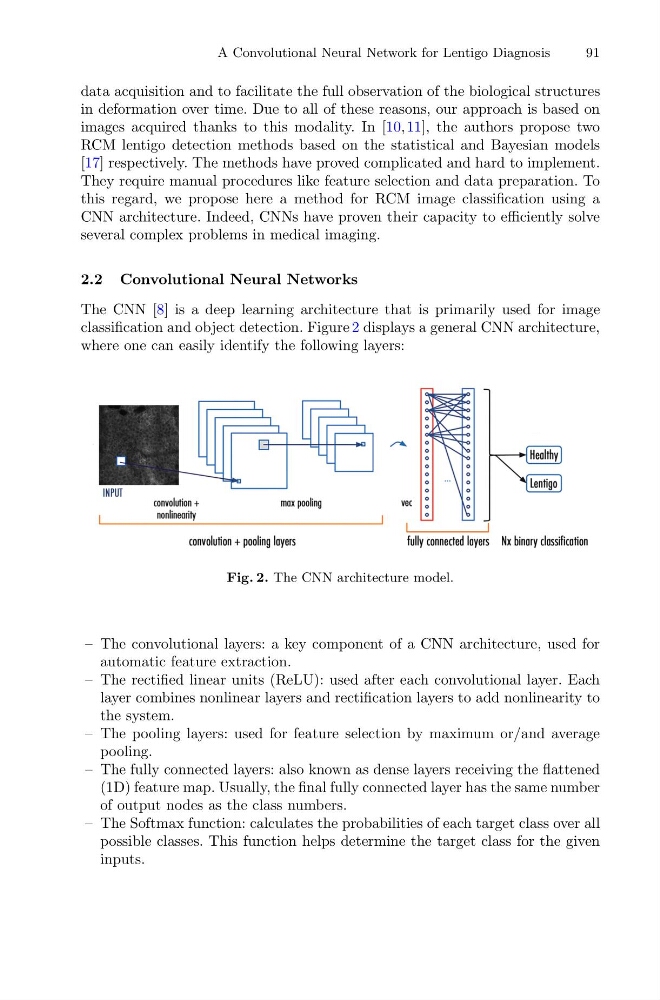
classification and object detection. Figure 2 displays a general CNN architecture,
where one can easily identify the following layers:
Fig. 2. The CNN architecture model.
– The convolutional layers: a key component of a CNN architecture, used for
automatic feature extraction.
– The rectified linear units (ReLU): used after each convolutional layer. Each
layer combines nonlinear layers and rectification layers to add nonlinearity to
the system.
– The pooling layers: used for feature selection by maximum or/and average
pooling.
– The fully connected layers: also known as dense layers receiving the flattened
(1D) feature map. Usually, the final fully connected layer has the same number
of output nodes as the class numbers.
– The Softmax function: calculates the probabilities of each target class over all
possible classes. This function helps determine the target class for the given
inputs.
91
data acquisition and to facilitate the full observation of the biological structures
in deformation over time. Due to all of these reasons, our approach is based on
images acquired thanks to this modality. In [10,11], the authors propose two
RCM lentigo detection methods based on the statistical and Bayesian models
[17] respectively. The methods have proved complicated and hard to implement.
They require manual procedures like feature selection and data preparation. To
this regard, we propose here a method for RCM image classification using a
CNN architecture. Indeed, CNNs have proven their capacity to efficiently solve
several complex problems in medical imaging.
2.2 Convolutional Neural Networks
The CNN [8] is a deep learning architecture that is primarily used for image
classification and object detection. Figure 2 displays a general CNN architecture,
where one can easily identify the following layers:
Fig. 2. The CNN architecture model.
– The convolutional layers: a key component of a CNN architecture, used for
automatic feature extraction.
– The rectified linear units (ReLU): used after each convolutional layer. Each
layer combines nonlinear layers and rectification layers to add nonlinearity to
the system.
– The pooling layers: used for feature selection by maximum or/and average
pooling.
– The fully connected layers: also known as dense layers receiving the flattened
(1D) feature map. Usually, the final fully connected layer has the same number
of output nodes as the class numbers.
– The Softmax function: calculates the probabilities of each target class over all
possible classes. This function helps determine the target class for the given
inputs.