

15
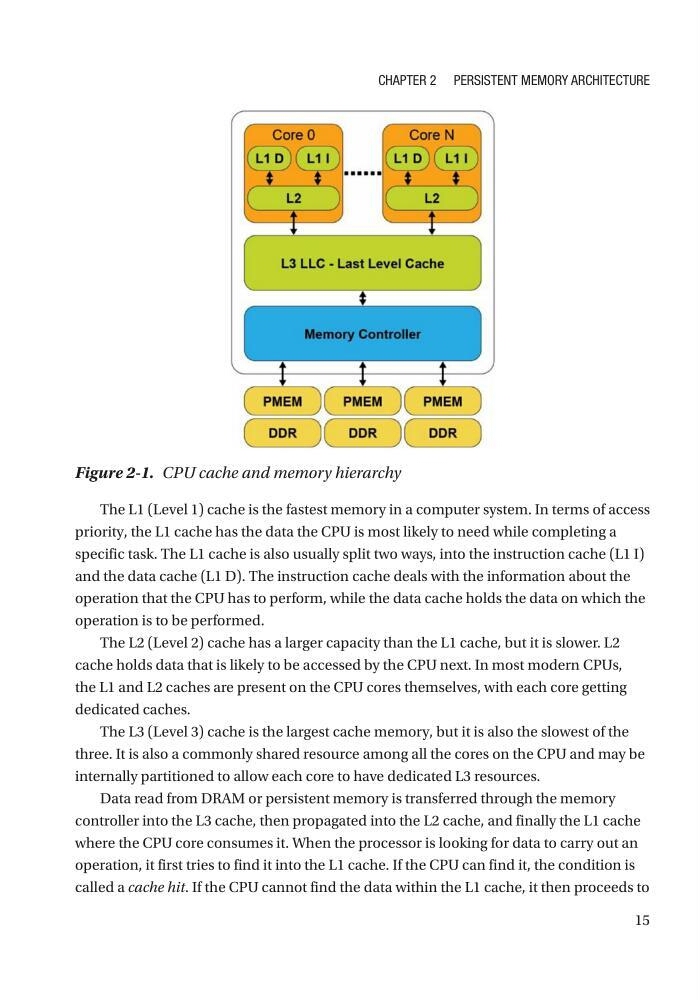
The L1 (Level 1) cache is the fastest memory in a computer system. In terms of access
priority, the L1 cache has the data the CPU is most likely to need while completing a
specific task. The L1 cache is also usually split two ways, into the instruction cache (L1 I)
and the data cache (L1 D). The instruction cache deals with the information about the
operation that the CPU has to perform, while the data cache holds the data on which the
operation is to be performed.
The L2 (Level 2) cache has a larger capacity than the L1 cache, but it is slower. L2
cache holds data that is likely to be accessed by the CPU next. In most modern CPUs,
the L1 and L2 caches are present on the CPU cores themselves, with each core getting
dedicated caches.
The L3 (Level 3) cache is the largest cache memory, but it is also the slowest of the
three. It is also a commonly shared resource among all the cores on the CPU and may be
internally partitioned to allow each core to have dedicated L3 resources.
Data read from DRAM or persistent memory is transferred through the memory
controller into the L3 cache, then propagated into the L2 cache, and finally the L1 cache
where the CPU core consumes it. When the processor is looking for data to carry out an
operation, it first tries to find it into the L1 cache. If the CPU can find it, the condition is
called a cache hit. If the CPU cannot find the data within the L1 cache, it then proceeds to
Figure 2-1. CPU cache and memory hierarchy
Chapter 2 persistent MeMory arChiteCture
The L1 (Level 1) cache is the fastest memory in a computer system. In terms of access
priority, the L1 cache has the data the CPU is most likely to need while completing a
specific task. The L1 cache is also usually split two ways, into the instruction cache (L1 I)
and the data cache (L1 D). The instruction cache deals with the information about the
operation that the CPU has to perform, while the data cache holds the data on which the
operation is to be performed.
The L2 (Level 2) cache has a larger capacity than the L1 cache, but it is slower. L2
cache holds data that is likely to be accessed by the CPU next. In most modern CPUs,
the L1 and L2 caches are present on the CPU cores themselves, with each core getting
dedicated caches.
The L3 (Level 3) cache is the largest cache memory, but it is also the slowest of the
three. It is also a commonly shared resource among all the cores on the CPU and may be
internally partitioned to allow each core to have dedicated L3 resources.
Data read from DRAM or persistent memory is transferred through the memory
controller into the L3 cache, then propagated into the L2 cache, and finally the L1 cache
where the CPU core consumes it. When the processor is looking for data to carry out an
operation, it first tries to find it into the L1 cache. If the CPU can find it, the condition is
called a cache hit. If the CPU cannot find the data within the L1 cache, it then proceeds to
Figure 2-1. CPU cache and memory hierarchy
Chapter 2 persistent MeMory arChiteCture