

340
vendors choose to implement additional persistent memory device methods for attributes
that are not covered by the vendor-agnostic methods. Many of these vendor-specific
health discovery methods are implemented as an ACPI device- specific method (_DSM).
Applications should be aware of degradation to the quality of service if they call ACPI
methods directly, since some platform implementations may impact memory traffic when
ACPI methods are invoked. Avoid excessive polling of device health methods when possible.
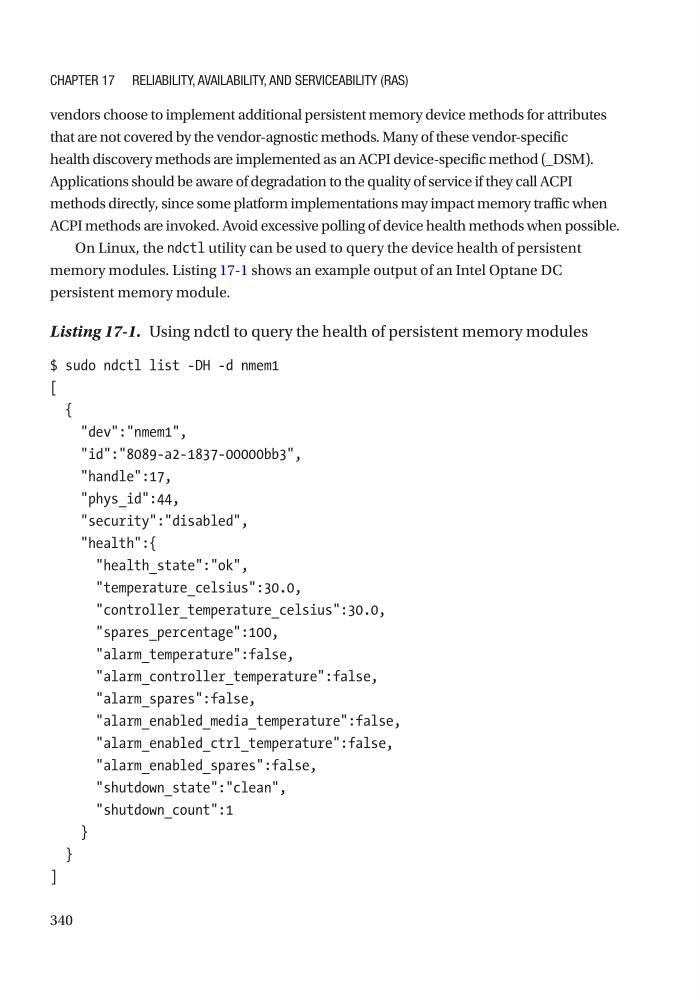
On Linux, the ndctl utility can be used to query the device health of persistent
memory modules. Listing 17-1 shows an example output of an Intel Optane DC
persistent memory module.
Listing 17-1. Using ndctl to query the health of persistent memory modules
$ sudo ndctl list -DH -d nmem1
[
{
"dev":"nmem1",
"id":"8089-a2-1837-00000bb3",
"handle":17,
"phys_id":44,
"security":"disabled",
"health":{
"health_state":"ok",
"temperature_celsius":30.0,
"controller_temperature_celsius":30.0,
"spares_percentage":100,
"alarm_temperature":false,
"alarm_controller_temperature":false,
"alarm_spares":false,
"alarm_enabled_media_temperature":false,
"alarm_enabled_ctrl_temperature":false,
"alarm_enabled_spares":false,
"shutdown_state":"clean",
"shutdown_count":1
}
}
]
Chapter 17 reliability, availability, and ServiCeability (raS)
vendors choose to implement additional persistent memory device methods for attributes
that are not covered by the vendor-agnostic methods. Many of these vendor-specific
health discovery methods are implemented as an ACPI device- specific method (_DSM).
Applications should be aware of degradation to the quality of service if they call ACPI
methods directly, since some platform implementations may impact memory traffic when
ACPI methods are invoked. Avoid excessive polling of device health methods when possible.
On Linux, the ndctl utility can be used to query the device health of persistent
memory modules. Listing 17-1 shows an example output of an Intel Optane DC
persistent memory module.
Listing 17-1. Using ndctl to query the health of persistent memory modules
$ sudo ndctl list -DH -d nmem1
[
{
"dev":"nmem1",
"id":"8089-a2-1837-00000bb3",
"handle":17,
"phys_id":44,
"security":"disabled",
"health":{
"health_state":"ok",
"temperature_celsius":30.0,
"controller_temperature_celsius":30.0,
"spares_percentage":100,
"alarm_temperature":false,
"alarm_controller_temperature":false,
"alarm_spares":false,
"alarm_enabled_media_temperature":false,
"alarm_enabled_ctrl_temperature":false,
"alarm_enabled_spares":false,
"shutdown_state":"clean",
"shutdown_count":1
}
}
]
Chapter 17 reliability, availability, and ServiCeability (raS)