

Population Viability Analysis
319
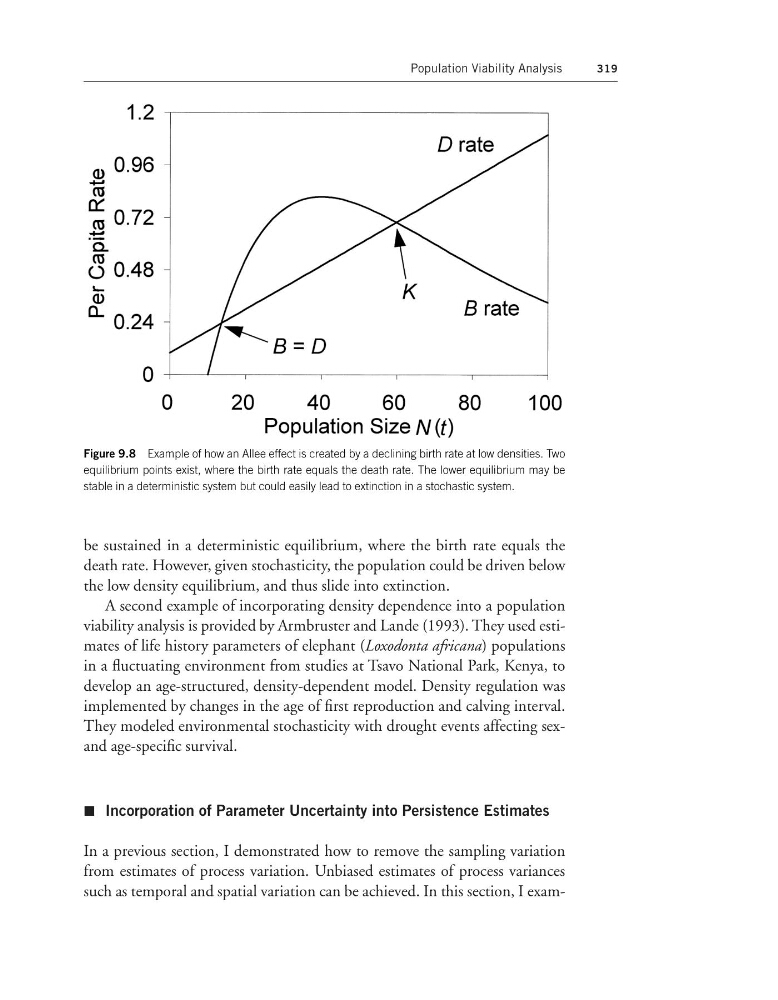
be sustained in a deterministic equilibrium, where the birth rate equals the
death rate. However, given stochasticity, the population could be driven below
the low density equilibrium, and thus slide into extinction.
A second example of incorporating density dependence into a population
viability analysis is provided by Armbruster and Lande (1993). They used estimates of life history parameters of elephant (Loxodonta africana) populations
in a fluctuating environment from studies at Tsavo National Park, Kenya, to
develop an age-structured, density-dependent model. Density regulation was
implemented by changes in the age of first reproduction and calving interval.
They modeled environmental stochasticity with drought events affecting sexand age-specific survival.
Incorporation of Parameter Uncertainty into Persistence Estimates
In a previous section, I demonstrated how to remove the sampling variation
from estimates of process variation. Unbiased estimates of process variances
such as temporal and spatial variation can be achieved. In this section, I examFigure 9.8 Example of how an Allee effect is created by a declining birth rate at low densities. Two
equilibrium points exist, where the birth rate equals the death rate. The lower equilibrium may be
stable in a deterministic system but could easily lead to extinction in a stochastic system.
319
be sustained in a deterministic equilibrium, where the birth rate equals the
death rate. However, given stochasticity, the population could be driven below
the low density equilibrium, and thus slide into extinction.
A second example of incorporating density dependence into a population
viability analysis is provided by Armbruster and Lande (1993). They used estimates of life history parameters of elephant (Loxodonta africana) populations
in a fluctuating environment from studies at Tsavo National Park, Kenya, to
develop an age-structured, density-dependent model. Density regulation was
implemented by changes in the age of first reproduction and calving interval.
They modeled environmental stochasticity with drought events affecting sexand age-specific survival.
Incorporation of Parameter Uncertainty into Persistence Estimates
In a previous section, I demonstrated how to remove the sampling variation
from estimates of process variation. Unbiased estimates of process variances
such as temporal and spatial variation can be achieved. In this section, I examFigure 9.8 Example of how an Allee effect is created by a declining birth rate at low densities. Two
equilibrium points exist, where the birth rate equals the death rate. The lower equilibrium may be
stable in a deterministic system but could easily lead to extinction in a stochastic system.