

Population Viability Analysis
315
Thus the resulting model is not a true Leslie matrix. Each iteration of the calculation also requires a temporal variance component, and making the parameters of the Leslie matrix into random variables (Burgman et al. 1993) is the
standard approach but eradicates the analytical results that normally are benefits of Leslie’s creative work. If multiple patches are modeled, each patch
requires a spatial variance component. Demographic variation can be built
into the model. Still, the resulting model doesn’t resemble the elegant matrix
model that Leslie originally developed.
However, use of the Leslie matrix framework ignores individual heterogeneity, and thus is likely to underestimate persistence. Incorporation of individual heterogeneity requires an individual-based model (DeAngelis and Gross
1992) and thus is conceptually different from the basic Leslie matrix approach.
Individual-based models can be spatially explicit (Conroy et al. 1995; Dunning et al. 1995; Holt et al. 1995; Turner et al. 1995), providing another approach to incorporating spatial stochasticity into the model.
As suggested by Boyce (1992), Stacey and Taper (1992), and Burgman et
al. (1993), density dependence is an important part of estimating a population’s persistence. Lande (1993) demonstrates that the importance of environmental stochasticity and random catastrophes depends on the density-dependence mechanism operating in the population, based on the value of K
carrying capacity. However, how density dependence is incorporated into the
model greatly affects the estimates of persistence (Pascual et al. 1997). In persistence models, as a population declines, compensation for small population
size takes the form of increased birth rates and decreased death rates (density
dependence) and so is a significant factor in increasing population persistence.
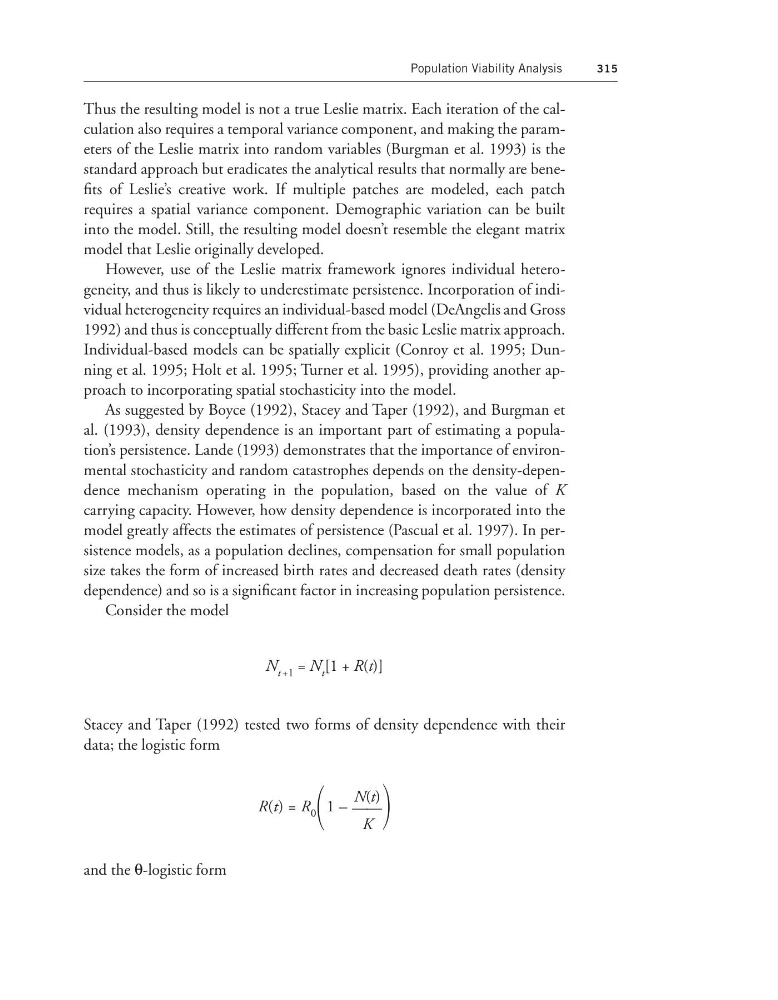
Consider the model
N t +1 = N t [1 + R(t)]
Stacey and Taper (1992) tested two forms of density dependence with their
data; the logistic form
R(t) = R 0
1 – ᎏ
N
K
(t)
ᎏ
and the θ-logistic form
315
Thus the resulting model is not a true Leslie matrix. Each iteration of the calculation also requires a temporal variance component, and making the parameters of the Leslie matrix into random variables (Burgman et al. 1993) is the
standard approach but eradicates the analytical results that normally are benefits of Leslie’s creative work. If multiple patches are modeled, each patch
requires a spatial variance component. Demographic variation can be built
into the model. Still, the resulting model doesn’t resemble the elegant matrix
model that Leslie originally developed.
However, use of the Leslie matrix framework ignores individual heterogeneity, and thus is likely to underestimate persistence. Incorporation of individual heterogeneity requires an individual-based model (DeAngelis and Gross
1992) and thus is conceptually different from the basic Leslie matrix approach.
Individual-based models can be spatially explicit (Conroy et al. 1995; Dunning et al. 1995; Holt et al. 1995; Turner et al. 1995), providing another approach to incorporating spatial stochasticity into the model.
As suggested by Boyce (1992), Stacey and Taper (1992), and Burgman et
al. (1993), density dependence is an important part of estimating a population’s persistence. Lande (1993) demonstrates that the importance of environmental stochasticity and random catastrophes depends on the density-dependence mechanism operating in the population, based on the value of K
carrying capacity. However, how density dependence is incorporated into the
model greatly affects the estimates of persistence (Pascual et al. 1997). In persistence models, as a population declines, compensation for small population
size takes the form of increased birth rates and decreased death rates (density
dependence) and so is a significant factor in increasing population persistence.
Consider the model
N t +1 = N t [1 + R(t)]
Stacey and Taper (1992) tested two forms of density dependence with their
data; the logistic form
R(t) = R 0
1 – ᎏ
N
K
(t)
ᎏ
and the θ-logistic form