

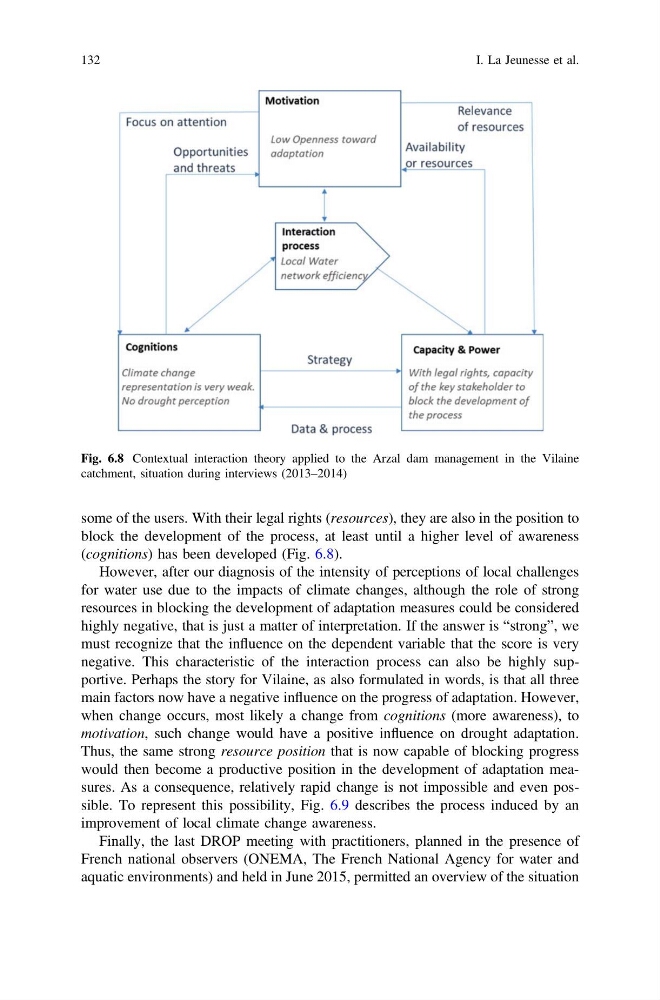
some of the users. With their legal rights (resources), they are also in the position to
block the development of the process, at least until a higher level of awareness
(cognitions) has been developed (Fig. 6.8).
However, after our diagnosis of the intensity of perceptions of local challenges
for water use due to the impacts of climate changes, although the role of strong
resources in blocking the development of adaptation measures could be considered
highly negative, that is just a matter of interpretation. If the answer is “strong”, we
must recognize that the influence on the dependent variable that the score is very
negative. This characteristic of the interaction process can also be highly supportive. Perhaps the story for Vilaine, as also formulated in words, is that all three
main factors now have a negative influence on the progress of adaptation. However,
when change occurs, most likely a change from cognitions (more awareness), to
motivation, such change would have a positive influence on drought adaptation.
Thus, the same strong resource position that is now capable of blocking progress
would then become a productive position in the development of adaptation measures. As a consequence, relatively rapid change is not impossible and even possible. To represent this possibility, Fig. 6.9 describes the process induced by an
improvement of local climate change awareness.
Finally, the last DROP meeting with practitioners, planned in the presence of
French national observers (ONEMA, The French National Agency for water and
aquatic environments) and held in June 2015, permitted an overview of the situation
Fig. 6.8 Contextual interaction theory applied to the Arzal dam management in the Vilaine
catchment, situation during interviews (2013–2014)
132
I. La Jeunesse et al.
block the development of the process, at least until a higher level of awareness
(cognitions) has been developed (Fig. 6.8).
However, after our diagnosis of the intensity of perceptions of local challenges
for water use due to the impacts of climate changes, although the role of strong
resources in blocking the development of adaptation measures could be considered
highly negative, that is just a matter of interpretation. If the answer is “strong”, we
must recognize that the influence on the dependent variable that the score is very
negative. This characteristic of the interaction process can also be highly supportive. Perhaps the story for Vilaine, as also formulated in words, is that all three
main factors now have a negative influence on the progress of adaptation. However,
when change occurs, most likely a change from cognitions (more awareness), to
motivation, such change would have a positive influence on drought adaptation.
Thus, the same strong resource position that is now capable of blocking progress
would then become a productive position in the development of adaptation measures. As a consequence, relatively rapid change is not impossible and even possible. To represent this possibility, Fig. 6.9 describes the process induced by an
improvement of local climate change awareness.
Finally, the last DROP meeting with practitioners, planned in the presence of
French national observers (ONEMA, The French National Agency for water and
aquatic environments) and held in June 2015, permitted an overview of the situation
Fig. 6.8 Contextual interaction theory applied to the Arzal dam management in the Vilaine
catchment, situation during interviews (2013–2014)
132
I. La Jeunesse et al.