

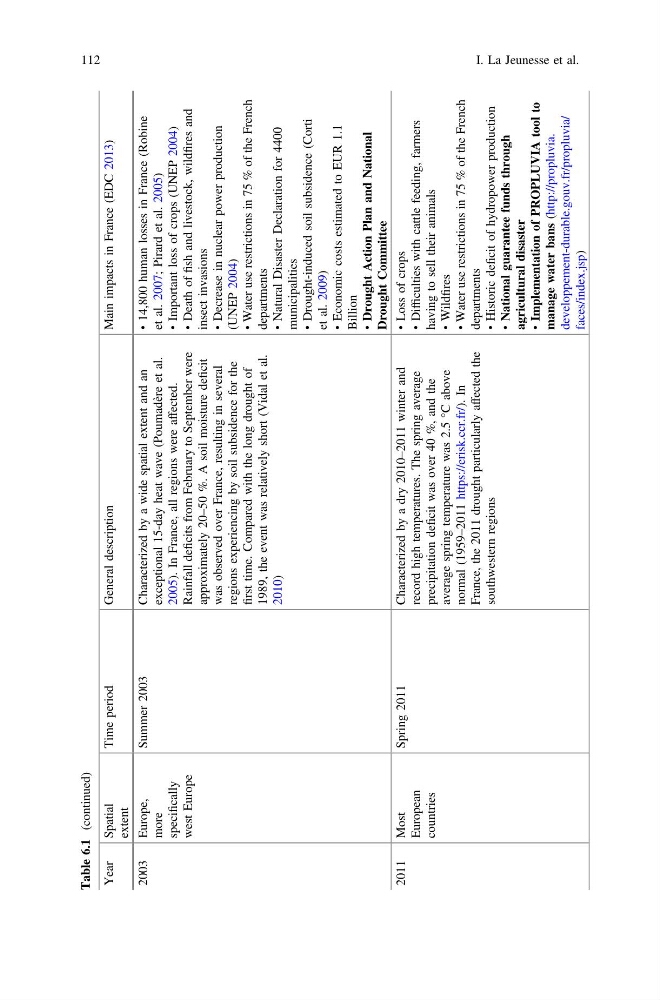
Table 6.1
(continued)
Year
Spatial
extent
Time period
General description
Main impacts in France (EDC 2013)
2003
Europe,
more
specifically
west Europe
Summer 2003
Characterized by a wide spatial extent and an
exceptional 15-day heat wave (Poumadère et al.
2005). In France, all regions were affected.
Rainfall deficits from February to September were
approximately 20–50 %. A soil moisture deficit
was observed over France, resulting in several
regions experiencing by soil subsidence for the
first time. Compared with the long drought of
1989, the event was relatively short (Vidal et al.
2010)
• 14,800 human losses in France (Robine
et al. 2007; Pirard et al. 2005)
• Important loss of crops (UNEP 2004)
• Death of
fish and livestock, wildfires and
insect invasions
• Decrease in nuclear power production
(UNEP 2004)
• Water use restrictions in 75 % of the French
departments
• Natural Disaster Declaration for 4400
municipalities
• Drought-induced soil subsidence (Corti
et al. 2009)
• Economic costs estimated to EUR 1.1
Billion
• Drought Action Plan and National
Drought Committee
2011
Most
European
countries
Spring 2011
Characterized by a dry 2010–2011 winter and
record high temperatures. The spring average
precipitation deficit was over 40 %, and the
average spring temperature was 2.5 °C above
normal (1959–2011 https://erisk.ccr.fr/). In
France, the 2011 drought particularly affected the
southwestern regions
• Loss of crops
• Difficulties with cattle feeding, farmers
having to sell their animals
• Wildfires
• Water use restrictions in 75 % of the French
departments
• Historic deficit of hydropower production
• National guarantee funds through
agricultural disaster
• Implementation of PROPLUVIA tool to
manage water bans
(http://propluvia.
developpement-durable.gouv.fr/propluvia/
faces/index.jsp)
112
I. La Jeunesse et al.
(continued)
Year
Spatial
extent
Time period
General description
Main impacts in France (EDC 2013)
2003
Europe,
more
specifically
west Europe
Summer 2003
Characterized by a wide spatial extent and an
exceptional 15-day heat wave (Poumadère et al.
2005). In France, all regions were affected.
Rainfall deficits from February to September were
approximately 20–50 %. A soil moisture deficit
was observed over France, resulting in several
regions experiencing by soil subsidence for the
first time. Compared with the long drought of
1989, the event was relatively short (Vidal et al.
2010)
• 14,800 human losses in France (Robine
et al. 2007; Pirard et al. 2005)
• Important loss of crops (UNEP 2004)
• Death of
fish and livestock, wildfires and
insect invasions
• Decrease in nuclear power production
(UNEP 2004)
• Water use restrictions in 75 % of the French
departments
• Natural Disaster Declaration for 4400
municipalities
• Drought-induced soil subsidence (Corti
et al. 2009)
• Economic costs estimated to EUR 1.1
Billion
• Drought Action Plan and National
Drought Committee
2011
Most
European
countries
Spring 2011
Characterized by a dry 2010–2011 winter and
record high temperatures. The spring average
precipitation deficit was over 40 %, and the
average spring temperature was 2.5 °C above
normal (1959–2011 https://erisk.ccr.fr/). In
France, the 2011 drought particularly affected the
southwestern regions
• Loss of crops
• Difficulties with cattle feeding, farmers
having to sell their animals
• Wildfires
• Water use restrictions in 75 % of the French
departments
• Historic deficit of hydropower production
• National guarantee funds through
agricultural disaster
• Implementation of PROPLUVIA tool to
manage water bans
(http://propluvia.
developpement-durable.gouv.fr/propluvia/
faces/index.jsp)
112
I. La Jeunesse et al.