

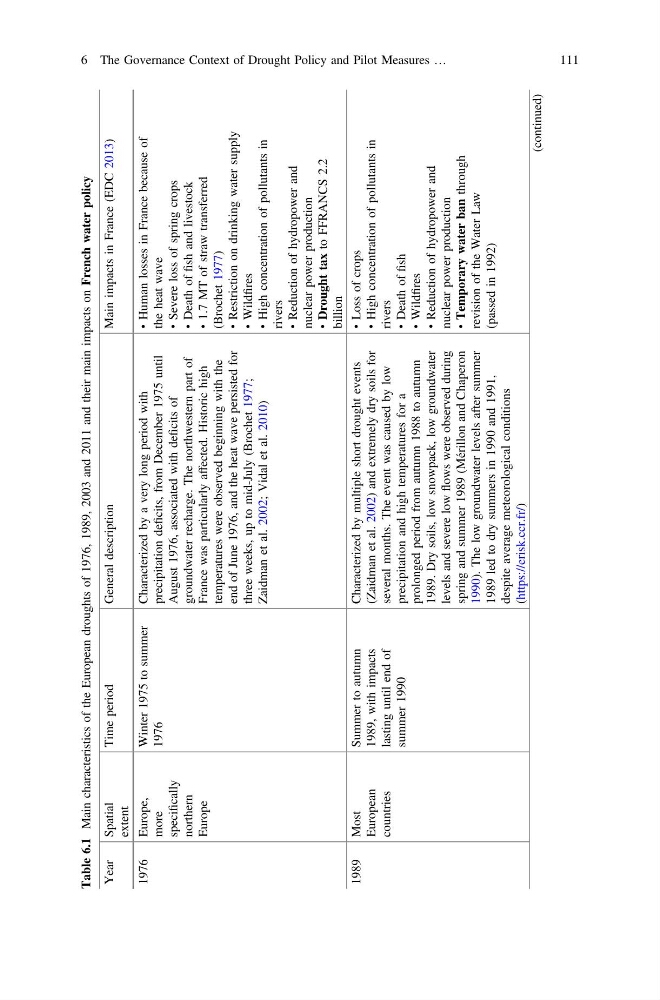
Table 6.1
Main characteristics of the European droughts of 1976, 1989, 2003 and 2011 and their main impacts on French water policy
Year
Spatial
extent
Time period
General description
Main impacts in France (EDC 2013)
1976
Europe,
more
specifically
northern
Europe
Winter 1975 to summer
1976
Characterized by a very long period with
precipitation deficits, from December 1975 until
August 1976, associated with deficits of
groundwater recharge. The northwestern part of
France was particularly affected. Historic high
temperatures were observed beginning with the
end of June 1976, and the heat wave persisted for
three weeks, up to mid-July (Brochet 1977;
Zaidman et al. 2002; Vidal et al. 2010)
• Human losses in France because of
the heat wave
• Severe loss of spring crops
• Death of
fish and livestock
• 1.7 MT of straw transferred
(Brochet 1977)
• Restriction on drinking water supply
• Wildfires
• High concentration of pollutants in
rivers
• Reduction of hydropower and
nuclear power production
• Drought tax
to FFRANCS 2.2
billion
1989
Most
European
countries
Summer to autumn
1989, with impacts
lasting until end of
summer 1990
Characterized by multiple short drought events
(Zaidman et al. 2002) and extremely dry soils for
several months. The event was caused by low
precipitation and high temperatures for a
prolonged period from autumn 1988 to autumn
1989. Dry soils, low snowpack, low groundwater
levels and severe low
flows were observed during
spring and summer 1989 (Mérillon and Chaperon
1990). The low groundwater levels after summer
1989 led to dry summers in 1990 and 1991,
despite average meteorological conditions
(https://erisk.ccr.fr/)
• Loss of crops
• High concentration of pollutants in
rivers
• Death of
fish
• Wildfires
• Reduction of hydropower and
nuclear power production
• Temporary water ban
through
revision of the Water Law
(passed in 1992)
(continued)
6 The Governance Context of Drought Policy and Pilot Measures …
111
Main characteristics of the European droughts of 1976, 1989, 2003 and 2011 and their main impacts on French water policy
Year
Spatial
extent
Time period
General description
Main impacts in France (EDC 2013)
1976
Europe,
more
specifically
northern
Europe
Winter 1975 to summer
1976
Characterized by a very long period with
precipitation deficits, from December 1975 until
August 1976, associated with deficits of
groundwater recharge. The northwestern part of
France was particularly affected. Historic high
temperatures were observed beginning with the
end of June 1976, and the heat wave persisted for
three weeks, up to mid-July (Brochet 1977;
Zaidman et al. 2002; Vidal et al. 2010)
• Human losses in France because of
the heat wave
• Severe loss of spring crops
• Death of
fish and livestock
• 1.7 MT of straw transferred
(Brochet 1977)
• Restriction on drinking water supply
• Wildfires
• High concentration of pollutants in
rivers
• Reduction of hydropower and
nuclear power production
• Drought tax
to FFRANCS 2.2
billion
1989
Most
European
countries
Summer to autumn
1989, with impacts
lasting until end of
summer 1990
Characterized by multiple short drought events
(Zaidman et al. 2002) and extremely dry soils for
several months. The event was caused by low
precipitation and high temperatures for a
prolonged period from autumn 1988 to autumn
1989. Dry soils, low snowpack, low groundwater
levels and severe low
flows were observed during
spring and summer 1989 (Mérillon and Chaperon
1990). The low groundwater levels after summer
1989 led to dry summers in 1990 and 1991,
despite average meteorological conditions
(https://erisk.ccr.fr/)
• Loss of crops
• High concentration of pollutants in
rivers
• Death of
fish
• Wildfires
• Reduction of hydropower and
nuclear power production
• Temporary water ban
through
revision of the Water Law
(passed in 1992)
(continued)
6 The Governance Context of Drought Policy and Pilot Measures …
111