

214
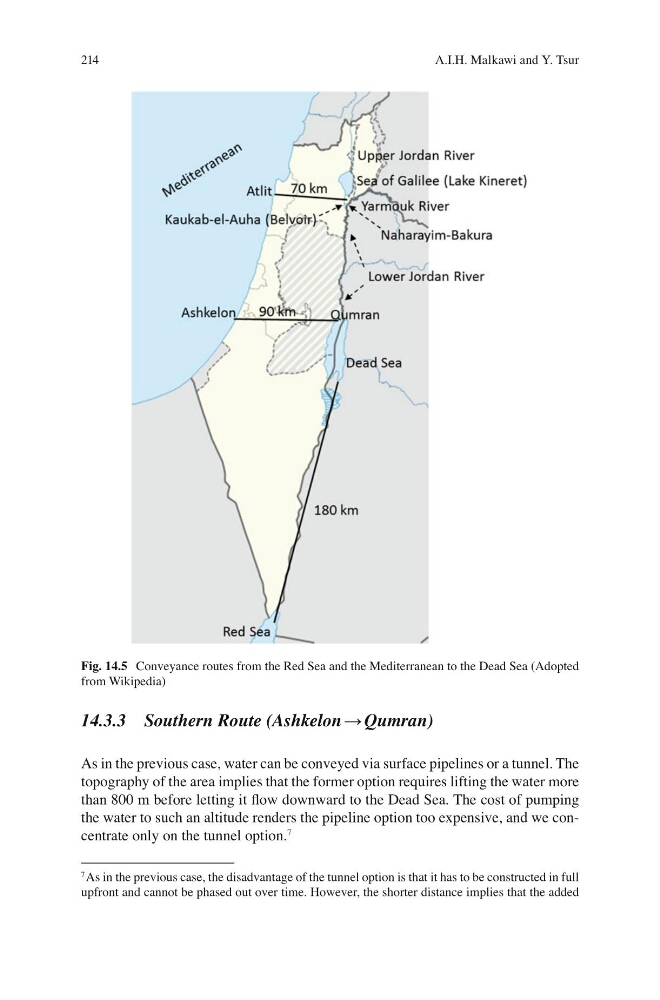
14.3.3 Southern Route (Ashkelon → Qumran)
As in the previous case, water can be conveyed via surface pipelines or a tunnel. The
topography of the area implies that the former option requires lifting the water more
than 800 m before letting it fl ow downward to the Dead Sea. The cost of pumping
the water to such an altitude renders the pipeline option too expensive, and we concentrate only on the tunnel option.
7
7 As in the previous case, the disadvantage of the tunnel option is that it has to be constructed in full
upfront and cannot be phased out over time. However, the shorter distance implies that the added
Fig. 14.5 Conveyance routes from the Red Sea and the Mediterranean to the Dead Sea (Adopted
from Wikipedia)
A.I.H. Malkawi and Y. Tsur
14.3.3 Southern Route (Ashkelon → Qumran)
As in the previous case, water can be conveyed via surface pipelines or a tunnel. The
topography of the area implies that the former option requires lifting the water more
than 800 m before letting it fl ow downward to the Dead Sea. The cost of pumping
the water to such an altitude renders the pipeline option too expensive, and we concentrate only on the tunnel option.
7
7 As in the previous case, the disadvantage of the tunnel option is that it has to be constructed in full
upfront and cannot be phased out over time. However, the shorter distance implies that the added
Fig. 14.5 Conveyance routes from the Red Sea and the Mediterranean to the Dead Sea (Adopted
from Wikipedia)
A.I.H. Malkawi and Y. Tsur