

212
tity of seawater–brine to be discharged in the Dead Sea after project completion.
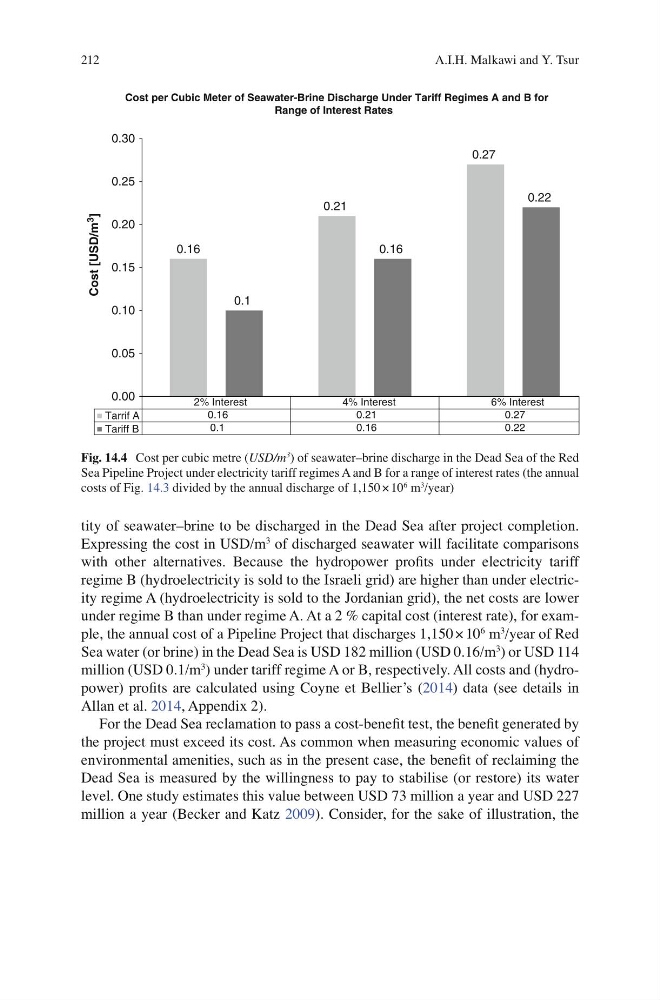
Expressing the cost in USD/m
3 of discharged seawater will facilitate comparisons
with other alternatives. Because the hydropower profi ts under electricity tariff
regime B (hydroelectricity is sold to the Israeli grid) are higher than under electricity regime A (hydroelectricity is sold to the Jordanian grid), the net costs are lower
under regime B than under regime A. At a 2 % capital cost (interest rate), for example, the annual cost of a Pipeline Project that discharges 1,150 × 10
6 m
3 /year of Red
Sea water (or brine) in the Dead Sea is USD 182 million (USD 0.16/m
3 ) or USD 114
million (USD 0.1/m
3 ) under tariff regime A or B, respectively. All costs and (hydropower) profi ts are calculated using Coyne et Bellier’s ( 2014 ) data (see details in
Allan et al. 2014 , Appendix 2).
For the Dead Sea reclamation to pass a cost-benefi t test, the benefi t generated by
the project must exceed its cost. As common when measuring economic values of
environmental amenities, such as in the present case, the benefi t of reclaiming the
Dead Sea is measured by the willingness to pay to stabilise (or restore) its water
level. One study estimates this value between USD 73 million a year and USD 227
million a year (Becker and Katz 2009 ). Consider, for the sake of illustration, the
2% Interest
4% Interest
6% Interest
Tarrif A
0.16
0.21
0.27
Tariff B
0.1
0.16
0.22
0.16
0.21
0.27
0.1
0.16
0.22
0.00
0.05
0.10
0.15
0.20
0.25
0.30
Cost [USD/m
3
]
Cost per Cubic Meter of Seawater-Brine Discharge Under Tariff Regimes A and B for
Range of Interest Rates
Fig. 14.4 Cost per cubic metre ( USD/m
3 ) of seawater–brine discharge in the Dead Sea of the Red
Sea Pipeline Project under electricity tariff regimes A and B for a range of interest rates (the annual
costs of Fig. 14.3 divided by the annual discharge of 1,150 × 10
6 m
3
/year)
A.I.H. Malkawi and Y. Tsur
tity of seawater–brine to be discharged in the Dead Sea after project completion.
Expressing the cost in USD/m
3 of discharged seawater will facilitate comparisons
with other alternatives. Because the hydropower profi ts under electricity tariff
regime B (hydroelectricity is sold to the Israeli grid) are higher than under electricity regime A (hydroelectricity is sold to the Jordanian grid), the net costs are lower
under regime B than under regime A. At a 2 % capital cost (interest rate), for example, the annual cost of a Pipeline Project that discharges 1,150 × 10
6 m
3 /year of Red
Sea water (or brine) in the Dead Sea is USD 182 million (USD 0.16/m
3 ) or USD 114
million (USD 0.1/m
3 ) under tariff regime A or B, respectively. All costs and (hydropower) profi ts are calculated using Coyne et Bellier’s ( 2014 ) data (see details in
Allan et al. 2014 , Appendix 2).
For the Dead Sea reclamation to pass a cost-benefi t test, the benefi t generated by
the project must exceed its cost. As common when measuring economic values of
environmental amenities, such as in the present case, the benefi t of reclaiming the
Dead Sea is measured by the willingness to pay to stabilise (or restore) its water
level. One study estimates this value between USD 73 million a year and USD 227
million a year (Becker and Katz 2009 ). Consider, for the sake of illustration, the
2% Interest
4% Interest
6% Interest
Tarrif A
0.16
0.21
0.27
Tariff B
0.1
0.16
0.22
0.16
0.21
0.27
0.1
0.16
0.22
0.00
0.05
0.10
0.15
0.20
0.25
0.30
Cost [USD/m
3
]
Cost per Cubic Meter of Seawater-Brine Discharge Under Tariff Regimes A and B for
Range of Interest Rates
Fig. 14.4 Cost per cubic metre ( USD/m
3 ) of seawater–brine discharge in the Dead Sea of the Red
Sea Pipeline Project under electricity tariff regimes A and B for a range of interest rates (the annual
costs of Fig. 14.3 divided by the annual discharge of 1,150 × 10
6 m
3
/year)
A.I.H. Malkawi and Y. Tsur