

194
In 2007, groundwater has been the most important source of water uses in the
Lower Jordan Basin. The total water abstraction for 2007 summed up to about
3131 × 10
6 m
3 . Israel released around 234 × 10
6 m
3 after use to the subsurface of
which 88 × 10
6 m
3 is lost due to leakages. Jordan released around 55 × 10
6 m
3 to
the subsurface with the share of losses probably being much higher as the unaccounted water in the municipals, which is around 50 % (Jordan Ministry for Water
and Irrigation 2009 ) and 30 % for the Palestine territories (Palestinian Water
Authority 2012 ).
13.1.2 Water Balance
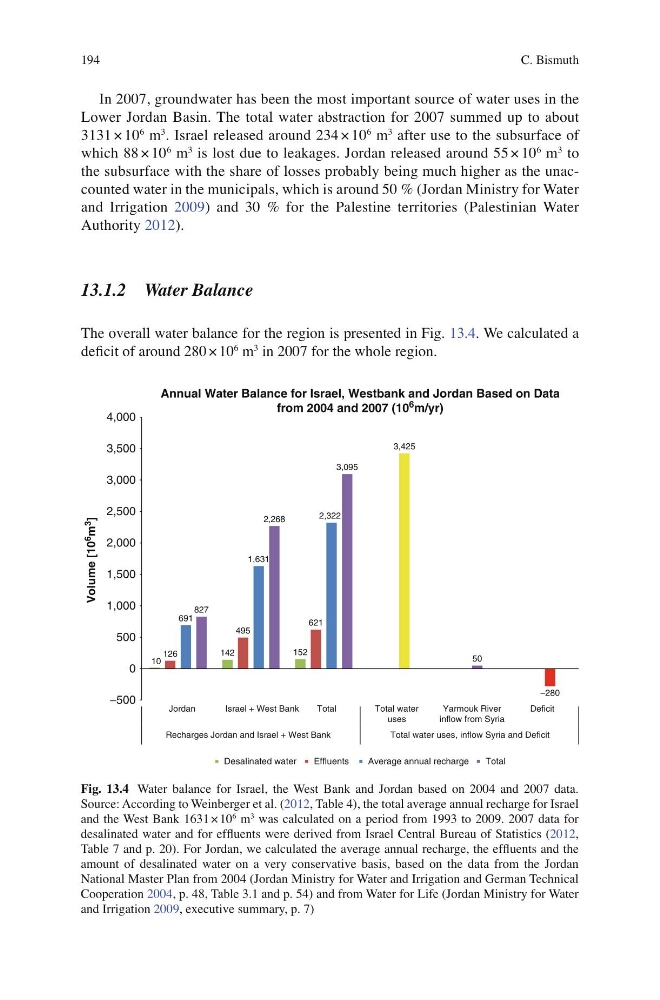
The overall water balance for the region is presented in Fig. 13.4 . We calculated a
defi cit of around 280 × 10
6 m
3 in 2007 for the whole region.
10
142
152
126
495
621
691
1,631
2,322
3,425
50
−280
827
2,268
3,095
−500
0
500
1,000
1,500
2,000
2,500
3,000
3,500
4,000
Jordan
Israel + West Bank
Total
Total water
uses
Yarmouk River
inflow from Syria
Deficit
Recharges Jordan and Israel + West Bank
Total water uses, inflow Syria and Deficit
Volume [10
6
m
3
]
Desalinated water
Effluents
Average annual recharge
Total
Annual Water Balance for Israel, Westbank and Jordan Based on Data
from 2004 and 2007 (10 6 m/yr)
Fig. 13.4 Water balance for Israel, the West Bank and Jordan based on 2004 and 2007 data.
Source: According to Weinberger et al. ( 2012 , Table 4), the total average annual recharge for Israel
and the West Bank 1631 × 10
6 m
3 was calculated on a period from 1993 to 2009. 2007 data for
desalinated water and for effl uents were derived from Israel Central Bureau of Statistics ( 2012 ,
Table 7 and p. 20). For Jordan, we calculated the average annual recharge, the effl uents and the
amount of desalinated water on a very conservative basis, based on the data from the Jordan
National Master Plan from 2004 (Jordan Ministry for Water and Irrigation and German Technical
Cooperation 2004 , p. 48, Table 3.1 and p. 54) and from Water for Life (Jordan Ministry for Water
and Irrigation 2009 , executive summary, p. 7)
C. Bismuth
In 2007, groundwater has been the most important source of water uses in the
Lower Jordan Basin. The total water abstraction for 2007 summed up to about
3131 × 10
6 m
3 . Israel released around 234 × 10
6 m
3 after use to the subsurface of
which 88 × 10
6 m
3 is lost due to leakages. Jordan released around 55 × 10
6 m
3 to
the subsurface with the share of losses probably being much higher as the unaccounted water in the municipals, which is around 50 % (Jordan Ministry for Water
and Irrigation 2009 ) and 30 % for the Palestine territories (Palestinian Water
Authority 2012 ).
13.1.2 Water Balance
The overall water balance for the region is presented in Fig. 13.4 . We calculated a
defi cit of around 280 × 10
6 m
3 in 2007 for the whole region.
10
142
152
126
495
621
691
1,631
2,322
3,425
50
−280
827
2,268
3,095
−500
0
500
1,000
1,500
2,000
2,500
3,000
3,500
4,000
Jordan
Israel + West Bank
Total
Total water
uses
Yarmouk River
inflow from Syria
Deficit
Recharges Jordan and Israel + West Bank
Total water uses, inflow Syria and Deficit
Volume [10
6
m
3
]
Desalinated water
Effluents
Average annual recharge
Total
Annual Water Balance for Israel, Westbank and Jordan Based on Data
from 2004 and 2007 (10 6 m/yr)
Fig. 13.4 Water balance for Israel, the West Bank and Jordan based on 2004 and 2007 data.
Source: According to Weinberger et al. ( 2012 , Table 4), the total average annual recharge for Israel
and the West Bank 1631 × 10
6 m
3 was calculated on a period from 1993 to 2009. 2007 data for
desalinated water and for effl uents were derived from Israel Central Bureau of Statistics ( 2012 ,
Table 7 and p. 20). For Jordan, we calculated the average annual recharge, the effl uents and the
amount of desalinated water on a very conservative basis, based on the data from the Jordan
National Master Plan from 2004 (Jordan Ministry for Water and Irrigation and German Technical
Cooperation 2004 , p. 48, Table 3.1 and p. 54) and from Water for Life (Jordan Ministry for Water
and Irrigation 2009 , executive summary, p. 7)
C. Bismuth