

179
sector. Instead of paying for water, farmers receive signifi cant subsidies for water
irrigation. “The obtainment of free inputs is an implicit side-payment from the state
to the farmers that allows them to use water for other purposes […] [F]armers have
few incentives to conserve water” (Weinthal 2006 , p. 22). Although water scarcity
has increased dramatically in the region over the last 25 years, this tendency to
favour agriculture has not been overcome to this day.
3
A further element that aggravates these tendencies even further can be seen in
the fact that water management issues in Central Asia have been focused on supplyside management measures to date. The history of water management in Russian
times and later in the Soviet era of Central Asia is part of the “heroic history of
irrigation engineering” (Abdullaev and Atabaeva 2012 , p. 105). All water-related
problems were considered as technical problems to be solved with the assistance of
large- scale technical solutions. Thus, the notion of steering demand by changing
3 It should be noted here that this is similar to many other countries where a felt need to protect the
agricultural sector can be observed. See, for example, the reference to Israel in this volume where
the authors state that the concern to protect the agricultural sector is “deeply rooted in the Zionist
movement” (Bismuth et al. 2015 , in this volume, pp. 253–275). Similarly, in Germany, the water
extraction charge (Wasserpfennig or Wasserentnahmeentgelt) , which is levied in some German
states, must be paid by water users – and not (!) by the agricultural sector. Instead, the revenues are
used to compensate farmers for income losses due to reduced use of nitrogen and fertilisers in
water protection areas. The polluter pays principle is thus reversed.
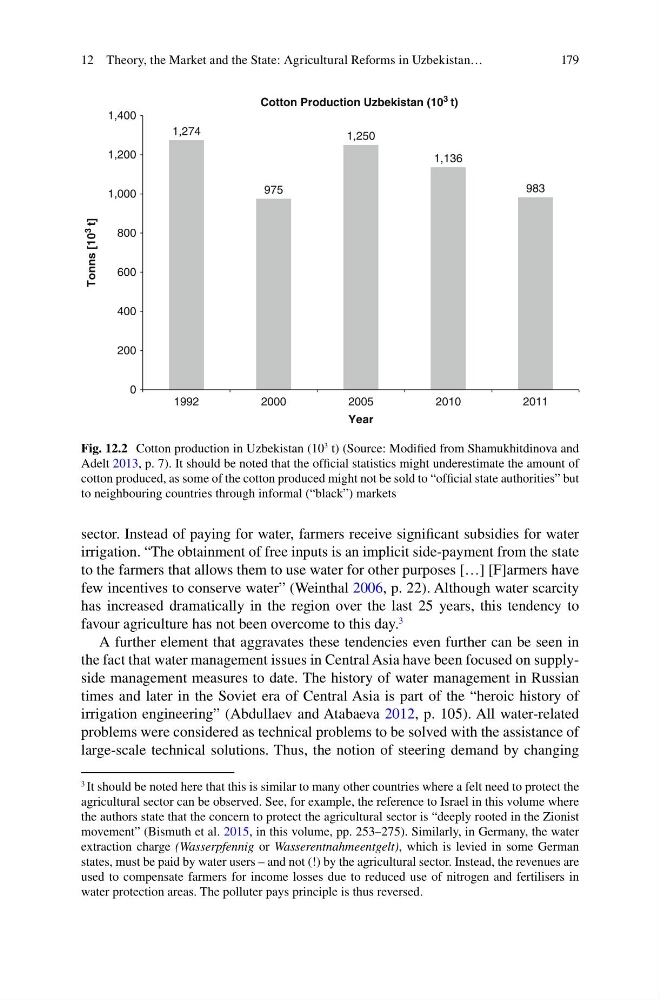
1,274
975
1,250
1,136
983
0
200
400
600
800
1,000
1,200
1,400
1992
2000
2005
2010
2011
Tonns [10 3
t]
Year
Cotton Production Uzbekistan (10 3 t)
Fig. 12.2 Cotton production in Uzbekistan (10
3 t) (Source: Modifi ed from Shamukhitdinova and
Adelt 2013 , p. 7). It should be noted that the offi cial statistics might underestimate the amount of
cotton produced, as some of the cotton produced might not be sold to “offi cial state authorities” but
to neighbouring countries through informal (“black”) markets
12 Theory, the Market and the State: Agricultural Reforms in Uzbekistan…
sector. Instead of paying for water, farmers receive signifi cant subsidies for water
irrigation. “The obtainment of free inputs is an implicit side-payment from the state
to the farmers that allows them to use water for other purposes […] [F]armers have
few incentives to conserve water” (Weinthal 2006 , p. 22). Although water scarcity
has increased dramatically in the region over the last 25 years, this tendency to
favour agriculture has not been overcome to this day.
3
A further element that aggravates these tendencies even further can be seen in
the fact that water management issues in Central Asia have been focused on supplyside management measures to date. The history of water management in Russian
times and later in the Soviet era of Central Asia is part of the “heroic history of
irrigation engineering” (Abdullaev and Atabaeva 2012 , p. 105). All water-related
problems were considered as technical problems to be solved with the assistance of
large- scale technical solutions. Thus, the notion of steering demand by changing
3 It should be noted here that this is similar to many other countries where a felt need to protect the
agricultural sector can be observed. See, for example, the reference to Israel in this volume where
the authors state that the concern to protect the agricultural sector is “deeply rooted in the Zionist
movement” (Bismuth et al. 2015 , in this volume, pp. 253–275). Similarly, in Germany, the water
extraction charge (Wasserpfennig or Wasserentnahmeentgelt) , which is levied in some German
states, must be paid by water users – and not (!) by the agricultural sector. Instead, the revenues are
used to compensate farmers for income losses due to reduced use of nitrogen and fertilisers in
water protection areas. The polluter pays principle is thus reversed.
1,274
975
1,250
1,136
983
0
200
400
600
800
1,000
1,200
1,400
1992
2000
2005
2010
2011
Tonns [10 3
t]
Year
Cotton Production Uzbekistan (10 3 t)
Fig. 12.2 Cotton production in Uzbekistan (10
3 t) (Source: Modifi ed from Shamukhitdinova and
Adelt 2013 , p. 7). It should be noted that the offi cial statistics might underestimate the amount of
cotton produced, as some of the cotton produced might not be sold to “offi cial state authorities” but
to neighbouring countries through informal (“black”) markets
12 Theory, the Market and the State: Agricultural Reforms in Uzbekistan…