

156
11.2.4 Current Status of WUAs
By the end of 2013, 1510 WUAs had been established in Uzbekistan, serving nearly
57,000 individual farmers and covering about 4.2 million ha (MAWR RUz 2014 ).
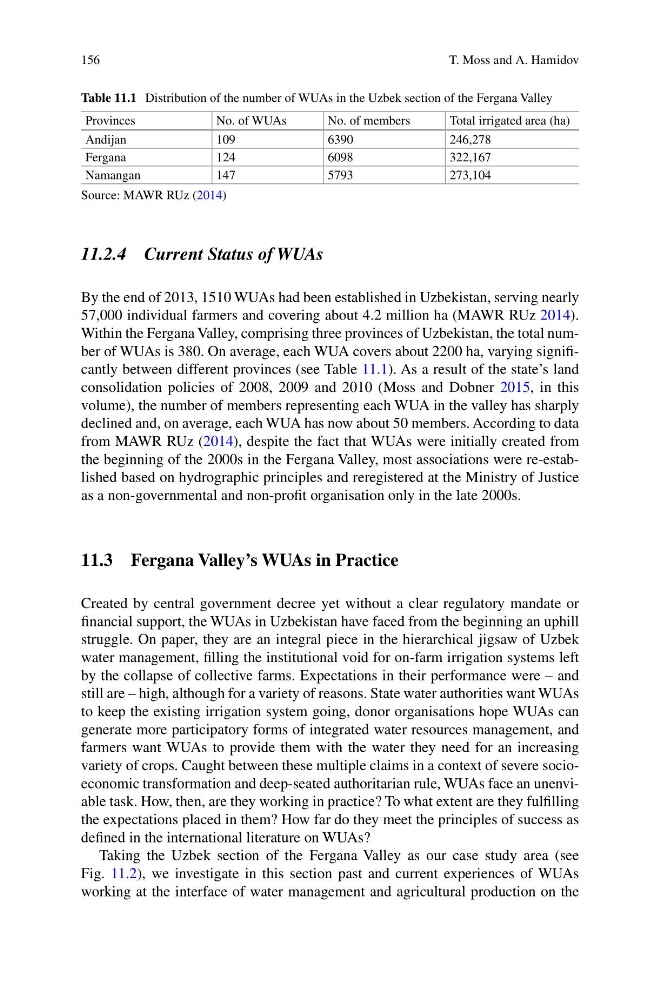
Within the Fergana Valley, comprising three provinces of Uzbekistan, the total number of WUAs is 380. On average, each WUA covers about 2200 ha, varying signifi -
cantly between different provinces (see Table 11.1 ). As a result of the state’s land
consolidation policies of 2008, 2009 and 2010 (Moss and Dobner 2015 , in this
volume), the number of members representing each WUA in the valley has sharply
declined and, on average, each WUA has now about 50 members. According to data
from MAWR RUz ( 2014 ), despite the fact that WUAs were initially created from
the beginning of the 2000s in the Fergana Valley, most associations were re-established based on hydrographic principles and reregistered at the Ministry of Justice
as a non-governmental and non-profi t organisation only in the late 2000s.
11.3 Fergana Valley’s WUAs in Practice
Created by central government decree yet without a clear regulatory mandate or
fi nancial support, the WUAs in Uzbekistan have faced from the beginning an uphill
struggle. On paper, they are an integral piece in the hierarchical jigsaw of Uzbek
water management, fi lling the institutional void for on-farm irrigation systems left
by the collapse of collective farms. Expectations in their performance were – and
still are – high, although for a variety of reasons. State water authorities want WUAs
to keep the existing irrigation system going, donor organisations hope WUAs can
generate more participatory forms of integrated water resources management, and
farmers want WUAs to provide them with the water they need for an increasing
variety of crops. Caught between these multiple claims in a context of severe socioeconomic transformation and deep-seated authoritarian rule, WUAs face an unenviable task. How, then, are they working in practice? To what extent are they fulfi lling
the expectations placed in them? How far do they meet the principles of success as
defi ned in the international literature on WUAs?
Taking the Uzbek section of the Fergana Valley as our case study area (see
Fig. 11.2 ), we investigate in this section past and current experiences of WUAs
working at the interface of water management and agricultural production on the
Table 11.1 Distribution of the number of WUAs in the Uzbek section of the Fergana Valley
Provinces
No. of WUAs
No. of members
Total irrigated area (ha)
Andijan
109
6390
246,278
Fergana
124
6098
322,167
Namangan
147
5793
273,104
Source: MAWR RUz ( 2014 )
T. Moss and A. Hamidov
11.2.4 Current Status of WUAs
By the end of 2013, 1510 WUAs had been established in Uzbekistan, serving nearly
57,000 individual farmers and covering about 4.2 million ha (MAWR RUz 2014 ).
Within the Fergana Valley, comprising three provinces of Uzbekistan, the total number of WUAs is 380. On average, each WUA covers about 2200 ha, varying signifi -
cantly between different provinces (see Table 11.1 ). As a result of the state’s land
consolidation policies of 2008, 2009 and 2010 (Moss and Dobner 2015 , in this
volume), the number of members representing each WUA in the valley has sharply
declined and, on average, each WUA has now about 50 members. According to data
from MAWR RUz ( 2014 ), despite the fact that WUAs were initially created from
the beginning of the 2000s in the Fergana Valley, most associations were re-established based on hydrographic principles and reregistered at the Ministry of Justice
as a non-governmental and non-profi t organisation only in the late 2000s.
11.3 Fergana Valley’s WUAs in Practice
Created by central government decree yet without a clear regulatory mandate or
fi nancial support, the WUAs in Uzbekistan have faced from the beginning an uphill
struggle. On paper, they are an integral piece in the hierarchical jigsaw of Uzbek
water management, fi lling the institutional void for on-farm irrigation systems left
by the collapse of collective farms. Expectations in their performance were – and
still are – high, although for a variety of reasons. State water authorities want WUAs
to keep the existing irrigation system going, donor organisations hope WUAs can
generate more participatory forms of integrated water resources management, and
farmers want WUAs to provide them with the water they need for an increasing
variety of crops. Caught between these multiple claims in a context of severe socioeconomic transformation and deep-seated authoritarian rule, WUAs face an unenviable task. How, then, are they working in practice? To what extent are they fulfi lling
the expectations placed in them? How far do they meet the principles of success as
defi ned in the international literature on WUAs?
Taking the Uzbek section of the Fergana Valley as our case study area (see
Fig. 11.2 ), we investigate in this section past and current experiences of WUAs
working at the interface of water management and agricultural production on the
Table 11.1 Distribution of the number of WUAs in the Uzbek section of the Fergana Valley
Provinces
No. of WUAs
No. of members
Total irrigated area (ha)
Andijan
109
6390
246,278
Fergana
124
6098
322,167
Namangan
147
5793
273,104
Source: MAWR RUz ( 2014 )
T. Moss and A. Hamidov