

154
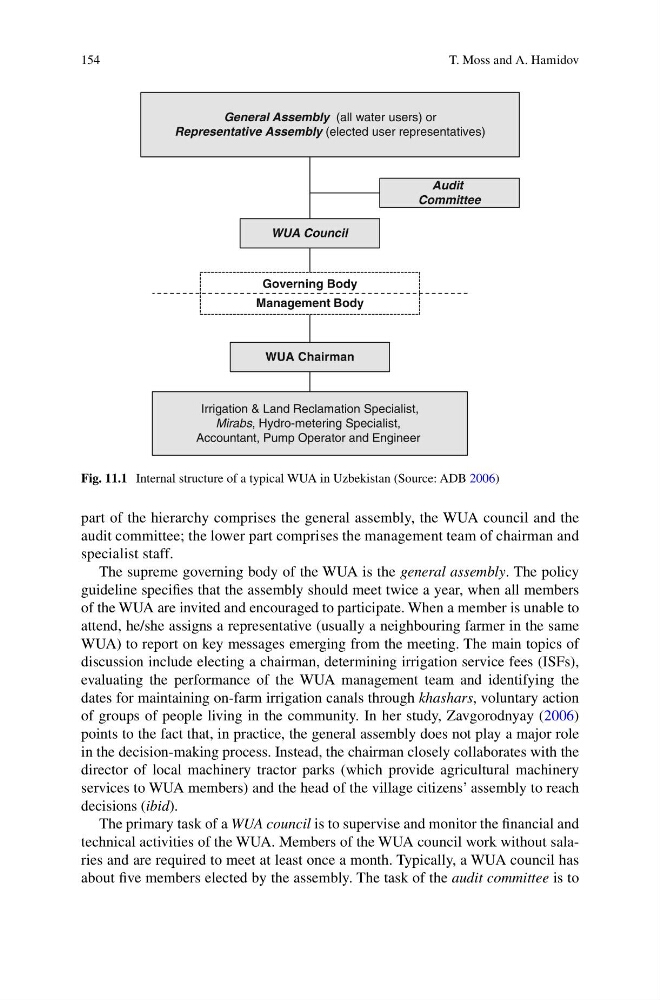
part of the hierarchy comprises the general assembly, the WUA council and the
audit committee; the lower part comprises the management team of chairman and
specialist staff.
The supreme governing body of the WUA is the general assembly . The policy
guideline specifi es that the assembly should meet twice a year, when all members
of the WUA are invited and encouraged to participate. When a member is unable to
attend, he/she assigns a representative (usually a neighbouring farmer in the same
WUA) to report on key messages emerging from the meeting. The main topics of
discussion include electing a chairman, determining irrigation service fees (ISFs),
evaluating the performance of the WUA management team and identifying the
dates for maintaining on-farm irrigation canals through khashars , voluntary action
of groups of people living in the community. In her study, Zavgorodnyay ( 2006 )
points to the fact that, in practice, the general assembly does not play a major role
in the decision-making process. Instead, the chairman closely collaborates with the
director of local machinery tractor parks (which provide agricultural machinery
services to WUA members) and the head of the village citizens’ assembly to reach
decisions ( ibid ).
The primary task of a WUA council is to supervise and monitor the fi nancial and
technical activities of the WUA. Members of the WUA council work without salaries and are required to meet at least once a month. Typically, a WUA council has
about fi ve members elected by the assembly. The task of the audit committee is to
General Assembly (all water users) or
Representative Assembly (elected user representatives)
Audit
Committee
WUA Council
Governing Body
Management Body
WUA Chairman
Irrigation & Land Reclamation Specialist,
Mirabs, Hydro-metering Specialist,
Accountant, Pump Operator and Engineer
Fig. 11.1 Internal structure of a typical WUA in Uzbekistan (Source: ADB 2006 )
T. Moss and A. Hamidov
part of the hierarchy comprises the general assembly, the WUA council and the
audit committee; the lower part comprises the management team of chairman and
specialist staff.
The supreme governing body of the WUA is the general assembly . The policy
guideline specifi es that the assembly should meet twice a year, when all members
of the WUA are invited and encouraged to participate. When a member is unable to
attend, he/she assigns a representative (usually a neighbouring farmer in the same
WUA) to report on key messages emerging from the meeting. The main topics of
discussion include electing a chairman, determining irrigation service fees (ISFs),
evaluating the performance of the WUA management team and identifying the
dates for maintaining on-farm irrigation canals through khashars , voluntary action
of groups of people living in the community. In her study, Zavgorodnyay ( 2006 )
points to the fact that, in practice, the general assembly does not play a major role
in the decision-making process. Instead, the chairman closely collaborates with the
director of local machinery tractor parks (which provide agricultural machinery
services to WUA members) and the head of the village citizens’ assembly to reach
decisions ( ibid ).
The primary task of a WUA council is to supervise and monitor the fi nancial and
technical activities of the WUA. Members of the WUA council work without salaries and are required to meet at least once a month. Typically, a WUA council has
about fi ve members elected by the assembly. The task of the audit committee is to
General Assembly (all water users) or
Representative Assembly (elected user representatives)
Audit
Committee
WUA Council
Governing Body
Management Body
WUA Chairman
Irrigation & Land Reclamation Specialist,
Mirabs, Hydro-metering Specialist,
Accountant, Pump Operator and Engineer
Fig. 11.1 Internal structure of a typical WUA in Uzbekistan (Source: ADB 2006 )
T. Moss and A. Hamidov