

132
10.2.2 Climate
The average air temperature in the valley is 13.1 °C, ranging from −8 °C to 3 °C in
winters (January) and 17 °C to 36 °C in summers (July). Annual precipitation ranges
from 109 to 502 mm, whereas evaporation ranges from 1133 to 1294 mm throughout the valley (Abdullaev et al. 2010 ; Reddy et al. 2012 ). The limited precipitation
on the lowland plain coupled with high temperatures, low humidity and high degree
of solar radiation causes a greater level of potential evapotranspiration. A steady
transfer of air temperature from 0 °C starts in the second half of February. This is
the time when the early fruit, such as apricot and almond, growing period begins.
The autumn transfer from 0 °C is observed in the second half of December. The
duration of the period with T ≥ 0 °C is 280–310 days per annum. When air temperature increases above 5 °C, the renewal period of lucerne, grains (winter wheat) and
the majority of fruit plants and spring regrowth of pasture grasslands start. This
transfer of air temperature is favourable to sow cotton and summer corn. The period
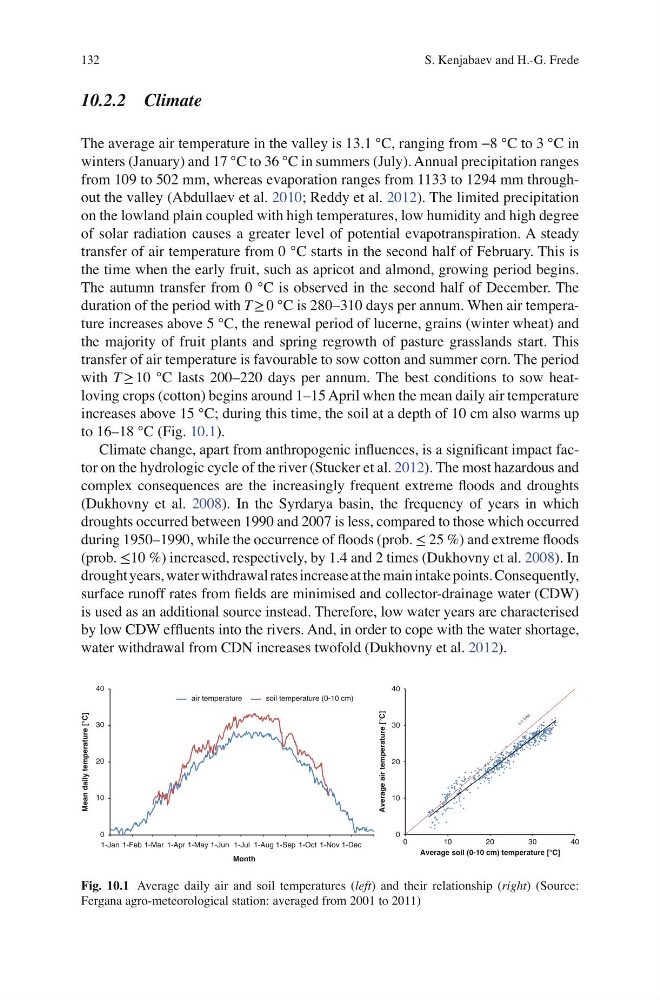
with T ≥ 10 °C lasts 200–220 days per annum. The best conditions to sow heatloving crops (cotton) begins around 1–15 April when the mean daily air temperature
increases above 15 °C; during this time, the soil at a depth of 10 cm also warms up
to 16–18 °C (Fig. 10.1 ).
Climate change, apart from anthropogenic infl uences, is a signifi cant impact factor on the hydrologic cycle of the river (Stucker et al. 2012 ). The most hazardous and
complex consequences are the increasingly frequent extreme fl oods and droughts
(Dukhovny et al. 2008 ). In the Syrdarya basin, the frequency of years in which
droughts occurred between 1990 and 2007 is less, compared to those which occurred
during 1950–1990, while the occurrence of fl oods (prob. ≤ 25 %) and extreme fl oods
(prob. ≤10 %) increased, respectively, by 1.4 and 2 times (Dukhovny et al. 2008 ). In
drought years, water withdrawal rates increase at the main intake points. Consequently,
surface runoff rates from fi elds are minimised and collector- drainage water (CDW)
is used as an additional source instead. Therefore, low water years are characterised
by low CDW effl uents into the rivers. And, in order to cope with the water shortage,
water withdrawal from CDN increases twofold (Dukhovny et al. 2012 ).
0
10
20
30
40
0
1 0
2 0
3 0
4 0
Average air temperature [°C]
0
10
20
30
40
1-Jan 1-Feb 1-Mar 1-Apr 1-May 1-Jun 1-Jul 1-Aug 1-Sep 1-Oct 1-Nov 1-Dec
Mean daily temperature [°C]
Month
air temperature
soil temperature (0-10 cm)
Average soil (0-10 cm) temperature [°C]
Fig. 10.1 Average daily air and soil temperatures ( left ) and their relationship ( right ) (Source:
Fergana agro-meteorological station: averaged from 2001 to 2011)
S. Kenjabaev and H.-G. Frede
10.2.2 Climate
The average air temperature in the valley is 13.1 °C, ranging from −8 °C to 3 °C in
winters (January) and 17 °C to 36 °C in summers (July). Annual precipitation ranges
from 109 to 502 mm, whereas evaporation ranges from 1133 to 1294 mm throughout the valley (Abdullaev et al. 2010 ; Reddy et al. 2012 ). The limited precipitation
on the lowland plain coupled with high temperatures, low humidity and high degree
of solar radiation causes a greater level of potential evapotranspiration. A steady
transfer of air temperature from 0 °C starts in the second half of February. This is
the time when the early fruit, such as apricot and almond, growing period begins.
The autumn transfer from 0 °C is observed in the second half of December. The
duration of the period with T ≥ 0 °C is 280–310 days per annum. When air temperature increases above 5 °C, the renewal period of lucerne, grains (winter wheat) and
the majority of fruit plants and spring regrowth of pasture grasslands start. This
transfer of air temperature is favourable to sow cotton and summer corn. The period
with T ≥ 10 °C lasts 200–220 days per annum. The best conditions to sow heatloving crops (cotton) begins around 1–15 April when the mean daily air temperature
increases above 15 °C; during this time, the soil at a depth of 10 cm also warms up
to 16–18 °C (Fig. 10.1 ).
Climate change, apart from anthropogenic infl uences, is a signifi cant impact factor on the hydrologic cycle of the river (Stucker et al. 2012 ). The most hazardous and
complex consequences are the increasingly frequent extreme fl oods and droughts
(Dukhovny et al. 2008 ). In the Syrdarya basin, the frequency of years in which
droughts occurred between 1990 and 2007 is less, compared to those which occurred
during 1950–1990, while the occurrence of fl oods (prob. ≤ 25 %) and extreme fl oods
(prob. ≤10 %) increased, respectively, by 1.4 and 2 times (Dukhovny et al. 2008 ). In
drought years, water withdrawal rates increase at the main intake points. Consequently,
surface runoff rates from fi elds are minimised and collector- drainage water (CDW)
is used as an additional source instead. Therefore, low water years are characterised
by low CDW effl uents into the rivers. And, in order to cope with the water shortage,
water withdrawal from CDN increases twofold (Dukhovny et al. 2012 ).
0
10
20
30
40
0
1 0
2 0
3 0
4 0
Average air temperature [°C]
0
10
20
30
40
1-Jan 1-Feb 1-Mar 1-Apr 1-May 1-Jun 1-Jul 1-Aug 1-Sep 1-Oct 1-Nov 1-Dec
Mean daily temperature [°C]
Month
air temperature
soil temperature (0-10 cm)
Average soil (0-10 cm) temperature [°C]
Fig. 10.1 Average daily air and soil temperatures ( left ) and their relationship ( right ) (Source:
Fergana agro-meteorological station: averaged from 2001 to 2011)
S. Kenjabaev and H.-G. Frede