

is burned for electricity production in LWRs and FRs whereas the minor actinides
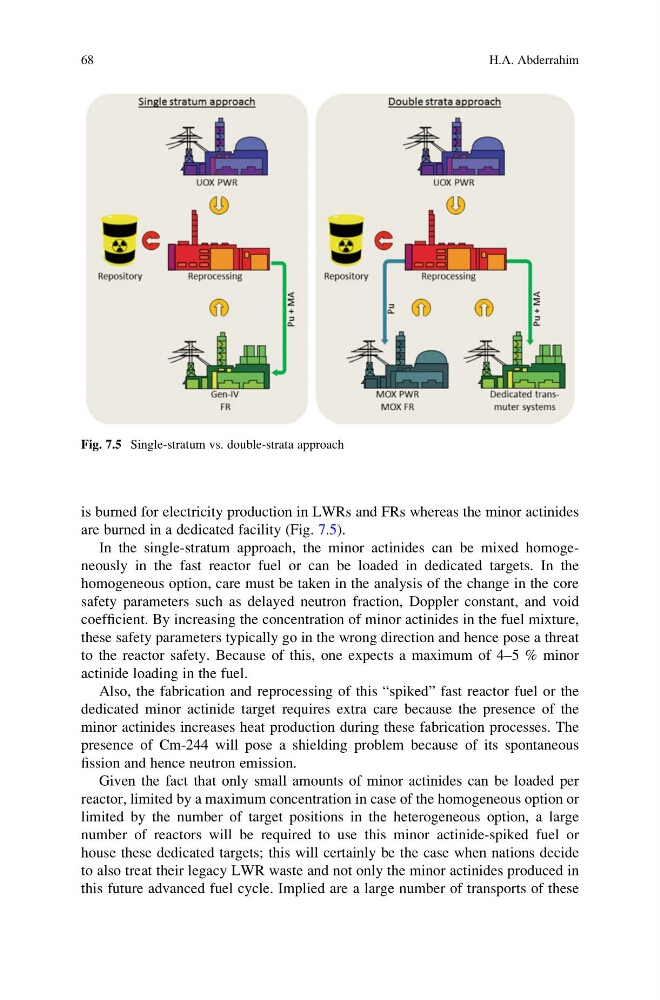
are burned in a dedicated facility (Fig. 7.5).
In the single-stratum approach, the minor actinides can be mixed homogeneously in the fast reactor fuel or can be loaded in dedicated targets. In the
homogeneous option, care must be taken in the analysis of the change in the core
safety parameters such as delayed neutron fraction, Doppler constant, and void
coefficient. By increasing the concentration of minor actinides in the fuel mixture,
these safety parameters typically go in the wrong direction and hence pose a threat
to the reactor safety. Because of this, one expects a maximum of 4–5 % minor
actinide loading in the fuel.
Also, the fabrication and reprocessing of this “spiked” fast reactor fuel or the
dedicated minor actinide target requires extra care because the presence of the
minor actinides increases heat production during these fabrication processes. The
presence of Cm-244 will pose a shielding problem because of its spontaneous
fission and hence neutron emission.
Given the fact that only small amounts of minor actinides can be loaded per
reactor, limited by a maximum concentration in case of the homogeneous option or
limited by the number of target positions in the heterogeneous option, a large
number of reactors will be required to use this minor actinide-spiked fuel or
house these dedicated targets; this will certainly be the case when nations decide
to also treat their legacy LWR waste and not only the minor actinides produced in
this future advanced fuel cycle. Implied are a large number of transports of these
Fig. 7.5 Single-stratum vs. double-strata approach
68
H.A. Abderrahim
are burned in a dedicated facility (Fig. 7.5).
In the single-stratum approach, the minor actinides can be mixed homogeneously in the fast reactor fuel or can be loaded in dedicated targets. In the
homogeneous option, care must be taken in the analysis of the change in the core
safety parameters such as delayed neutron fraction, Doppler constant, and void
coefficient. By increasing the concentration of minor actinides in the fuel mixture,
these safety parameters typically go in the wrong direction and hence pose a threat
to the reactor safety. Because of this, one expects a maximum of 4–5 % minor
actinide loading in the fuel.
Also, the fabrication and reprocessing of this “spiked” fast reactor fuel or the
dedicated minor actinide target requires extra care because the presence of the
minor actinides increases heat production during these fabrication processes. The
presence of Cm-244 will pose a shielding problem because of its spontaneous
fission and hence neutron emission.
Given the fact that only small amounts of minor actinides can be loaded per
reactor, limited by a maximum concentration in case of the homogeneous option or
limited by the number of target positions in the heterogeneous option, a large
number of reactors will be required to use this minor actinide-spiked fuel or
house these dedicated targets; this will certainly be the case when nations decide
to also treat their legacy LWR waste and not only the minor actinides produced in
this future advanced fuel cycle. Implied are a large number of transports of these
Fig. 7.5 Single-stratum vs. double-strata approach
68
H.A. Abderrahim