

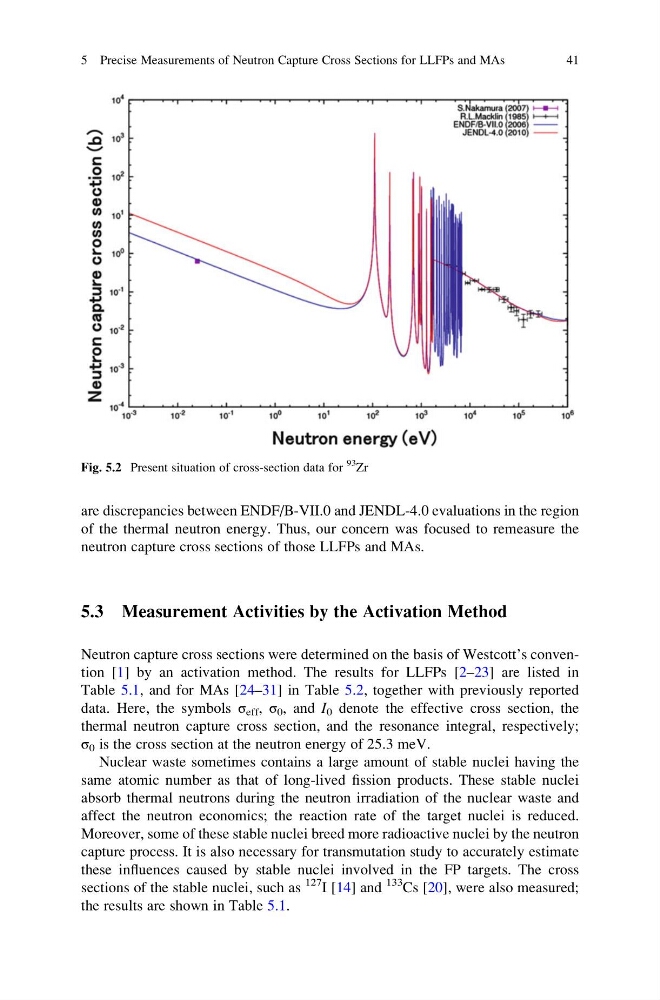
are discrepancies between ENDF/B-VII.0 and JENDL-4.0 evaluations in the region
of the thermal neutron energy. Thus, our concern was focused to remeasure the
neutron capture cross sections of those LLFPs and MAs.
5.3 Measurement Activities by the Activation Method
Neutron capture cross sections were determined on the basis of Westcott’s convention [1] by an activation method. The results for LLFPs [2–23] are listed in
Table 5.1, and for MAs [24–31] in Table 5.2, together with previously reported
data. Here, the symbols σ eff , σ 0 , and I 0 denote the effective cross section, the
thermal neutron capture cross section, and the resonance integral, respectively;
σ 0 is the cross section at the neutron energy of 25.3 meV.
Nuclear waste sometimes contains a large amount of stable nuclei having the
same atomic number as that of long-lived fission products. These stable nuclei
absorb thermal neutrons during the neutron irradiation of the nuclear waste and
affect the neutron economics; the reaction rate of the target nuclei is reduced.
Moreover, some of these stable nuclei breed more radioactive nuclei by the neutron
capture process. It is also necessary for transmutation study to accurately estimate
these influences caused by stable nuclei involved in the FP targets. The cross
sections of the stable nuclei, such as
127 I [14] and
133
Cs [20], were also measured;
the results are shown in Table 5.1.
Fig. 5.2 Present situation of cross-section data for
93
Zr
5 Precise Measurements of Neutron Capture Cross Sections for LLFPs and MAs
41
of the thermal neutron energy. Thus, our concern was focused to remeasure the
neutron capture cross sections of those LLFPs and MAs.
5.3 Measurement Activities by the Activation Method
Neutron capture cross sections were determined on the basis of Westcott’s convention [1] by an activation method. The results for LLFPs [2–23] are listed in
Table 5.1, and for MAs [24–31] in Table 5.2, together with previously reported
data. Here, the symbols σ eff , σ 0 , and I 0 denote the effective cross section, the
thermal neutron capture cross section, and the resonance integral, respectively;
σ 0 is the cross section at the neutron energy of 25.3 meV.
Nuclear waste sometimes contains a large amount of stable nuclei having the
same atomic number as that of long-lived fission products. These stable nuclei
absorb thermal neutrons during the neutron irradiation of the nuclear waste and
affect the neutron economics; the reaction rate of the target nuclei is reduced.
Moreover, some of these stable nuclei breed more radioactive nuclei by the neutron
capture process. It is also necessary for transmutation study to accurately estimate
these influences caused by stable nuclei involved in the FP targets. The cross
sections of the stable nuclei, such as
127 I [14] and
133
Cs [20], were also measured;
the results are shown in Table 5.1.
Fig. 5.2 Present situation of cross-section data for
93
Zr
5 Precise Measurements of Neutron Capture Cross Sections for LLFPs and MAs
41