

5.1 Introduction
Associated with the social acceptability of nuclear power reactors, it is desirable to
solve the problems of nuclear waste management of the long-lived fission products
(LLFPs) and minor actinides (MAs) existing in spent nuclear fuels. A method of
nuclear transmutation seems to be one of the solutions to reduce the radiotoxicity of
nuclear wastes. The transmutation method makes it possible to reduce both the size
of a repository for packages of nuclear wastes and the storage risks for the long
term. To evaluate the feasibility of development of the nuclear transmutation
method, precise nuclear data of neutron capture cross sections for LLFPs and
MAs are indispensable.
This chapter presents joint research activities by JAEA and universities for
measurements of the neutron capture cross sections for LLFPs and MAs by
activation and neutron time-of-flight (TOF) methods.
5.2 Present Situation of Data for LLFPs and MAs
Although accurate data of neutron capture cross sections are necessary to evaluate
reaction rates and burn-up times, there are discrepancies among the reported data
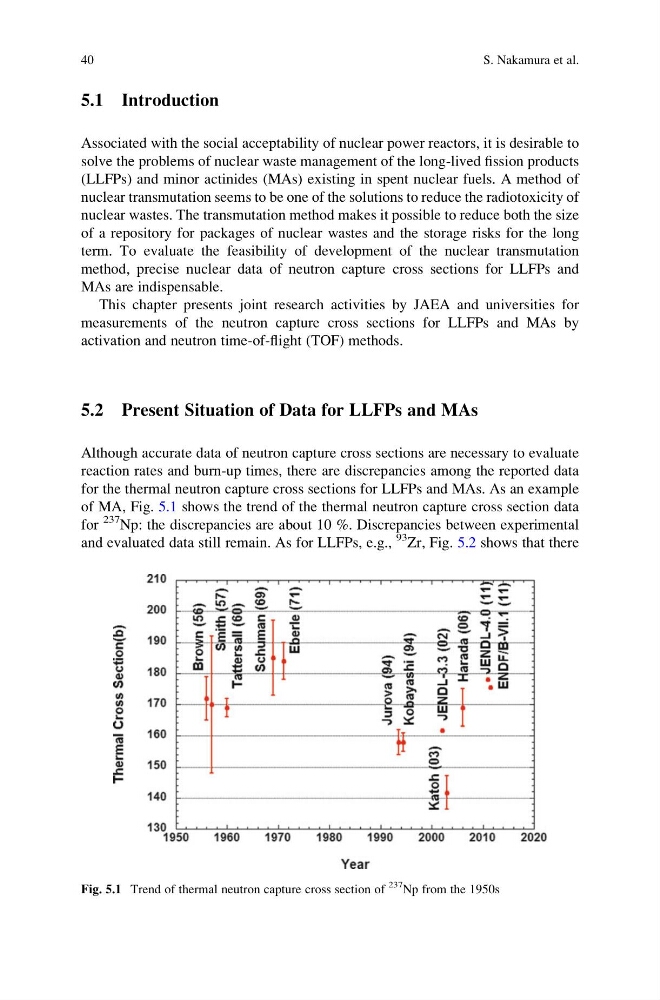
for the thermal neutron capture cross sections for LLFPs and MAs. As an example
of MA, Fig. 5.1 shows the trend of the thermal neutron capture cross section data
for
237 Np: the discrepancies are about 10 %. Discrepancies between experimental
and evaluated data still remain. As for LLFPs, e.g.,
93 Zr, Fig. 5.2 shows that there
Fig. 5.1 Trend of thermal neutron capture cross section of
237
Np from the 1950s
40
S. Nakamura et al.
Associated with the social acceptability of nuclear power reactors, it is desirable to
solve the problems of nuclear waste management of the long-lived fission products
(LLFPs) and minor actinides (MAs) existing in spent nuclear fuels. A method of
nuclear transmutation seems to be one of the solutions to reduce the radiotoxicity of
nuclear wastes. The transmutation method makes it possible to reduce both the size
of a repository for packages of nuclear wastes and the storage risks for the long
term. To evaluate the feasibility of development of the nuclear transmutation
method, precise nuclear data of neutron capture cross sections for LLFPs and
MAs are indispensable.
This chapter presents joint research activities by JAEA and universities for
measurements of the neutron capture cross sections for LLFPs and MAs by
activation and neutron time-of-flight (TOF) methods.
5.2 Present Situation of Data for LLFPs and MAs
Although accurate data of neutron capture cross sections are necessary to evaluate
reaction rates and burn-up times, there are discrepancies among the reported data
for the thermal neutron capture cross sections for LLFPs and MAs. As an example
of MA, Fig. 5.1 shows the trend of the thermal neutron capture cross section data
for
237 Np: the discrepancies are about 10 %. Discrepancies between experimental
and evaluated data still remain. As for LLFPs, e.g.,
93 Zr, Fig. 5.2 shows that there
Fig. 5.1 Trend of thermal neutron capture cross section of
237
Np from the 1950s
40
S. Nakamura et al.