

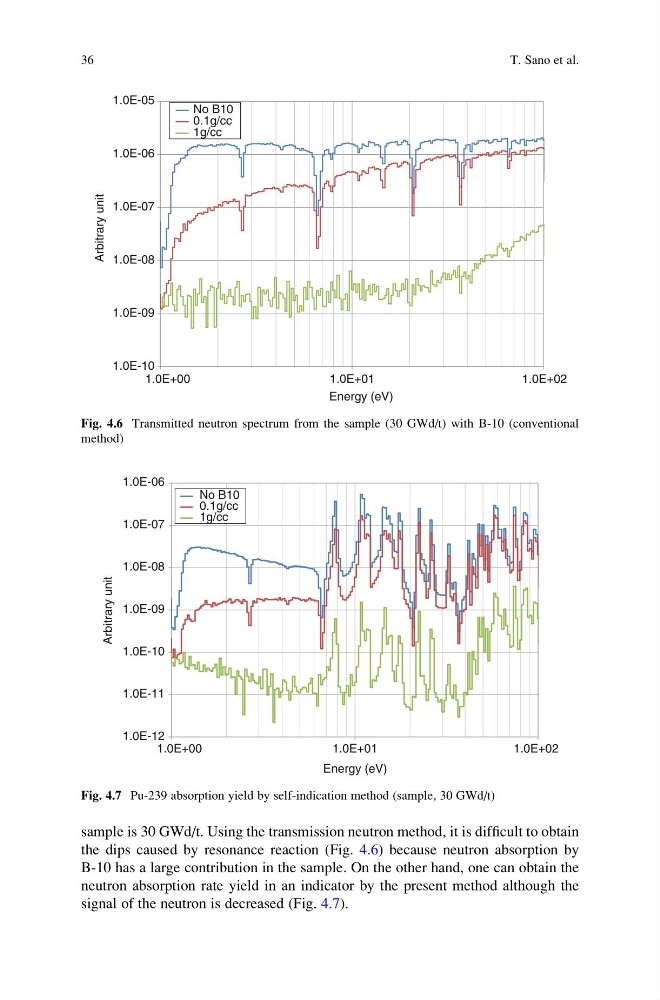
sample is 30 GWd/t. Using the transmission neutron method, it is difficult to obtain
the dips caused by resonance reaction (Fig. 4.6) because neutron absorption by
B-10 has a large contribution in the sample. On the other hand, one can obtain the
neutron absorption rate yield in an indicator by the present method although the
signal of the neutron is decreased (Fig. 4.7).
1.0E-10
1.0E-09
1.0E-08
1.0E-07
1.0E-06
1.0E-05
1.0E+00
1.0E+01
1.0E+02
Arbitrary unit
Energy (eV)
No B10
0.1g/cc
1g/cc
Fig. 4.6 Transmitted neutron spectrum from the sample (30 GWd/t) with B-10 (conventional
method)
1.0E-12
1.0E-11
1.0E-10
1.0E-09
1.0E-08
1.0E-07
1.0E-06
1.0E+00
1.0E+01
1.0E+02
Arbitrary unit
Energy (eV)
No B10
0.1g/cc
1g/cc
Fig. 4.7 Pu-239 absorption yield by self-indication method (sample, 30 GWd/t)
36
T. Sano et al.
the dips caused by resonance reaction (Fig. 4.6) because neutron absorption by
B-10 has a large contribution in the sample. On the other hand, one can obtain the
neutron absorption rate yield in an indicator by the present method although the
signal of the neutron is decreased (Fig. 4.7).
1.0E-10
1.0E-09
1.0E-08
1.0E-07
1.0E-06
1.0E-05
1.0E+00
1.0E+01
1.0E+02
Arbitrary unit
Energy (eV)
No B10
0.1g/cc
1g/cc
Fig. 4.6 Transmitted neutron spectrum from the sample (30 GWd/t) with B-10 (conventional
method)
1.0E-12
1.0E-11
1.0E-10
1.0E-09
1.0E-08
1.0E-07
1.0E-06
1.0E+00
1.0E+01
1.0E+02
Arbitrary unit
Energy (eV)
No B10
0.1g/cc
1g/cc
Fig. 4.7 Pu-239 absorption yield by self-indication method (sample, 30 GWd/t)
36
T. Sano et al.