

The γ-ray spectrometer used for NRCA/PGA, therefore, requires properties of not
only high-energy resolution and fast timing response, but also a high peak-toCompton ratio.
To satisfy these requirements, a well-type spectrometer made of LaBr 3 crystal
has been proposed [2, 15]. In a study based on Monte Carlo simulations of a welltype LaBr 3 spectrometer [15, 16], the Compton edge was successfully reduced by
an order of magnitude. Such reduction enables us to roughly quantify
10 B in a
sample, even in the presence of high background γ-rays from
137 Cs.
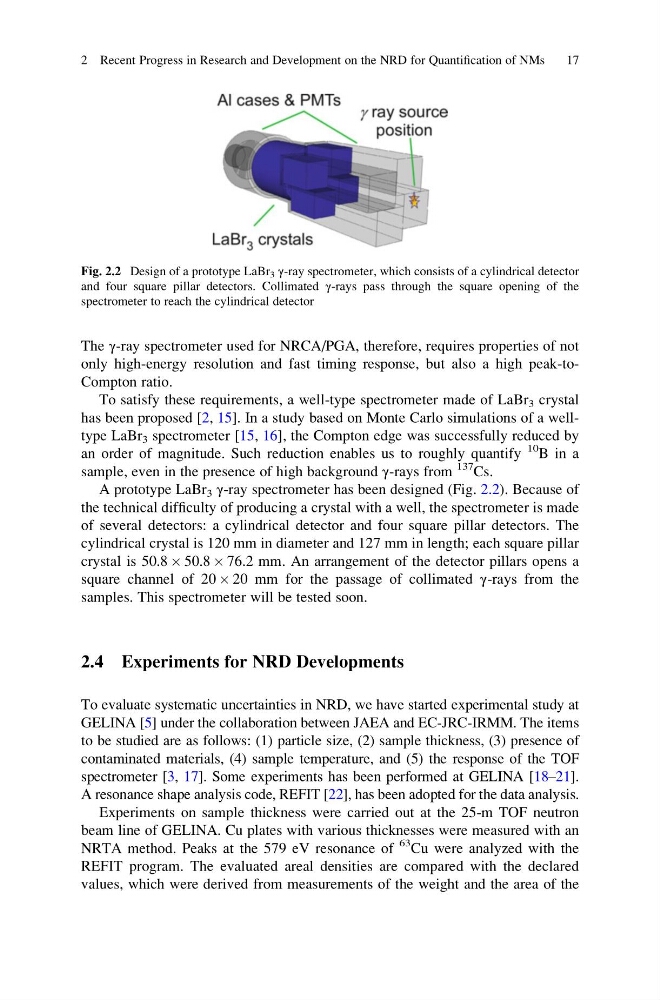
A prototype LaBr 3 γ-ray spectrometer has been designed (Fig. 2.2). Because of
the technical difficulty of producing a crystal with a well, the spectrometer is made
of several detectors: a cylindrical detector and four square pillar detectors. The
cylindrical crystal is 120 mm in diameter and 127 mm in length; each square pillar
crystal is 50.8 Â 50.8 Â 76.2 mm. An arrangement of the detector pillars opens a
square channel of 20 Â 20 mm for the passage of collimated γ-rays from the
samples. This spectrometer will be tested soon.
2.4 Experiments for NRD Developments
To evaluate systematic uncertainties in NRD, we have started experimental study at
GELINA [5] under the collaboration between JAEA and EC-JRC-IRMM. The items
to be studied are as follows: (1) particle size, (2) sample thickness, (3) presence of
contaminated materials, (4) sample temperature, and (5) the response of the TOF
spectrometer [3, 17]. Some experiments has been performed at GELINA [18–21].
A resonance shape analysis code, REFIT [22], has been adopted for the data analysis.
Experiments on sample thickness were carried out at the 25-m TOF neutron
beam line of GELINA. Cu plates with various thicknesses were measured with an
NRTA method. Peaks at the 579 eV resonance of
63 Cu were analyzed with the
REFIT program. The evaluated areal densities are compared with the declared
values, which were derived from measurements of the weight and the area of the
Fig. 2.2 Design of a prototype LaBr 3 γ-ray spectrometer, which consists of a cylindrical detector
and four square pillar detectors. Collimated γ-rays pass through the square opening of the
spectrometer to reach the cylindrical detector
2 Recent Progress in Research and Development on the NRD for Quantification of NMs
17
only high-energy resolution and fast timing response, but also a high peak-toCompton ratio.
To satisfy these requirements, a well-type spectrometer made of LaBr 3 crystal
has been proposed [2, 15]. In a study based on Monte Carlo simulations of a welltype LaBr 3 spectrometer [15, 16], the Compton edge was successfully reduced by
an order of magnitude. Such reduction enables us to roughly quantify
10 B in a
sample, even in the presence of high background γ-rays from
137 Cs.
A prototype LaBr 3 γ-ray spectrometer has been designed (Fig. 2.2). Because of
the technical difficulty of producing a crystal with a well, the spectrometer is made
of several detectors: a cylindrical detector and four square pillar detectors. The
cylindrical crystal is 120 mm in diameter and 127 mm in length; each square pillar
crystal is 50.8 Â 50.8 Â 76.2 mm. An arrangement of the detector pillars opens a
square channel of 20 Â 20 mm for the passage of collimated γ-rays from the
samples. This spectrometer will be tested soon.
2.4 Experiments for NRD Developments
To evaluate systematic uncertainties in NRD, we have started experimental study at
GELINA [5] under the collaboration between JAEA and EC-JRC-IRMM. The items
to be studied are as follows: (1) particle size, (2) sample thickness, (3) presence of
contaminated materials, (4) sample temperature, and (5) the response of the TOF
spectrometer [3, 17]. Some experiments has been performed at GELINA [18–21].
A resonance shape analysis code, REFIT [22], has been adopted for the data analysis.
Experiments on sample thickness were carried out at the 25-m TOF neutron
beam line of GELINA. Cu plates with various thicknesses were measured with an
NRTA method. Peaks at the 579 eV resonance of
63 Cu were analyzed with the
REFIT program. The evaluated areal densities are compared with the declared
values, which were derived from measurements of the weight and the area of the
Fig. 2.2 Design of a prototype LaBr 3 γ-ray spectrometer, which consists of a cylindrical detector
and four square pillar detectors. Collimated γ-rays pass through the square opening of the
spectrometer to reach the cylindrical detector
2 Recent Progress in Research and Development on the NRD for Quantification of NMs
17