

24.4 Concept of Geological Disposal and Risk
Geological disposal is a globally common technology of HLW disposal for either
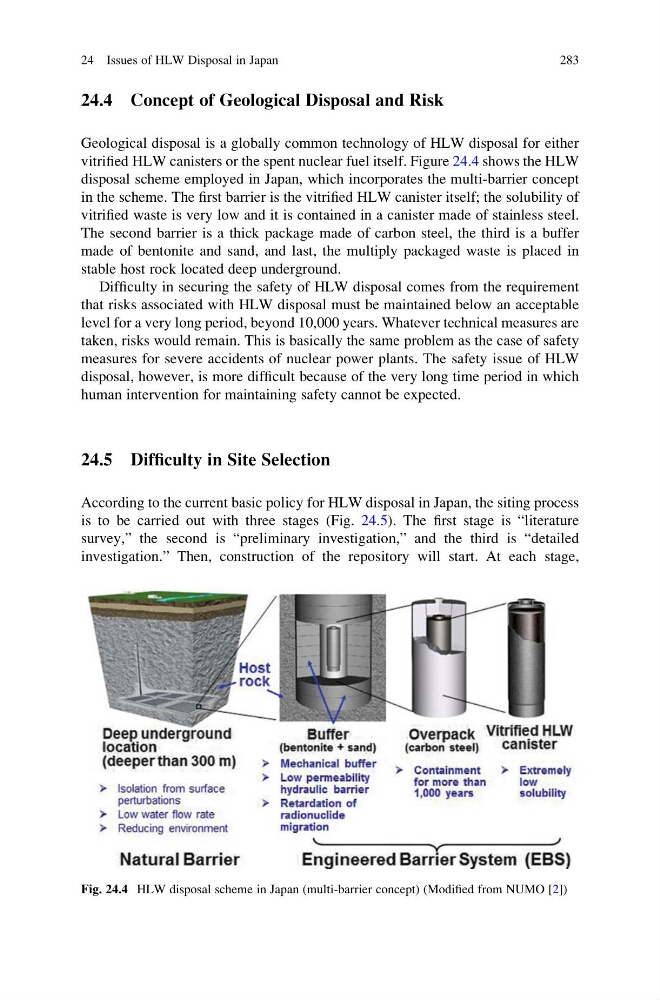
vitrified HLW canisters or the spent nuclear fuel itself. Figure 24.4 shows the HLW
disposal scheme employed in Japan, which incorporates the multi-barrier concept
in the scheme. The first barrier is the vitrified HLW canister itself; the solubility of
vitrified waste is very low and it is contained in a canister made of stainless steel.
The second barrier is a thick package made of carbon steel, the third is a buffer
made of bentonite and sand, and last, the multiply packaged waste is placed in
stable host rock located deep underground.
Difficulty in securing the safety of HLW disposal comes from the requirement
that risks associated with HLW disposal must be maintained below an acceptable
level for a very long period, beyond 10,000 years. Whatever technical measures are
taken, risks would remain. This is basically the same problem as the case of safety
measures for severe accidents of nuclear power plants. The safety issue of HLW
disposal, however, is more difficult because of the very long time period in which
human intervention for maintaining safety cannot be expected.
24.5 Difficulty in Site Selection
According to the current basic policy for HLW disposal in Japan, the siting process
is to be carried out with three stages (Fig. 24.5). The first stage is “literature
survey,” the second is “preliminary investigation,” and the third is “detailed
investigation.” Then, construction of the repository will start. At each stage,
Fig. 24.4 HLW disposal scheme in Japan (multi-barrier concept) (Modified from NUMO [2])
24 Issues of HLW Disposal in Japan
283
Geological disposal is a globally common technology of HLW disposal for either
vitrified HLW canisters or the spent nuclear fuel itself. Figure 24.4 shows the HLW
disposal scheme employed in Japan, which incorporates the multi-barrier concept
in the scheme. The first barrier is the vitrified HLW canister itself; the solubility of
vitrified waste is very low and it is contained in a canister made of stainless steel.
The second barrier is a thick package made of carbon steel, the third is a buffer
made of bentonite and sand, and last, the multiply packaged waste is placed in
stable host rock located deep underground.
Difficulty in securing the safety of HLW disposal comes from the requirement
that risks associated with HLW disposal must be maintained below an acceptable
level for a very long period, beyond 10,000 years. Whatever technical measures are
taken, risks would remain. This is basically the same problem as the case of safety
measures for severe accidents of nuclear power plants. The safety issue of HLW
disposal, however, is more difficult because of the very long time period in which
human intervention for maintaining safety cannot be expected.
24.5 Difficulty in Site Selection
According to the current basic policy for HLW disposal in Japan, the siting process
is to be carried out with three stages (Fig. 24.5). The first stage is “literature
survey,” the second is “preliminary investigation,” and the third is “detailed
investigation.” Then, construction of the repository will start. At each stage,
Fig. 24.4 HLW disposal scheme in Japan (multi-barrier concept) (Modified from NUMO [2])
24 Issues of HLW Disposal in Japan
283