

role along with the second progress report of JNC to set the contents of the Final
Disposal Act.
Under the act, geological disposal is chosen for HLW disposal, and NUMO
(Nuclear Waste Management Organization of Japan) was established for
implementing the final disposal of HLW.
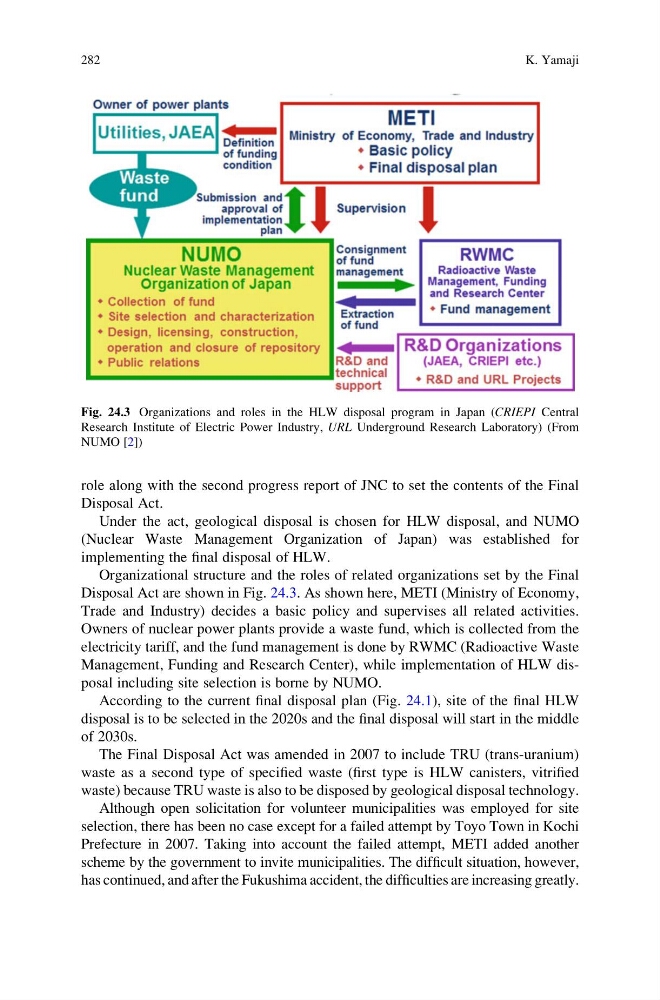
Organizational structure and the roles of related organizations set by the Final
Disposal Act are shown in Fig. 24.3. As shown here, METI (Ministry of Economy,
Trade and Industry) decides a basic policy and supervises all related activities.
Owners of nuclear power plants provide a waste fund, which is collected from the
electricity tariff, and the fund management is done by RWMC (Radioactive Waste
Management, Funding and Research Center), while implementation of HLW disposal including site selection is borne by NUMO.
According to the current final disposal plan (Fig. 24.1), site of the final HLW
disposal is to be selected in the 2020s and the final disposal will start in the middle
of 2030s.
The Final Disposal Act was amended in 2007 to include TRU (trans-uranium)
waste as a second type of specified waste (first type is HLW canisters, vitrified
waste) because TRU waste is also to be disposed by geological disposal technology.
Although open solicitation for volunteer municipalities was employed for site
selection, there has been no case except for a failed attempt by Toyo Town in Kochi
Prefecture in 2007. Taking into account the failed attempt, METI added another
scheme by the government to invite municipalities. The difficult situation, however,
has continued, and after the Fukushima accident, the difficulties are increasing greatly.
Fig. 24.3 Organizations and roles in the HLW disposal program in Japan (CRIEPI Central
Research Institute of Electric Power Industry, URL Underground Research Laboratory) (From
NUMO [2])
282
K. Yamaji
Disposal Act.
Under the act, geological disposal is chosen for HLW disposal, and NUMO
(Nuclear Waste Management Organization of Japan) was established for
implementing the final disposal of HLW.
Organizational structure and the roles of related organizations set by the Final
Disposal Act are shown in Fig. 24.3. As shown here, METI (Ministry of Economy,
Trade and Industry) decides a basic policy and supervises all related activities.
Owners of nuclear power plants provide a waste fund, which is collected from the
electricity tariff, and the fund management is done by RWMC (Radioactive Waste
Management, Funding and Research Center), while implementation of HLW disposal including site selection is borne by NUMO.
According to the current final disposal plan (Fig. 24.1), site of the final HLW
disposal is to be selected in the 2020s and the final disposal will start in the middle
of 2030s.
The Final Disposal Act was amended in 2007 to include TRU (trans-uranium)
waste as a second type of specified waste (first type is HLW canisters, vitrified
waste) because TRU waste is also to be disposed by geological disposal technology.
Although open solicitation for volunteer municipalities was employed for site
selection, there has been no case except for a failed attempt by Toyo Town in Kochi
Prefecture in 2007. Taking into account the failed attempt, METI added another
scheme by the government to invite municipalities. The difficult situation, however,
has continued, and after the Fukushima accident, the difficulties are increasing greatly.
Fig. 24.3 Organizations and roles in the HLW disposal program in Japan (CRIEPI Central
Research Institute of Electric Power Industry, URL Underground Research Laboratory) (From
NUMO [2])
282
K. Yamaji