

coefficients clearly showed that the (n, α) reaction of C-13 is the dominant pathway
for Be-10 generation in Zircaloy-2.
Figure 20.2b shows an example of nuclides generated through long and complicated generation chains. The source nuclide of Cl-36 generated in SUS304 stainless
steel is ambiguous because the initial composition in this analysis does not contain
chlorine, which could be the dominant source element of Cl-36. The sensitivity
coefficients quantitatively clarified that S-34 is the source nuclide of Cl-36 even for
the long and complicated chain.
20.3.4 Sensitivity Analysis Using the Initial Composition
Based on Measured Data
The sensitivity coefficients shown in Sect. 20.3.3 are valid within the assumed
analysis conditions in Sect. 20.3.1. However, the impurity elements that are not
specified in the standard specification can be possibly present in the material. To
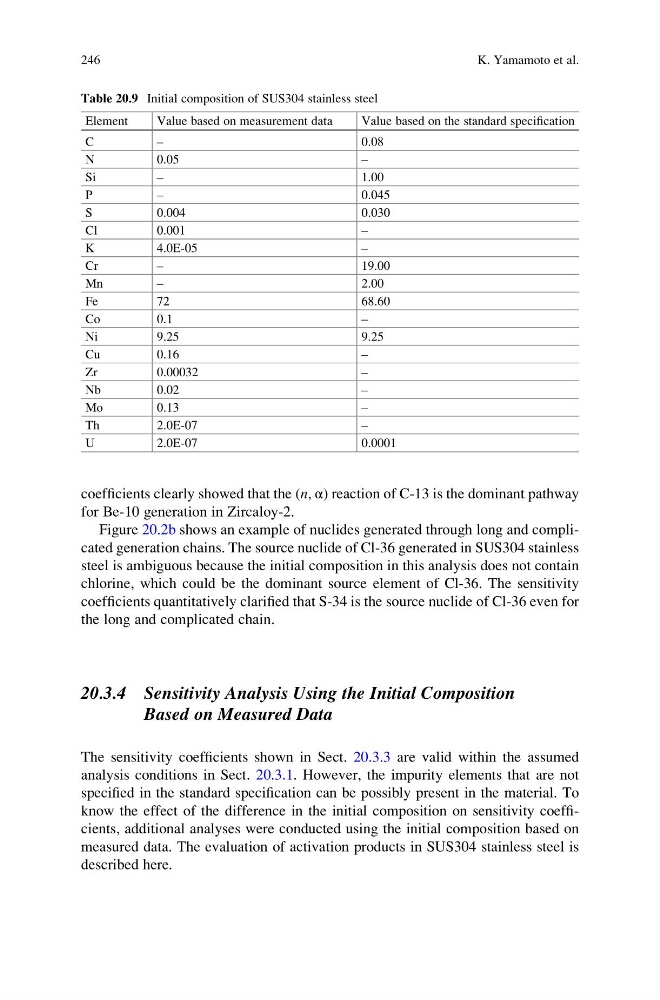
know the effect of the difference in the initial composition on sensitivity coefficients, additional analyses were conducted using the initial composition based on
measured data. The evaluation of activation products in SUS304 stainless steel is
described here.
Table 20.9 Initial composition of SUS304 stainless steel
Element
Value based on measurement data
Value based on the standard specification
C
–
0.08
N
0.05
–
Si
–
1.00
P
–
0.045
S
0.004
0.030
Cl
0.001
–
K
4.0E-05
–
Cr
–
19.00
Mn
–
2.00
Fe
72
68.60
Co
0.1
–
Ni
9.25
9.25
Cu
0.16
–
Zr
0.00032
–
Nb
0.02
–
Mo
0.13
–
Th
2.0E-07
–
U
2.0E-07
0.0001
246
K. Yamamoto et al.
for Be-10 generation in Zircaloy-2.
Figure 20.2b shows an example of nuclides generated through long and complicated generation chains. The source nuclide of Cl-36 generated in SUS304 stainless
steel is ambiguous because the initial composition in this analysis does not contain
chlorine, which could be the dominant source element of Cl-36. The sensitivity
coefficients quantitatively clarified that S-34 is the source nuclide of Cl-36 even for
the long and complicated chain.
20.3.4 Sensitivity Analysis Using the Initial Composition
Based on Measured Data
The sensitivity coefficients shown in Sect. 20.3.3 are valid within the assumed
analysis conditions in Sect. 20.3.1. However, the impurity elements that are not
specified in the standard specification can be possibly present in the material. To
know the effect of the difference in the initial composition on sensitivity coefficients, additional analyses were conducted using the initial composition based on
measured data. The evaluation of activation products in SUS304 stainless steel is
described here.
Table 20.9 Initial composition of SUS304 stainless steel
Element
Value based on measurement data
Value based on the standard specification
C
–
0.08
N
0.05
–
Si
–
1.00
P
–
0.045
S
0.004
0.030
Cl
0.001
–
K
4.0E-05
–
Cr
–
19.00
Mn
–
2.00
Fe
72
68.60
Co
0.1
–
Ni
9.25
9.25
Cu
0.16
–
Zr
0.00032
–
Nb
0.02
–
Mo
0.13
–
Th
2.0E-07
–
U
2.0E-07
0.0001
246
K. Yamamoto et al.