

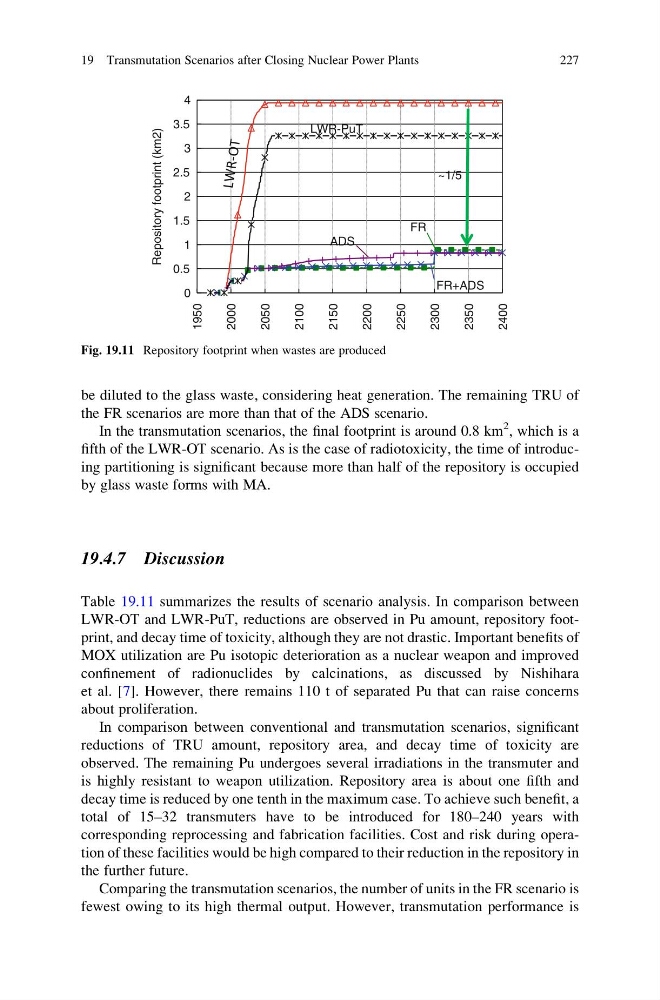
be diluted to the glass waste, considering heat generation. The remaining TRU of
the FR scenarios are more than that of the ADS scenario.
In the transmutation scenarios, the final footprint is around 0.8 km
2 , which is a
fifth of the LWR-OT scenario. As is the case of radiotoxicity, the time of introducing partitioning is significant because more than half of the repository is occupied
by glass waste forms with MA.
19.4.7 Discussion
Table 19.11 summarizes the results of scenario analysis. In comparison between
LWR-OT and LWR-PuT, reductions are observed in Pu amount, repository footprint, and decay time of toxicity, although they are not drastic. Important benefits of
MOX utilization are Pu isotopic deterioration as a nuclear weapon and improved
confinement of radionuclides by calcinations, as discussed by Nishihara
et al. [7]. However, there remains 110 t of separated Pu that can raise concerns
about proliferation.
In comparison between conventional and transmutation scenarios, significant
reductions of TRU amount, repository area, and decay time of toxicity are
observed. The remaining Pu undergoes several irradiations in the transmuter and
is highly resistant to weapon utilization. Repository area is about one fifth and
decay time is reduced by one tenth in the maximum case. To achieve such benefit, a
total of 15–32 transmuters have to be introduced for 180–240 years with
corresponding reprocessing and fabrication facilities. Cost and risk during operation of these facilities would be high compared to their reduction in the repository in
the further future.
Comparing the transmutation scenarios, the number of units in the FR scenario is
fewest owing to its high thermal output. However, transmutation performance is
0
0.5
1
1.5
2
2.5
3
3.5
4
1950
2000
2050
2100
2150
2200
2250
2300
2350
2400
Repository footprint (km2)
ADS
FR+ADS
FR
~1/5
LWR-PuT
Fig. 19.11 Repository footprint when wastes are produced
19 Transmutation Scenarios after Closing Nuclear Power Plants
227
the FR scenarios are more than that of the ADS scenario.
In the transmutation scenarios, the final footprint is around 0.8 km
2 , which is a
fifth of the LWR-OT scenario. As is the case of radiotoxicity, the time of introducing partitioning is significant because more than half of the repository is occupied
by glass waste forms with MA.
19.4.7 Discussion
Table 19.11 summarizes the results of scenario analysis. In comparison between
LWR-OT and LWR-PuT, reductions are observed in Pu amount, repository footprint, and decay time of toxicity, although they are not drastic. Important benefits of
MOX utilization are Pu isotopic deterioration as a nuclear weapon and improved
confinement of radionuclides by calcinations, as discussed by Nishihara
et al. [7]. However, there remains 110 t of separated Pu that can raise concerns
about proliferation.
In comparison between conventional and transmutation scenarios, significant
reductions of TRU amount, repository area, and decay time of toxicity are
observed. The remaining Pu undergoes several irradiations in the transmuter and
is highly resistant to weapon utilization. Repository area is about one fifth and
decay time is reduced by one tenth in the maximum case. To achieve such benefit, a
total of 15–32 transmuters have to be introduced for 180–240 years with
corresponding reprocessing and fabrication facilities. Cost and risk during operation of these facilities would be high compared to their reduction in the repository in
the further future.
Comparing the transmutation scenarios, the number of units in the FR scenario is
fewest owing to its high thermal output. However, transmutation performance is
0
0.5
1
1.5
2
2.5
3
3.5
4
1950
2000
2050
2100
2150
2200
2250
2300
2350
2400
Repository footprint (km2)
ADS
FR+ADS
FR
~1/5
LWR-PuT
Fig. 19.11 Repository footprint when wastes are produced
19 Transmutation Scenarios after Closing Nuclear Power Plants
227