

waste corresponding to 40-year operation of the RRP, because the spent fuel
assembly occupies more area and heat generation from the Pu in it also contributes.
In the LWR-PuT scenario, two kinds of waste form are produced: 37,000 glass
waste forms containing FP and MA, and spent fuel assembly of MOX of 4,000 t.
Each occupies 1.6 km
2 , and the total is 3.3 km
2 . Although an amount of MOX spent
fuel is smaller than that of UO 2 spent fuel in the LWR-OT scenario by a factor of
11, it contains more heat-generating actinides such as Am and Pu, and its footprint
is significant.
In the early several hundreds of years,
90 Sr and
137
Cs, whose half-life is around
30 years, are dominant for the footprint. They are separated in the RRP after 2025 as
well as MA in the transmutation scenarios. They are absorbed by adsorbents such as
zeolite and calcined to the waste form. Because half-life is rather short and the
repository footprint is almost proportional to heat generation, long-term storage of
the calcined waste is effective [9]. After 300 years of storage, an accumulated
layout for the TRU wastes that is low heat generating and with long-term radioactive wastes becomes available. The footprint of this layout is smaller by two orders
of magnitude than a typical layout for the vitrified waste. After separating
90 Sr and
137 Cs,
241 Am, whose half-life is 432.2 years, becomes dominant, but this nuclide is
transmuted in the transmutation scenarios. Heat generation from other fission
products that are vitrified quickly decays to the level of the TRU waste.
As result of the long-term storage and transmutation, the footprint becomes
almost constant after 2025 (Fig. 19.11). The glass waste form that is produced
before 2025 and contains MA occupies 0.5 km
2 . In the ADS scenario, partitioning
and long-term storage of Sr and Cs in the wastes produced from reprocessing of
ADS spent fuel is not assumed because the impact is small. As a result, the footprint
gradually increases to 0.8 km
2 . Technologically, separation is possible in the
reprocessing for ADS, and it will be applied if the increase becomes significant.
Steps observed in 2230 and 2330 are caused by wastes of remaining TRU that will
1E+7
1E+8
1E+9
1E+10
1E+11
1E+12
1E+13
1E+14
1E+0
1E+1
1E+2
1E+3
1E+4
1E+5
1E+6
1E+7
Intake dose (Sv)
Time (year)
ADS
FR+ADS
FR
natU
LWR-PuT
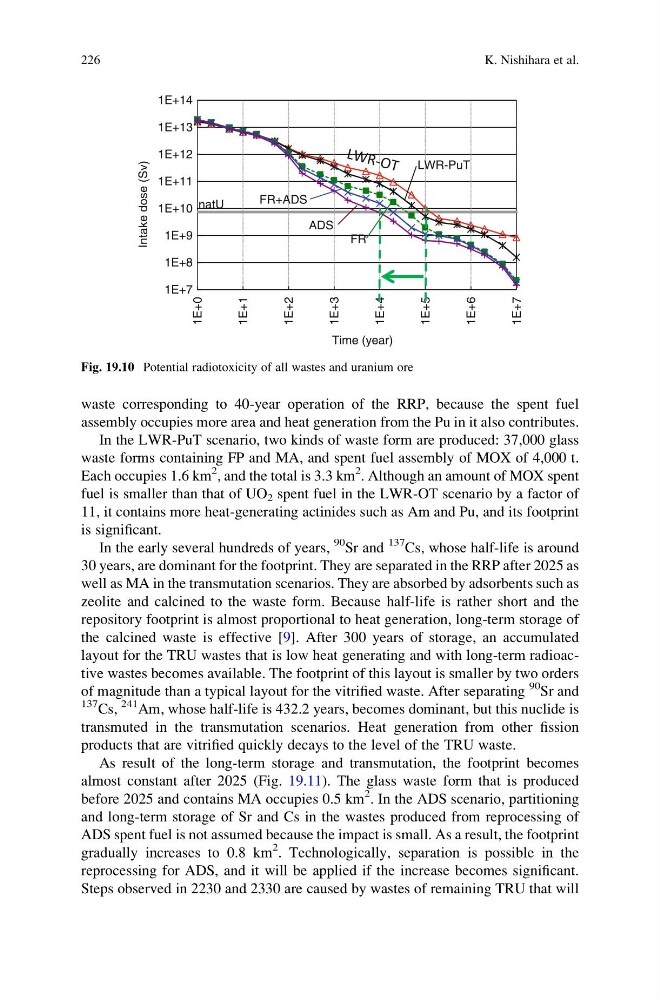
Fig. 19.10 Potential radiotoxicity of all wastes and uranium ore
226
K. Nishihara et al.
assembly occupies more area and heat generation from the Pu in it also contributes.
In the LWR-PuT scenario, two kinds of waste form are produced: 37,000 glass
waste forms containing FP and MA, and spent fuel assembly of MOX of 4,000 t.
Each occupies 1.6 km
2 , and the total is 3.3 km
2 . Although an amount of MOX spent
fuel is smaller than that of UO 2 spent fuel in the LWR-OT scenario by a factor of
11, it contains more heat-generating actinides such as Am and Pu, and its footprint
is significant.
In the early several hundreds of years,
90 Sr and
137
Cs, whose half-life is around
30 years, are dominant for the footprint. They are separated in the RRP after 2025 as
well as MA in the transmutation scenarios. They are absorbed by adsorbents such as
zeolite and calcined to the waste form. Because half-life is rather short and the
repository footprint is almost proportional to heat generation, long-term storage of
the calcined waste is effective [9]. After 300 years of storage, an accumulated
layout for the TRU wastes that is low heat generating and with long-term radioactive wastes becomes available. The footprint of this layout is smaller by two orders
of magnitude than a typical layout for the vitrified waste. After separating
90 Sr and
137 Cs,
241 Am, whose half-life is 432.2 years, becomes dominant, but this nuclide is
transmuted in the transmutation scenarios. Heat generation from other fission
products that are vitrified quickly decays to the level of the TRU waste.
As result of the long-term storage and transmutation, the footprint becomes
almost constant after 2025 (Fig. 19.11). The glass waste form that is produced
before 2025 and contains MA occupies 0.5 km
2 . In the ADS scenario, partitioning
and long-term storage of Sr and Cs in the wastes produced from reprocessing of
ADS spent fuel is not assumed because the impact is small. As a result, the footprint
gradually increases to 0.8 km
2 . Technologically, separation is possible in the
reprocessing for ADS, and it will be applied if the increase becomes significant.
Steps observed in 2230 and 2330 are caused by wastes of remaining TRU that will
1E+7
1E+8
1E+9
1E+10
1E+11
1E+12
1E+13
1E+14
1E+0
1E+1
1E+2
1E+3
1E+4
1E+5
1E+6
1E+7
Intake dose (Sv)
Time (year)
ADS
FR+ADS
FR
natU
LWR-PuT
Fig. 19.10 Potential radiotoxicity of all wastes and uranium ore
226
K. Nishihara et al.