

19.4 Scenario Analysis
Based on the ADS design in Sect. 19.3 and FR design in Wakabayashi et al. [1], the
impact of introducing transmutation is evaluated by mass-flow analysis. Table 19.9
lists analyzed scenarios in which two conventional scenarios and three transmutations are included. In the conventional once-through scenario identified as “LWROT,” Pu and MA exist in spent fuel and are directly disposed of in an underground
repository. The second conventional scenario identified as “LWR-PuT” is Pu
utilization in a LWR. The spent uranium fuels from an LWR are reprocessed,
and, separated Pu is fabricated as MOX and burned in the LWR. Spent MOX fuel is
directly disposed.
In the FR scenario, both Pu and MA are mixed or co-extracted and transmuted in
FR without any limit of MA content in the fuel. In the ADS scenario, Pu is
transmuted in the present design (Pu-ADS) and MA are transmuted in the reference
ADS (MA-ADS). In the FR+ADS scenario, MA content in FR is limited to less than
5 % and the remaining MA are transmuted in the ADS.
Characteristics of transmutation systems are listed in Table 19.10. FR has a
twice larger thermal output than ADSs, although the specific heat is smaller.
Therefore, initial inventory involving fuels in the core and in the fuel cycle of FR
is much larger than Pu-ADS even if uranium is excluded; thus, the number of FR
that can be introduced is limited. As a result, the transmutation half-life of FR is
longer than ADSs by a factor of two.
19.4.1 Result of LWR-OT
Figure 19.5 illustrates a result of the LWR-OT scenario where time evolution of
electricity generation, Pu inventory, and MA inventory are shown. The peak of
50 GWe appears in 2010 and decreases because of the Fukushima accident and
closure after 40-year operations. All LWRs will be shut down in 2055. The
Rokkasho reprocessing plant (RRP) will not be operated, but 7,100 tHM spent
fuel has been reprocessed, mainly overseas. The year of reprocessing is not clear
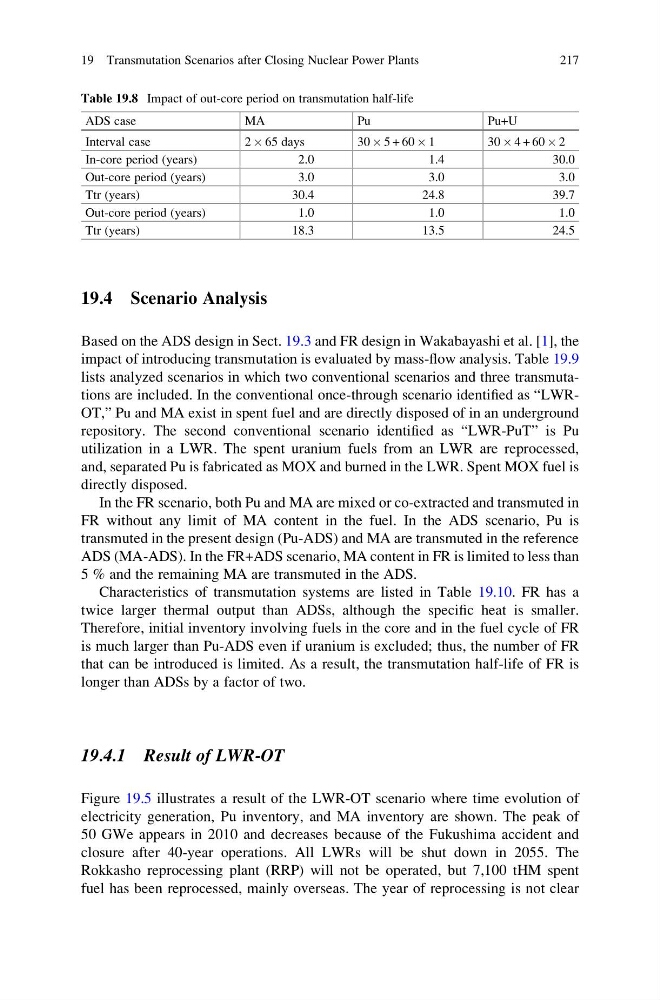
Table 19.8 Impact of out-core period on transmutation half-life
ADS case
MA
Pu
Pu+U
Interval case
2 Â 65 days
30 Â 5 + 60 Â 1
3 0 Â 4 + 60 Â 2
In-core period (years)
2.0
1.4
30.0
Out-core period (years)
3.0
3.0
3.0
Ttr (years)
30.4
24.8
39.7
Out-core period (years)
1.0
1.0
1.0
Ttr (years)
18.3
13.5
24.5
19 Transmutation Scenarios after Closing Nuclear Power Plants
217
Based on the ADS design in Sect. 19.3 and FR design in Wakabayashi et al. [1], the
impact of introducing transmutation is evaluated by mass-flow analysis. Table 19.9
lists analyzed scenarios in which two conventional scenarios and three transmutations are included. In the conventional once-through scenario identified as “LWROT,” Pu and MA exist in spent fuel and are directly disposed of in an underground
repository. The second conventional scenario identified as “LWR-PuT” is Pu
utilization in a LWR. The spent uranium fuels from an LWR are reprocessed,
and, separated Pu is fabricated as MOX and burned in the LWR. Spent MOX fuel is
directly disposed.
In the FR scenario, both Pu and MA are mixed or co-extracted and transmuted in
FR without any limit of MA content in the fuel. In the ADS scenario, Pu is
transmuted in the present design (Pu-ADS) and MA are transmuted in the reference
ADS (MA-ADS). In the FR+ADS scenario, MA content in FR is limited to less than
5 % and the remaining MA are transmuted in the ADS.
Characteristics of transmutation systems are listed in Table 19.10. FR has a
twice larger thermal output than ADSs, although the specific heat is smaller.
Therefore, initial inventory involving fuels in the core and in the fuel cycle of FR
is much larger than Pu-ADS even if uranium is excluded; thus, the number of FR
that can be introduced is limited. As a result, the transmutation half-life of FR is
longer than ADSs by a factor of two.
19.4.1 Result of LWR-OT
Figure 19.5 illustrates a result of the LWR-OT scenario where time evolution of
electricity generation, Pu inventory, and MA inventory are shown. The peak of
50 GWe appears in 2010 and decreases because of the Fukushima accident and
closure after 40-year operations. All LWRs will be shut down in 2055. The
Rokkasho reprocessing plant (RRP) will not be operated, but 7,100 tHM spent
fuel has been reprocessed, mainly overseas. The year of reprocessing is not clear
Table 19.8 Impact of out-core period on transmutation half-life
ADS case
MA
Pu
Pu+U
Interval case
2 Â 65 days
30 Â 5 + 60 Â 1
3 0 Â 4 + 60 Â 2
In-core period (years)
2.0
1.4
30.0
Out-core period (years)
3.0
3.0
3.0
Ttr (years)
30.4
24.8
39.7
Out-core period (years)
1.0
1.0
1.0
Ttr (years)
18.3
13.5
24.5
19 Transmutation Scenarios after Closing Nuclear Power Plants
217