

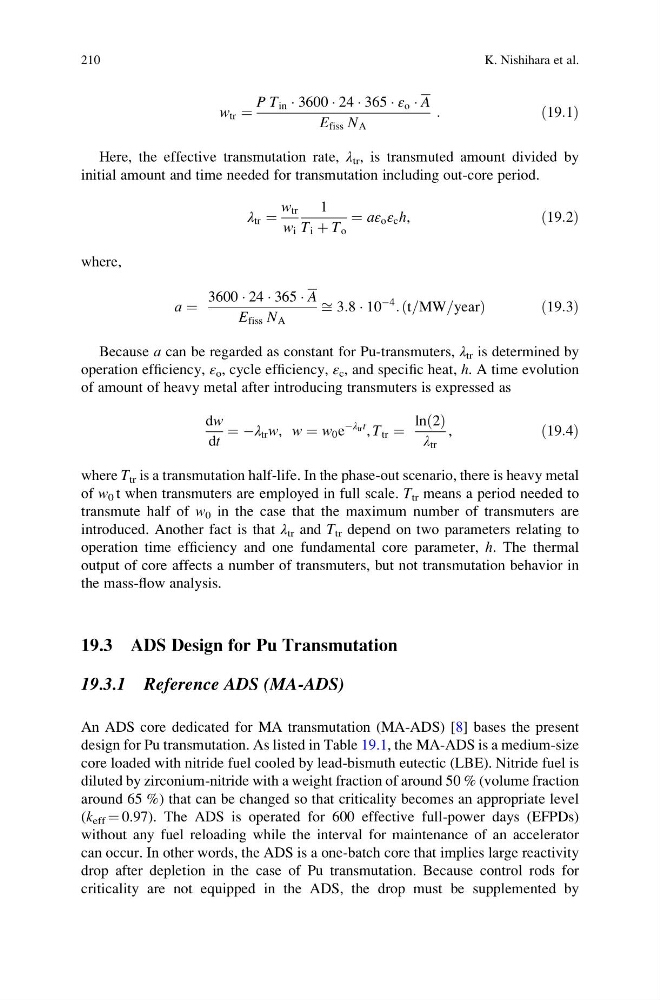
w tr ¼
P T in Á 3600 Á 24 Á 365 Á ε o Á A
E fiss N A
:
ð19:1Þ
Here, the effective transmutation rate, λ tr , is transmuted amount divided by
initial amount and time needed for transmutation including out-core period.
λ tr ¼
w tr
w i
1
T i þ T o
¼ aε o ε c h,
ð19:2Þ
where,
a ¼
3600 Á 24 Á 365 Á A
E fiss N A
ffi 3:8 Á 10
À4
: t=MW=year
ð
Þ
ð 19:3Þ
Because a can be regarded as constant for Pu-transmuters, λ tr is determined by
operation efficiency, ε o , cycle efficiency, ε c , and specific heat, h. A time evolution
of amount of heavy metal after introducing transmuters is expressed as
dw
dt
¼ Àλ tr w, w ¼ w 0 e
Àλ tr t , T tr ¼
ln 2
ð Þ
λ tr
,
ð19:4Þ
where T tr is a transmutation half-life. In the phase-out scenario, there is heavy metal
of w 0 t when transmuters are employed in full scale. T tr means a period needed to
transmute half of w 0 in the case that the maximum number of transmuters are
introduced. Another fact is that λ tr and T tr depend on two parameters relating to
operation time efficiency and one fundamental core parameter, h. The thermal
output of core affects a number of transmuters, but not transmutation behavior in
the mass-flow analysis.
19.3 ADS Design for Pu Transmutation
19.3.1 Reference ADS (MA-ADS)
An ADS core dedicated for MA transmutation (MA-ADS) [8] bases the present
design for Pu transmutation. As listed in Table 19.1, the MA-ADS is a medium-size
core loaded with nitride fuel cooled by lead-bismuth eutectic (LBE). Nitride fuel is
diluted by zirconium-nitride with a weight fraction of around 50 % (volume fraction
around 65 %) that can be changed so that criticality becomes an appropriate level
(k eff ¼ 0.97). The ADS is operated for 600 effective full-power days (EFPDs)
without any fuel reloading while the interval for maintenance of an accelerator
can occur. In other words, the ADS is a one-batch core that implies large reactivity
drop after depletion in the case of Pu transmutation. Because control rods for
criticality are not equipped in the ADS, the drop must be supplemented by
210
K. Nishihara et al.
P T in Á 3600 Á 24 Á 365 Á ε o Á A
E fiss N A
:
ð19:1Þ
Here, the effective transmutation rate, λ tr , is transmuted amount divided by
initial amount and time needed for transmutation including out-core period.
λ tr ¼
w tr
w i
1
T i þ T o
¼ aε o ε c h,
ð19:2Þ
where,
a ¼
3600 Á 24 Á 365 Á A
E fiss N A
ffi 3:8 Á 10
À4
: t=MW=year
ð
Þ
ð 19:3Þ
Because a can be regarded as constant for Pu-transmuters, λ tr is determined by
operation efficiency, ε o , cycle efficiency, ε c , and specific heat, h. A time evolution
of amount of heavy metal after introducing transmuters is expressed as
dw
dt
¼ Àλ tr w, w ¼ w 0 e
Àλ tr t , T tr ¼
ln 2
ð Þ
λ tr
,
ð19:4Þ
where T tr is a transmutation half-life. In the phase-out scenario, there is heavy metal
of w 0 t when transmuters are employed in full scale. T tr means a period needed to
transmute half of w 0 in the case that the maximum number of transmuters are
introduced. Another fact is that λ tr and T tr depend on two parameters relating to
operation time efficiency and one fundamental core parameter, h. The thermal
output of core affects a number of transmuters, but not transmutation behavior in
the mass-flow analysis.
19.3 ADS Design for Pu Transmutation
19.3.1 Reference ADS (MA-ADS)
An ADS core dedicated for MA transmutation (MA-ADS) [8] bases the present
design for Pu transmutation. As listed in Table 19.1, the MA-ADS is a medium-size
core loaded with nitride fuel cooled by lead-bismuth eutectic (LBE). Nitride fuel is
diluted by zirconium-nitride with a weight fraction of around 50 % (volume fraction
around 65 %) that can be changed so that criticality becomes an appropriate level
(k eff ¼ 0.97). The ADS is operated for 600 effective full-power days (EFPDs)
without any fuel reloading while the interval for maintenance of an accelerator
can occur. In other words, the ADS is a one-batch core that implies large reactivity
drop after depletion in the case of Pu transmutation. Because control rods for
criticality are not equipped in the ADS, the drop must be supplemented by
210
K. Nishihara et al.