

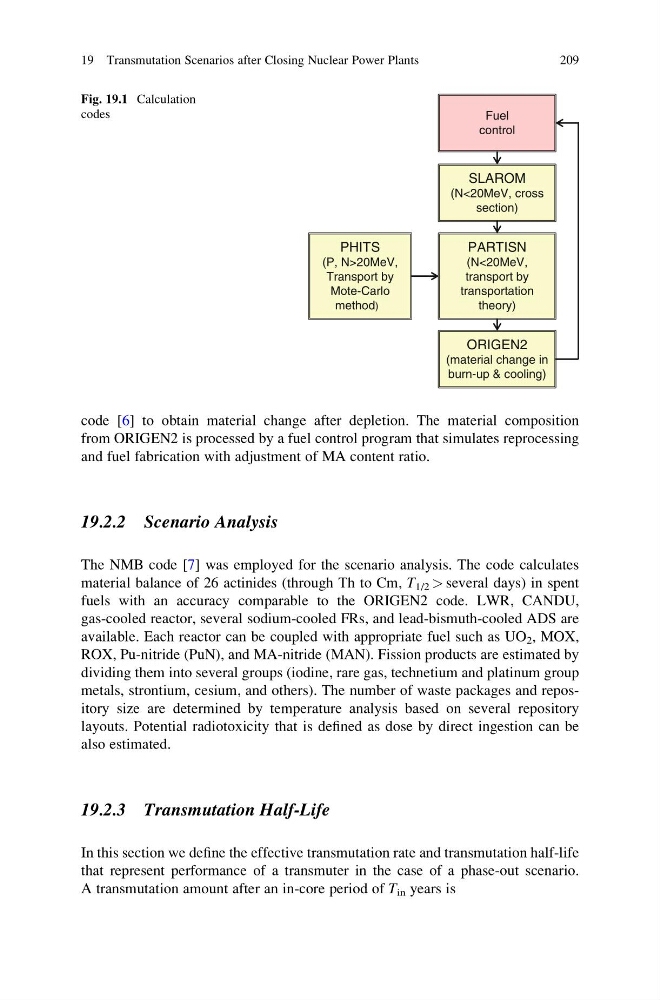
code [6] to obtain material change after depletion. The material composition
from ORIGEN2 is processed by a fuel control program that simulates reprocessing
and fuel fabrication with adjustment of MA content ratio.
19.2.2 Scenario Analysis
The NMB code [7] was employed for the scenario analysis. The code calculates
material balance of 26 actinides (through Th to Cm, T 1/2 > several days) in spent
fuels with an accuracy comparable to the ORIGEN2 code. LWR, CANDU,
gas-cooled reactor, several sodium-cooled FRs, and lead-bismuth-cooled ADS are
available. Each reactor can be coupled with appropriate fuel such as UO 2 , MOX,
ROX, Pu-nitride (PuN), and MA-nitride (MAN). Fission products are estimated by
dividing them into several groups (iodine, rare gas, technetium and platinum group
metals, strontium, cesium, and others). The number of waste packages and repository size are determined by temperature analysis based on several repository
layouts. Potential radiotoxicity that is defined as dose by direct ingestion can be
also estimated.
19.2.3 Transmutation Half-Life
In this section we define the effective transmutation rate and transmutation half-life
that represent performance of a transmuter in the case of a phase-out scenario.
A transmutation amount after an in-core period of T in years is
PHITS
(P, N>20MeV,
Transport by
Mote-Carlo
method)
PARTISN
(N<20MeV,
transport by
transportation
theory)
SLAROM
(N<20MeV, cross
section)
ORIGEN2
(material change in
burn-up & cooling)
Fuel
control
Fig. 19.1 Calculation
codes
19 Transmutation Scenarios after Closing Nuclear Power Plants
209
from ORIGEN2 is processed by a fuel control program that simulates reprocessing
and fuel fabrication with adjustment of MA content ratio.
19.2.2 Scenario Analysis
The NMB code [7] was employed for the scenario analysis. The code calculates
material balance of 26 actinides (through Th to Cm, T 1/2 > several days) in spent
fuels with an accuracy comparable to the ORIGEN2 code. LWR, CANDU,
gas-cooled reactor, several sodium-cooled FRs, and lead-bismuth-cooled ADS are
available. Each reactor can be coupled with appropriate fuel such as UO 2 , MOX,
ROX, Pu-nitride (PuN), and MA-nitride (MAN). Fission products are estimated by
dividing them into several groups (iodine, rare gas, technetium and platinum group
metals, strontium, cesium, and others). The number of waste packages and repository size are determined by temperature analysis based on several repository
layouts. Potential radiotoxicity that is defined as dose by direct ingestion can be
also estimated.
19.2.3 Transmutation Half-Life
In this section we define the effective transmutation rate and transmutation half-life
that represent performance of a transmuter in the case of a phase-out scenario.
A transmutation amount after an in-core period of T in years is
PHITS
(P, N>20MeV,
Transport by
Mote-Carlo
method)
PARTISN
(N<20MeV,
transport by
transportation
theory)
SLAROM
(N<20MeV, cross
section)
ORIGEN2
(material change in
burn-up & cooling)
Fuel
control
Fig. 19.1 Calculation
codes
19 Transmutation Scenarios after Closing Nuclear Power Plants
209