

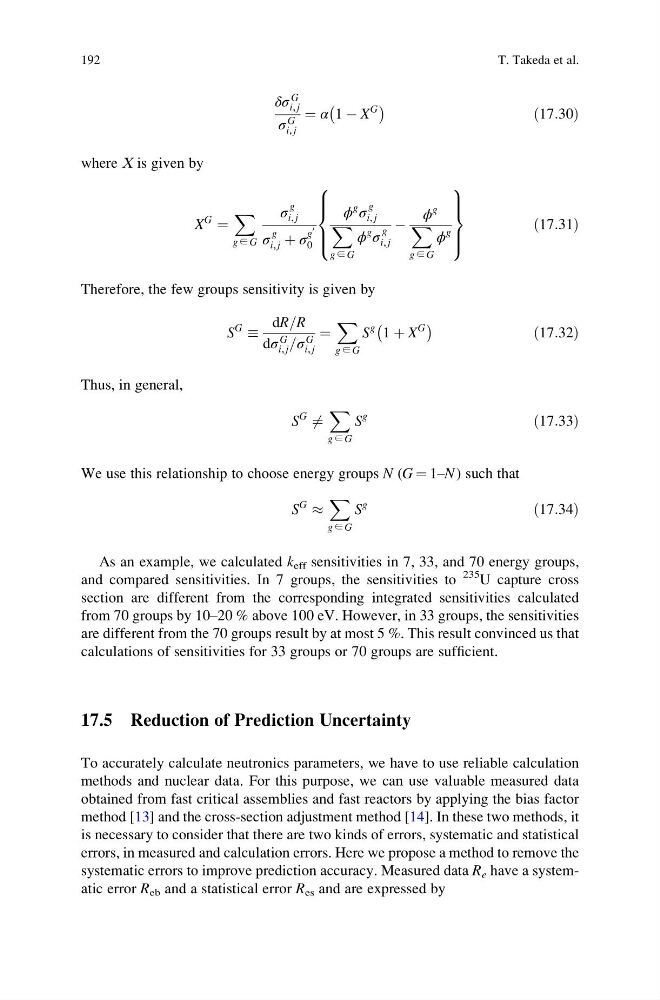
δσ
G
i, j
σ
G
i, j
¼ α 1 À X
G
À
Á
ð17:30Þ
where Χ is given by
X
G
¼
X
g ∈ G
σ
g
i, j
σ
g
i, j þ σ
g
0
0
ϕ
g
σ
g
i, j
X
g ∈ G
ϕ
g
σ
g
i, j
À
ϕ
g
X
g ∈ G
ϕ
g
8
> > <
> > :
9
> > =
> > ;
ð17:31Þ
Therefore, the few groups sensitivity is given by
S
G
dR=R
dσ
G
i, j =σ
G
i, j
¼
X
g ∈ G
S
g 1 þ X
G
À
Á
ð17:32Þ
Thus, in general,
S
G
6 ¼
X
g ∈ G
S
g
ð17:33Þ
We use this relationship to choose energy groups N (G ¼ 1–N ) such that
S
G
%
X
g ∈ G
S
g
ð17:34Þ
As an example, we calculated k eff sensitivities in 7, 33, and 70 energy groups,
and compared sensitivities. In 7 groups, the sensitivities to
235 U capture cross
section are different from the corresponding integrated sensitivities calculated
from 70 groups by 10–20 % above 100 eV. However, in 33 groups, the sensitivities
are different from the 70 groups result by at most 5 %. This result convinced us that
calculations of sensitivities for 33 groups or 70 groups are sufficient.
17.5 Reduction of Prediction Uncertainty
To accurately calculate neutronics parameters, we have to use reliable calculation
methods and nuclear data. For this purpose, we can use valuable measured data
obtained from fast critical assemblies and fast reactors by applying the bias factor
method [13] and the cross-section adjustment method [14]. In these two methods, it
is necessary to consider that there are two kinds of errors, systematic and statistical
errors, in measured and calculation errors. Here we propose a method to remove the
systematic errors to improve prediction accuracy. Measured data R e have a systematic error R eb and a statistical error R es and are expressed by
192
T. Takeda et al.
G
i, j
σ
G
i, j
¼ α 1 À X
G
À
Á
ð17:30Þ
where Χ is given by
X
G
¼
X
g ∈ G
σ
g
i, j
σ
g
i, j þ σ
g
0
0
ϕ
g
σ
g
i, j
X
g ∈ G
ϕ
g
σ
g
i, j
À
ϕ
g
X
g ∈ G
ϕ
g
8
> > <
> > :
9
> > =
> > ;
ð17:31Þ
Therefore, the few groups sensitivity is given by
S
G
dR=R
dσ
G
i, j =σ
G
i, j
¼
X
g ∈ G
S
g 1 þ X
G
À
Á
ð17:32Þ
Thus, in general,
S
G
6 ¼
X
g ∈ G
S
g
ð17:33Þ
We use this relationship to choose energy groups N (G ¼ 1–N ) such that
S
G
%
X
g ∈ G
S
g
ð17:34Þ
As an example, we calculated k eff sensitivities in 7, 33, and 70 energy groups,
and compared sensitivities. In 7 groups, the sensitivities to
235 U capture cross
section are different from the corresponding integrated sensitivities calculated
from 70 groups by 10–20 % above 100 eV. However, in 33 groups, the sensitivities
are different from the 70 groups result by at most 5 %. This result convinced us that
calculations of sensitivities for 33 groups or 70 groups are sufficient.
17.5 Reduction of Prediction Uncertainty
To accurately calculate neutronics parameters, we have to use reliable calculation
methods and nuclear data. For this purpose, we can use valuable measured data
obtained from fast critical assemblies and fast reactors by applying the bias factor
method [13] and the cross-section adjustment method [14]. In these two methods, it
is necessary to consider that there are two kinds of errors, systematic and statistical
errors, in measured and calculation errors. Here we propose a method to remove the
systematic errors to improve prediction accuracy. Measured data R e have a systematic error R eb and a statistical error R es and are expressed by
192
T. Takeda et al.