

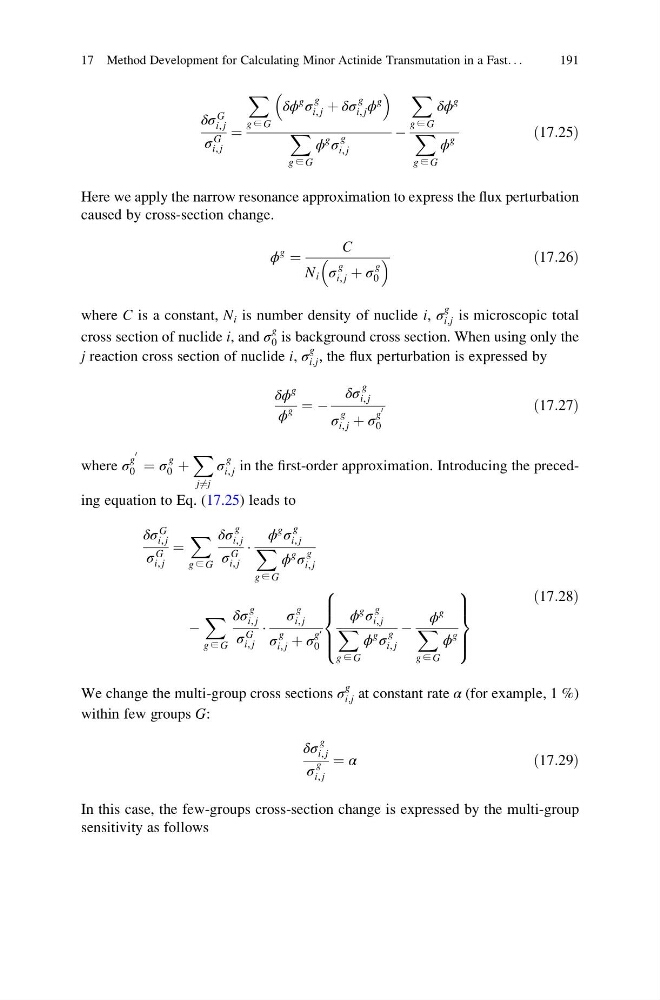
δσ
G
i, j
σ
G
i, j
¼
X
g ∈ G
δϕ
g
σ
g
i, j þ δσ
g
i, j ϕ
g
X
g ∈ G
ϕ
g
σ
g
i, j
À
X
g ∈ G
δϕ
g
X
g ∈ G
ϕ
g
ð17:25Þ
Here we apply the narrow resonance approximation to express the flux perturbation
caused by cross-section change.
ϕ
g
¼
C
N i σ
g
i, j þ σ
g
0
ð17:26Þ
where C is a constant, N i is number density of nuclide i, σ
g
i;j is microscopic total
cross section of nuclide i, and σ
g
0 is background cross section. When using only the
j reaction cross section of nuclide i, σ
g
i;j , the flux perturbation is expressed by
δϕ
g
ϕ
g ¼ À
δσ
g
i, j
σ
g
i, j þ σ
g
0
0
ð17:27Þ
where σ
g
0
0 ¼ σ
g
0 þ
X
j6 ¼j
σ
g
i, j in the first-order approximation. Introducing the preceding equation to Eq. (17.25) leads to
δσ
G
i, j
σ
G
i, j
¼
X
g ∈ G
δσ
g
i, j
σ
G
i, j
Á
ϕ
g
σ
g
i, j
X
g ∈ G
ϕ
g
σ
g
i, j
À
X
g ∈ G
δσ
g
i, j
σ
G
i, j
Á
σ
g
i, j
σ
g
i, j þ σ
g 0
0
ϕ
g
σ
g
i, j
X
g ∈ G
ϕ
g
σ
g
i, j
À
ϕ
g
X
g ∈ G
ϕ
g
8
> > <
> > :
9
> > =
> > ;
ð17:28Þ
We change the multi-group cross sections σ
g
i;j at constant rate α (for example, 1 %)
within few groups G:
δσ
g
i, j
σ
g
i, j
¼ α
ð17:29Þ
In this case, the few-groups cross-section change is expressed by the multi-group
sensitivity as follows
17 Method Development for Calculating Minor Actinide Transmutation in a Fast. . .
191
G
i, j
σ
G
i, j
¼
X
g ∈ G
δϕ
g
σ
g
i, j þ δσ
g
i, j ϕ
g
X
g ∈ G
ϕ
g
σ
g
i, j
À
X
g ∈ G
δϕ
g
X
g ∈ G
ϕ
g
ð17:25Þ
Here we apply the narrow resonance approximation to express the flux perturbation
caused by cross-section change.
ϕ
g
¼
C
N i σ
g
i, j þ σ
g
0
ð17:26Þ
where C is a constant, N i is number density of nuclide i, σ
g
i;j is microscopic total
cross section of nuclide i, and σ
g
0 is background cross section. When using only the
j reaction cross section of nuclide i, σ
g
i;j , the flux perturbation is expressed by
δϕ
g
ϕ
g ¼ À
δσ
g
i, j
σ
g
i, j þ σ
g
0
0
ð17:27Þ
where σ
g
0
0 ¼ σ
g
0 þ
X
j6 ¼j
σ
g
i, j in the first-order approximation. Introducing the preceding equation to Eq. (17.25) leads to
δσ
G
i, j
σ
G
i, j
¼
X
g ∈ G
δσ
g
i, j
σ
G
i, j
Á
ϕ
g
σ
g
i, j
X
g ∈ G
ϕ
g
σ
g
i, j
À
X
g ∈ G
δσ
g
i, j
σ
G
i, j
Á
σ
g
i, j
σ
g
i, j þ σ
g 0
0
ϕ
g
σ
g
i, j
X
g ∈ G
ϕ
g
σ
g
i, j
À
ϕ
g
X
g ∈ G
ϕ
g
8
> > <
> > :
9
> > =
> > ;
ð17:28Þ
We change the multi-group cross sections σ
g
i;j at constant rate α (for example, 1 %)
within few groups G:
δσ
g
i, j
σ
g
i, j
¼ α
ð17:29Þ
In this case, the few-groups cross-section change is expressed by the multi-group
sensitivity as follows
17 Method Development for Calculating Minor Actinide Transmutation in a Fast. . .
191