

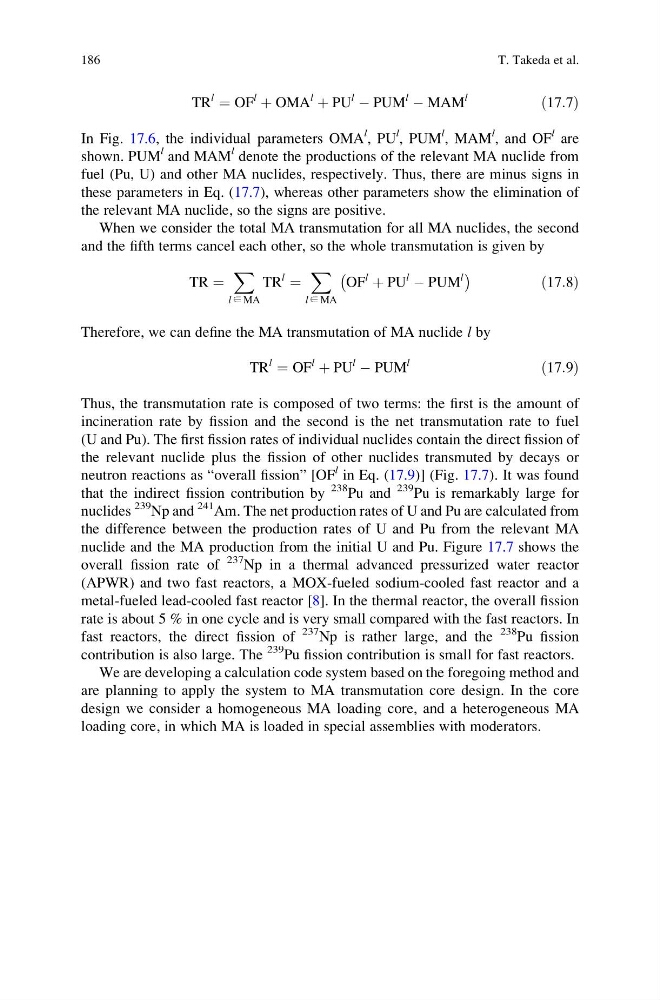
TR
l
¼ OF
l
þ OMA
l
þ PU
l
À PUM
l
À MAM
l
ð17:7Þ
In Fig. 17.6, the individual parameters OMA
l
, PU
l
, PUM
l
, MAM
l
, and OF
l are
shown. PUM
l and MAM
l denote the productions of the relevant MA nuclide from
fuel (Pu, U) and other MA nuclides, respectively. Thus, there are minus signs in
these parameters in Eq. (17.7), whereas other parameters show the elimination of
the relevant MA nuclide, so the signs are positive.
When we consider the total MA transmutation for all MA nuclides, the second
and the fifth terms cancel each other, so the whole transmutation is given by
TR ¼
X
l ∈ MA
TR
l
¼
X
l ∈ MA
OF
l
þ PU
l
À PUM
l
À
Á
ð17:8Þ
Therefore, we can define the MA transmutation of MA nuclide l by
TR
l
¼ OF
l
þ PU
l
À PUM
l
ð17:9Þ
Thus, the transmutation rate is composed of two terms: the first is the amount of
incineration rate by fission and the second is the net transmutation rate to fuel
(U and Pu). The first fission rates of individual nuclides contain the direct fission of
the relevant nuclide plus the fission of other nuclides transmuted by decays or
neutron reactions as “overall fission” [OF
l in Eq. (17.9)] (Fig. 17.7). It was found
that the indirect fission contribution by
238 Pu and
239 Pu is remarkably large for
nuclides
239 Np and
241
Am. The net production rates of U and Pu are calculated from
the difference between the production rates of U and Pu from the relevant MA
nuclide and the MA production from the initial U and Pu. Figure 17.7 shows the
overall fission rate of
237 Np in a thermal advanced pressurized water reactor
(APWR) and two fast reactors, a MOX-fueled sodium-cooled fast reactor and a
metal-fueled lead-cooled fast reactor [8]. In the thermal reactor, the overall fission
rate is about 5 % in one cycle and is very small compared with the fast reactors. In
fast reactors, the direct fission of
237 Np is rather large, and the
238 Pu fission
contribution is also large. The
239 Pu fission contribution is small for fast reactors.
We are developing a calculation code system based on the foregoing method and
are planning to apply the system to MA transmutation core design. In the core
design we consider a homogeneous MA loading core, and a heterogeneous MA
loading core, in which MA is loaded in special assemblies with moderators.
186
T. Takeda et al.
l
¼ OF
l
þ OMA
l
þ PU
l
À PUM
l
À MAM
l
ð17:7Þ
In Fig. 17.6, the individual parameters OMA
l
, PU
l
, PUM
l
, MAM
l
, and OF
l are
shown. PUM
l and MAM
l denote the productions of the relevant MA nuclide from
fuel (Pu, U) and other MA nuclides, respectively. Thus, there are minus signs in
these parameters in Eq. (17.7), whereas other parameters show the elimination of
the relevant MA nuclide, so the signs are positive.
When we consider the total MA transmutation for all MA nuclides, the second
and the fifth terms cancel each other, so the whole transmutation is given by
TR ¼
X
l ∈ MA
TR
l
¼
X
l ∈ MA
OF
l
þ PU
l
À PUM
l
À
Á
ð17:8Þ
Therefore, we can define the MA transmutation of MA nuclide l by
TR
l
¼ OF
l
þ PU
l
À PUM
l
ð17:9Þ
Thus, the transmutation rate is composed of two terms: the first is the amount of
incineration rate by fission and the second is the net transmutation rate to fuel
(U and Pu). The first fission rates of individual nuclides contain the direct fission of
the relevant nuclide plus the fission of other nuclides transmuted by decays or
neutron reactions as “overall fission” [OF
l in Eq. (17.9)] (Fig. 17.7). It was found
that the indirect fission contribution by
238 Pu and
239 Pu is remarkably large for
nuclides
239 Np and
241
Am. The net production rates of U and Pu are calculated from
the difference between the production rates of U and Pu from the relevant MA
nuclide and the MA production from the initial U and Pu. Figure 17.7 shows the
overall fission rate of
237 Np in a thermal advanced pressurized water reactor
(APWR) and two fast reactors, a MOX-fueled sodium-cooled fast reactor and a
metal-fueled lead-cooled fast reactor [8]. In the thermal reactor, the overall fission
rate is about 5 % in one cycle and is very small compared with the fast reactors. In
fast reactors, the direct fission of
237 Np is rather large, and the
238 Pu fission
contribution is also large. The
239 Pu fission contribution is small for fast reactors.
We are developing a calculation code system based on the foregoing method and
are planning to apply the system to MA transmutation core design. In the core
design we consider a homogeneous MA loading core, and a heterogeneous MA
loading core, in which MA is loaded in special assemblies with moderators.
186
T. Takeda et al.