

For the application of Hf-hydride to neutron absorber material in FBR [3], the
Hf-hydride pin has been developed. The fabrication of sodium-bonded Hf-hydride
pins has been demonstrated. The pins were successfully irradiated in BOR-60
for 1 year [7]. The MA-target pin was designed based on the foregoing experiences.
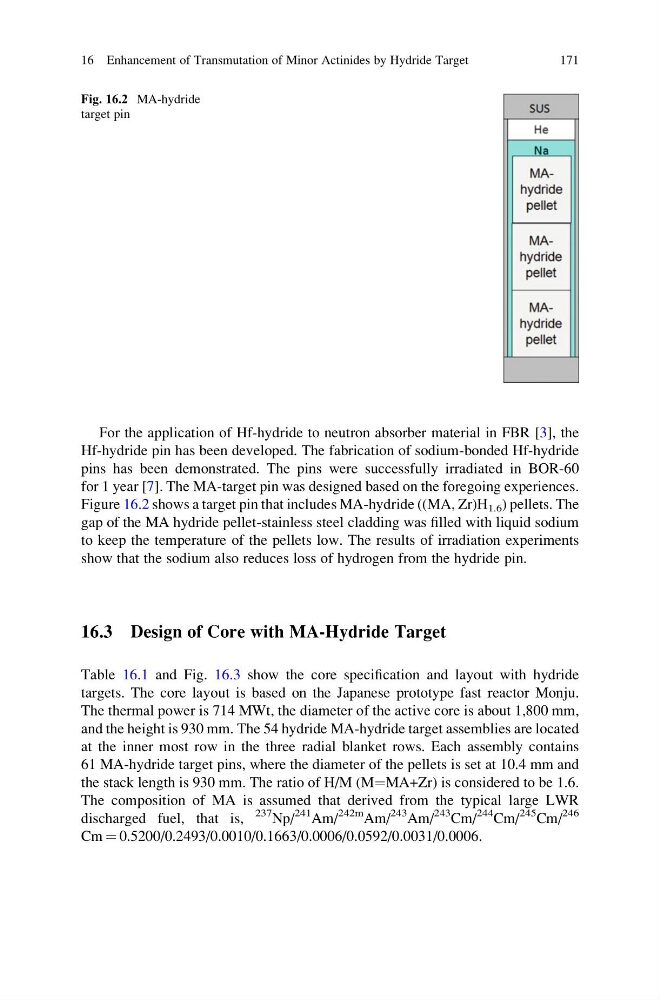
Figure 16.2 shows a target pin that includes MA-hydride ((MA, Zr)H 1.6 ) pellets. The
gap of the MA hydride pellet-stainless steel cladding was filled with liquid sodium
to keep the temperature of the pellets low. The results of irradiation experiments
show that the sodium also reduces loss of hydrogen from the hydride pin.
16.3 Design of Core with MA-Hydride Target
Table 16.1 and Fig. 16.3 show the core specification and layout with hydride
targets. The core layout is based on the Japanese prototype fast reactor Monju.
The thermal power is 714 MWt, the diameter of the active core is about 1,800 mm,
and the height is 930 mm. The 54 hydride MA-hydride target assemblies are located
at the inner most row in the three radial blanket rows. Each assembly contains
61 MA-hydride target pins, where the diameter of the pellets is set at 10.4 mm and
the stack length is 930 mm. The ratio of H/M (M¼MA+Zr) is considered to be 1.6.
The composition of MA is assumed that derived from the typical large LWR
discharged fuel, that is,
237 Np/
241 Am/
242m Am/
243 Am/
243 Cm/
244 Cm/
245 Cm/
246
Cm ¼ 0.5200/0.2493/0.0010/0.1663/0.0006/0.0592/0.0031/0.0006.
Fig. 16.2 MA-hydride
target pin
16 Enhancement of Transmutation of Minor Actinides by Hydride Target
171
Hf-hydride pin has been developed. The fabrication of sodium-bonded Hf-hydride
pins has been demonstrated. The pins were successfully irradiated in BOR-60
for 1 year [7]. The MA-target pin was designed based on the foregoing experiences.
Figure 16.2 shows a target pin that includes MA-hydride ((MA, Zr)H 1.6 ) pellets. The
gap of the MA hydride pellet-stainless steel cladding was filled with liquid sodium
to keep the temperature of the pellets low. The results of irradiation experiments
show that the sodium also reduces loss of hydrogen from the hydride pin.
16.3 Design of Core with MA-Hydride Target
Table 16.1 and Fig. 16.3 show the core specification and layout with hydride
targets. The core layout is based on the Japanese prototype fast reactor Monju.
The thermal power is 714 MWt, the diameter of the active core is about 1,800 mm,
and the height is 930 mm. The 54 hydride MA-hydride target assemblies are located
at the inner most row in the three radial blanket rows. Each assembly contains
61 MA-hydride target pins, where the diameter of the pellets is set at 10.4 mm and
the stack length is 930 mm. The ratio of H/M (M¼MA+Zr) is considered to be 1.6.
The composition of MA is assumed that derived from the typical large LWR
discharged fuel, that is,
237 Np/
241 Am/
242m Am/
243 Am/
243 Cm/
244 Cm/
245 Cm/
246
Cm ¼ 0.5200/0.2493/0.0010/0.1663/0.0006/0.0592/0.0031/0.0006.
Fig. 16.2 MA-hydride
target pin
16 Enhancement of Transmutation of Minor Actinides by Hydride Target
171